

Refined fuel exports are also substantial. Energy analytics firm Kpler estimates Iran exported roughly 820,000 barrels per day of refined fuel products in 2025, including LPG and other petroleum fuels. That makes the country a significant exporter of both crude and refined energy products.
In practical terms, oil functions as one of the central pillars of the Iranian economy. Strikes on storage depots, refining infrastructure, and distribution networks do more than destroy physical equipment. They can interrupt domestic fuel supply, reduce export capacity, and force the government to divert resources toward emergency repairs.
Fuel depots are particularly important in modern warfare because they support both civilian and military operations. Armies run on fuel. Military vehicles, aircraft, logistics fleets, and generators all depend on stable fuel distribution networks. Damage to those systems complicates logistics and places additional strain on the state’s industrial capacity.
Why the Strait of Hormuz is Critical
The consequences of such strikes extend far beyond Iran’s borders. Anyone who has put gas in their car recently knows this.
Global energy markets react immediately to threats against major producers or key transportation routes.
One of the most critical chokepoints in global energy trade is the Strait of Hormuz. Roughly one-fifth of global oil consumption moves through that narrow waterway each day. In addition, a similar share of global liquefied natural gas trade also transits the Strait.
Any conflict involving Iran, therefore, creates immediate concern about potential disruption to global energy supplies.
Even the perception of risk in the Strait of Hormuz can drive oil prices upward as traders build uncertainty into the market. Energy analysts have warned that an expanded regional conflict could push oil prices significantly higher if shipping through the Strait were seriously disrupted.
Why Americans Feel It at the Pump
American consumers often feel the effects quickly. Although the United States produces large volumes of oil domestically, crude oil is traded on global markets. When global oil prices rise, gasoline prices in the United States usually rise as well.
AAA reported that the national average gasoline price briefly jumped more than twenty cents in roughly a week during the early phase of the conflict, pushing the national average above three dollars per gallon. Here in Central Florida, it’s more like $3.50.
Because fuel costs ripple through transportation, aviation, and freight logistics, sustained increases in oil prices often translate into broader inflationary pressure across the economy.
In other words, a strike on an oil depot outside Tehran can eventually show up on a receipt at a gas pump in Ohio or Arizona.
We, the American people, are paying for this…literally.
The Scale of Oil Fires in Modern War
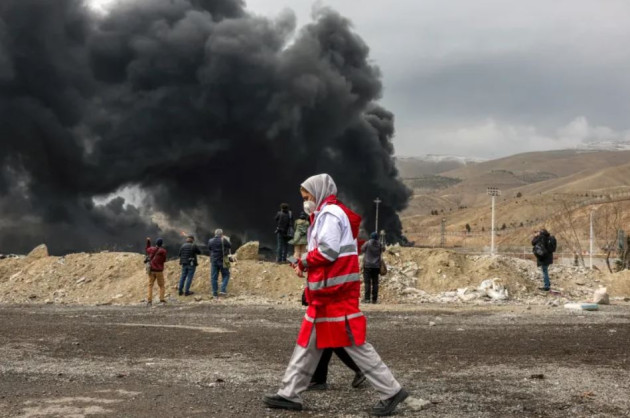
The physical scale of the fires themselves remains uncertain. Public reporting confirms large fires at fuel depots and storage tanks near Tehran, but there is not yet a verified estimate for how many barrels of oil or fuel may be burning or lost each day in the current strikes.
History offers some perspective.
During the 1991 Gulf War, retreating Iraqi forces set hundreds of Kuwaiti oil wells on fire. Estimates of the oil burned each day ranged between roughly four and six million barrels, with later scientific analysis of smoke emissions placing the figure at about 4.6 million barrels per day.
In addition, between 70 and 100 million cubic meters of natural gas were burned daily at the peak of the disaster.
Those fires created one of the largest environmental catastrophes in modern industrial history.
The Environmental Fallout
The environmental consequences of large oil fires are severe. Burning petroleum releases dense soot, sulfur compounds, and microscopic airborne particles into the atmosphere.
Scientists classify the most dangerous of these particles as PM2.5, meaning particulate matter smaller than 2.5 microns in diameter.
Because these particles are extremely small, they can penetrate deep into the lungs and even enter the bloodstream. Exposure to high concentrations of PM2.5 has been linked to respiratory illness, cardiovascular problems, and increased health risks for vulnerable populations.
In dense urban areas, heavy smoke from large fuel fires can quickly become a public health hazard.
Rebuilding Energy Infrastructure
Rebuilding damaged oil infrastructure is neither quick nor simple, nor cheap.
Storage tanks and pipeline segments can sometimes be repaired within months if the underlying systems remain intact. But damage to refinery processing units, cracking towers, or export terminals requires specialized engineering, imported components, and significant financial investment.
Energy infrastructure is among the most complex industrial systems on earth. Repair timelines can stretch from months to years depending on the scale of the damage and the availability of replacement equipment.
Even limited damage to refinery systems can ripple through a country’s entire energy distribution network.
The Psychological Effect of Burning Oil
There is also a psychological dimension to targeting oil infrastructure.
Large black smoke columns rising over fuel depots send an unmistakable signal. Energy systems represent a country’s industrial backbone. When those systems burn, the message spreads quickly through markets, governments, and the population watching it happen.
For energy traders, it signals risk to global supply.
For governments, it signals pressure on national revenue and logistics
For civilians, it signals that the war has reached the country’s economic core.
Once a nation’s energy system becomes a battlefield, the character of the war changes.
Oil fuels armies, powers economies, and stabilizes governments. When that system starts to fail, the consequences move far beyond the battlefield and into the daily life of an entire nation.








COMMENTS