

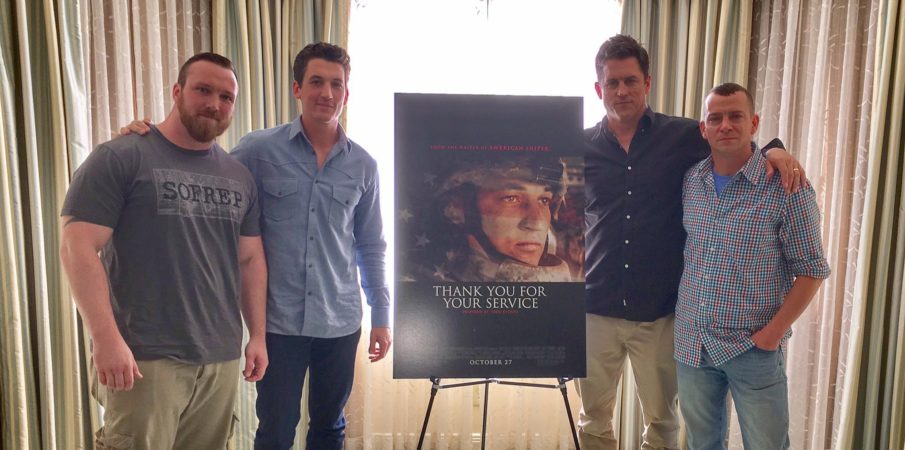
Miles Teller echoed Hall’s respect for the veteran community. So much so that he admitted that he was initially intimidated by the screenplay when it came across his desk.
With pretty much every other profession, you can kind of fake your way through it,” Teller told me, “Ya know, I played a boxer, and there was a small boxing community there to tell me that my jab was off in some shots or something, but I grew up in a small, country town with so much respect for the military. A lot of my close friends have been in the military, and I worried that just acting the role could seem disrespectful to the sacrifices these guys make.”
Ultimately, Teller explained, he felt like he could help bring the story to life, and share something that he, like Hall, felt was important.
Hall and Teller are both Hollywood professionals, complete with the fit and finish you’d expect of someone who presents themselves to guys like me for a living. They were respectful, personable, and easy-going, but they were also well-practiced at the press junket bonanza. Ultimately, the story these two men were working to tell was that of Schumann, so it was important to me that I got a sense of how he felt about the film, and about the challenges faced by veterans as a whole. Schumann had Finkel, the book’s author, following him in real-time throughout many of the stories recounted in the book, and then the movie.
I forget sometimes that there was a fly on the wall for some of darkest days of my life, and I think that anyone that has a camera in their house 24-7 would end up embarrassed by some of the things they ended up doing… I was in a place that was alien to me, coming back home, ya know? I didn’t know what I was doing.” Schumann spoke softly, and to be honest, it hadn’t occurred to me as a moviegoer that he might have felt embarrassment at the depiction of his weakest moments on the big screen.
“Seeing the movie shook me down to the core… It brought me back to places, like that funeral in Iraq… when TAPS starts playing and you’re putting your friend to rest and you do final roll call. The First Sergeant calls their name and there’s no fuckin’ response… it just hits you in the nuts… but honestly, if the movie didn’t do that to me, then Jason and Miles wouldn’t have done their job.”
That sense of responsibility between Jason Hall and Miles Teller was palpable in the room with us. These men set out to tell one man’s story as a means to shed light on the plight of millions of others, and it was clear that they’d worked throughout with the intent to do the veteran community a service.
For Hall, who spent time working with VA doctors, meeting with patients, and talking with veterans that have gone through similar circumstances to Schumann’s, his understanding of the mental health challenges faced by veterans today is more than superficial. The movie depicts the VA in a brutally realistic light, but Hall was quick to point out that the VA’s failures are often due to limited resources, rather than an unconcerned staff.
The woman you see at the VA, scheduling patients through her lunch break – that’s a real person. Her name is Beth. She’s married to a soldier that’s a quadriplegic. When she goes home from her job helping veterans, she spends the rest of her time helping the one she loves.”
Schumann and I both admitted to laughing during a particularly heated scene where Teller scolds a VA employee for making him wait for hours only to be turned away from treatment and told to return on another day. It’s a moment that likely rings true for every veteran that’s ever spent a day waiting to be seen at a VA clinic, but that may come as a surprise to those who haven’t.
You know as well as I do that you could come home from theater, throw a six-pack between us and try to relate your experience to me and I might not ever get any sense of what it was really like…” Hall said. “But the magic of a movie, done well, is that it can articulate the experience that Adam went through. It could be that every civilian walks out of this movie like, ‘I had no idea…’ That’s what I want. I want the audience to have a new awareness and understanding of the veteran experience. It’s things like that that’ll bridge the divide, and hopefully, bring a new empathy and a new understanding to veterans.”
Schumann’s story is unique to him, but the struggle, unfortunately isn’t. Now that a good deal of time has gone by, I asked him what he would have done differently if he could go back and do it again.
I look back, and it took me years to start reaching out to the guys from my unit again, and if I had just done that in the beginning, it might not have been such a shitty process.” He told me.
The process of getting help is, for Schumann like many other veterans, often a messy and difficult one, but he’s a shining example of a man who has been to the edge and managed to fight his way back. I asked him if anything from those dark days of his struggle stick with him, and he shook his head.
None of that stays with me. The loss of James… that’s what stays with me.”
“Thank You for Your Service” opens everywhere on Friday.








COMMENTS