


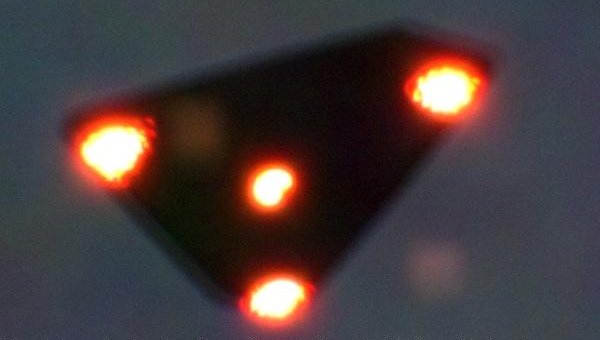
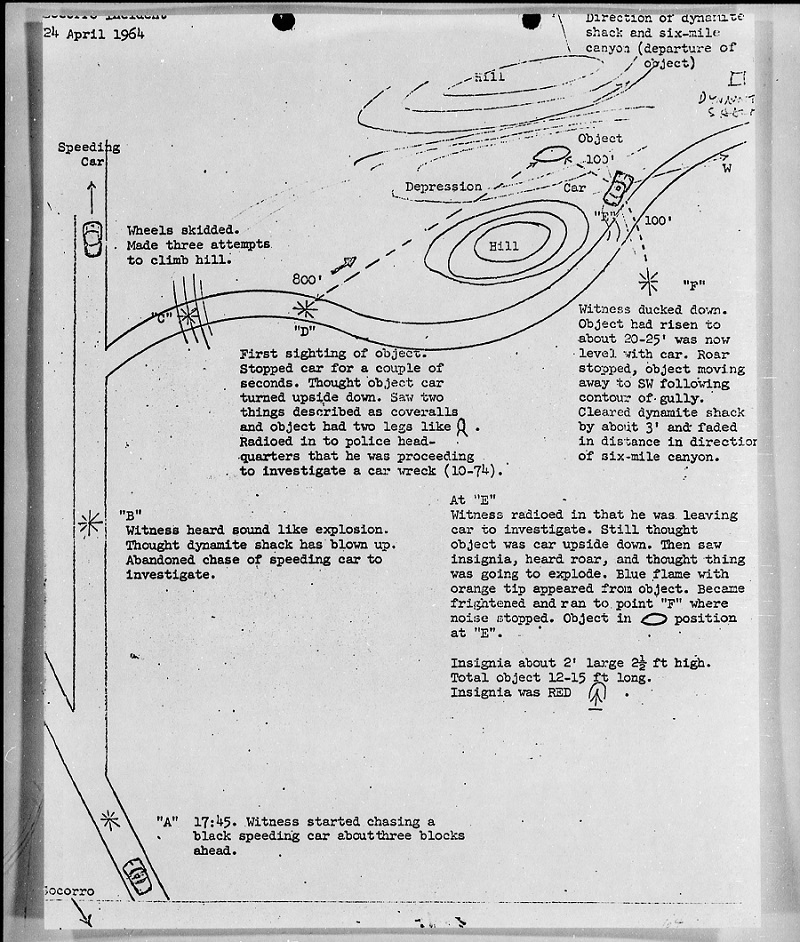
The thing is, that’s not exactly true. The United States government has always had an interest in the possibility of Unidentified Flying Objects, regardless of their origin. In the 1940s and 50s, the Air Force funded Projects Sign and Grudge, both tasked with finding explanations for military reports of strange aerial phenomena. In the 50s and 60s, Project Blue Book was born out of the two previous efforts. Over the span of 17 years, Project Blue Book investigators looked into 12,618 reports of “flying saucers” and similar mysterious aircraft, before being shut down. That was the last time the government openly acknowledged their efforts in this field, but was far from the end of their interest.
The CIA continued to study UFOs (as well as even stranger paranormal mysteries) well into the 1990s. Starting in the 1970s and continuing through the 90s, NASA provided around $12 million per year to SETI (the Search for Extra Terrestrial Intelligence) and today, NASA’s Astrobiology Institute exists solely to look for and postulate on the possibility of alien life.
Not much money was spent on the project.
As the New York Times revealed in its investigation, the Pentagon’s secret UFO investigative arm received around $22 million in funding, a lofty figure that has drawn some criticism. There’s no question that $22 million is a LOT, but for the sake of perspective, let’s try to view that number through the scope of defense enterprises, rather than your average American’s budget.
The Advanced Aviation Threat Identification Program received funding through the Pentagon from its inception in 2007 through its fiscal cutoff in 2012, meaning that $22 million was disbursed over six years of effort. That means the annual budget for the effort was around $3.6 million per year. It’s true that even the smaller figure is still a lot of money, but let’s compare it to some other things the defense department spends money on each year to gain a bit of perspective:
$283,500 per year to monitor the day-to-day life of baby gnatchatchers, an endangered species of bird.
$84 million per year on erectile dysfunction medications for military service members.
$100 million in flight tickets purchased but then not used between 1997 and 2003.
$3.1 billion over two years on sending employees on paid administrative leave when “barred from their desks” for a variety of reasons.
It could be riddled with corruption.

Now that we’ve clarified that, all in all, the Pentagon’s most recent effort to identify mysterious craft in the skies wasn’t a particularly expensive endeavor, it’s equally important that we acknowledge the likelihood that much of that money may have simply been squandered on a celestial snake oil salesman.
While Luis Elizondo was in charge of the Pentagon’s staff of investigators, he and his team were not the direct recipient of much of the funding allocated to the effort. Instead, most of that $22 million went to billionaire industrialist, Space contractor and UFO believer Robert Bigelow. By his own admission, it was a trip to Bigelow’s legendary “Skinwalker Ranch” that first convinced Senator Harry Reid that the investigation needed to be opened, and it was Bigelow’s company that then received the lion’s share of the Pentagon’s funding for the effort. In the eyes of believers, this sounds like Bigelow could have been onto something… but it’s just as likely that he used one hell of a sales pitch to funnel more money out of Uncle Sam’s pockets.
Images courtsey of Wikimedia Commons








COMMENTS