

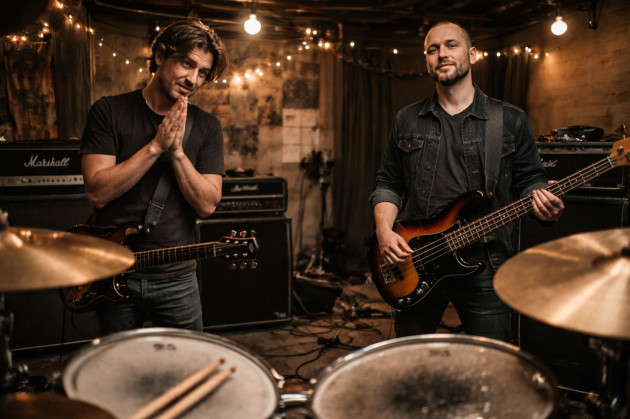
“Ah, crap. Sorry. That was me. My bad.”
Danny just counts us back in. We go again.
Second run is cleaner. We get to the chorus, and Phil actually lands a sweet little riff… one he’d been noodling with for a few weeks. Sounds good. Adds texture.
“Hey, your little riff works great in that spot, bro,” I say.
Phil shrugs. “Yeah? I don’t know. It might be too busy. We can cut it if you want. I mean, whatever you guys think. Sorry.”
Marcus looks up from his bass. Says nothing. Just looks.
We move on.
Third song in, Marcus misses a change. Just blanks on it. Happens to everyone. He doesn’t stop. Doesn’t flinch. When we wrap the take, he turns to Danny.
“Thanks for holding that down. I got lost for a second.”
Danny shrugs. “All good. You came back in clean.”
That’s it. We keep moving.
Later, I toss out an idea for rearranging the outro. Double the length, build it out, let it breathe.
Phil jumps in. “Oh, yeah, I should have thought of that one! Sorry.”
Marcus says, “I also say we drop the second verse entirely. Tighten the whole thing up.”
No apology. No hedge. Just an idea, thrown on the table like it belongs there.
Danny nods. “Let’s try it.”
We try it. It’s a banger.
Now let me ask you something.
If you had to pick one of those guys to front a project, handle a crisis, or have your back when things got sideways, who are you calling?
Wasn’t even close, was it?
Here’s what happened in that room, whether anyone noticed or not.
Every time Phil apologized for something that didn’t need an apology, he got a little smaller. Not in anyone’s eyes, necessarily. But certainly in his own. He was handing out apologies like flyers no one asked for. And every single one said the same thing: I shouldn’t be here. I’m an inconvenience. Please don’t be mad.
Marcus didn’t do that. When he made a mistake, he didn’t grovel. He thanked Danny for holding the rhythm together. When he had an idea, he didn’t ask permission to have it. He just offered it.
One guy shrank. The other expanded.
Same talent. Same room. Completely different presence.
The move here is simple, and it costs you nothing.
Replace the apology with a thank you.
“Sorry I’m late” becomes “Thanks for waiting.”
“Sorry for venting” becomes “Thanks for listening.”
“Sorry to bother you” becomes “Thanks for your time.”
“Sorry, that was probably stupid” becomes… nothing. Just say the idea. Or don’t. But don’t apologize for having one.
The energy shifts. You stop framing yourself as a problem to be tolerated and start acknowledging the people around you for what they bring. Gratitude builds. Apology erodes. And you begin to slowly regain self-confidence.
Know this: I’m not saying one should never apologize. When you actually screw up, own it. A real apology, delivered clean and without excuse, is one of the most powerful things you can offer someone.
But that’s the point. When you apologize for everything, your apologies mean nothing. They become noise. Filler. A verbal tic that signals insecurity more than remorse. It’s the F-word of clean language.
Save them for when they matter. The rest of the time? Say thanks.
A rule I try to live by:
Say thank you twice as often as you say you’re sorry.
Not because gratitude is polite. Because it’s a position of strength and growth.
Phil’s a hell of a guitar player, but he doesn’t know it yet. He’s too busy apologizing for being in the room.
Marcus isn’t better. He just takes up space like he belongs there.
Because he decided he does. No apology required.
—
Tegan Broadwater spent 13 years with the Fort Worth Police Department, including two years assigned to the FBI working deep undercover inside a violent Crip organization. That operation, detailed in his book Life in the Fishbowl, resulted in 51 convictions. He has since founded Tactical Systems Network, an armed security & protection firm primarily staffed by veterans, is a creative writer and musician, and hosts The Tegan Broadwater Podcast. All book profits benefit children of incarcerated parents. Learn more at TeganBroadwater.com








COMMENTS