

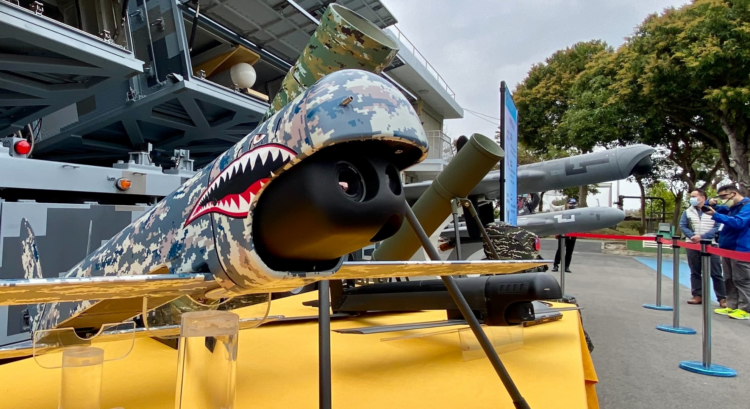
Taiwan’s Indigenous Attack Drones
As mentioned, five of the eight displayed drones were unveiled to the public for the first time, including the Albatross II surveillance drone, capable of performing extensive hours of tracking and monitoring naval ships over the sea using artificial intelligence (AI). According to CNN, the UAV can operate up to 16 hours straight and has a maximum range of over 300 kilometers (186 miles).
Likewise, the NCSIST introduced the Cardinal III UAV, capable of performing vertical take-off and landing aircraft (VTOL) and is primarily designed to monitor activities along the coastline.
Taiwan's NCSIST unveils new UAVs, including Albatross II, Cardinal III, an unnamed type of loitering munitions, and two variants of the Chien Hsiang anti-radiation drone (GPS-guided and image-guided). pic.twitter.com/1hZW8JaGSW
— 陳彥翰 Chen Yen-Han 🌻 (@Chen_YenHan) March 14, 2023
Another UAV on display is a Loitering Munition drone modeled after the American Switchblade 300, which Ukrainian forces have widely used to disable Russian radar systems. This Taiwanese drone has been identified as a crucial combat weapon that can be operated by a single soldier equipped with a warhead that can be used to strike targets on the ground from above.
Other drones showcased were Medium Altitude Long Endurance UAVs, which are capable of long-distance surveillance and have advanced air and sea warning, and attack drones with loitering munitions that can cruise toward a target before plummeting at velocity and detonating on impact.
Apart from the basic information, no more in-depth technical specifications have been provided by the NCSIST as these are considered classified by the Taiwanese government.
NCSIST revealed new drones:
1. Albatross II (looks pretty cool, surprisingly)
2. Chien Hsiang attack drones (optical guidance and GPS guidance versions).
3. Cardinal III drone (VTOL)
4. Taiwan switchblade pic.twitter.com/AKqDcH4sC8— Taepodong (@stoa1984) March 14, 2023
Preparing for the Worst
In recent years, China has increasingly become assertive over its subjugation of the democratic island, home to 23.5 million Taiwanese people, despite Taiwan’s strong objections. Beijing ramped up its military activities near the waters of Taipei, and with all that is happening in Ukraine with the same territorial claims that pushed Russia to launch its special military operation, the island country began seeking to boost its defense and military capabilities.
The tweet below is from August 2022, showing footage from a Chinese drone that wandered in Taiwan-controlled Kinmen island, followed by Taiwanese soldiers throwing rocks at it. When asked about the video, Chinese Foreign Ministry spokesperson Zhao Lijian said, “Chinese drones flying about Chinese territory, this is not something to make a fuss about.”
ℹ️🏪➡️🇨🇳🇹🇼⬇️"No biggie," says China's FM spokesman Zhao Lijian, over a video taken by a drone from the Chinese mainland of bewildered-looking soldiers on the Kinmen island currently controlled by Taiwan, "Just a Chinese drone flying in the Chinese territory." pic.twitter.com/OAEizODdkg
— 🌐World News 24 🌍🌎🌏 (@DailyWorld24) August 29, 2022
Moreover, China has also been very active in building up its combat capacity with drones. Thus the need for innovation in Taiwan’s armed forces was also significantly relevant, both combat and surveillance as well as anti-drone systems.
In response to China’s “total blockade” threats, Taiwan has diverted some of its budget spending into improving and replenishing artillery and rocket ammunition, as well as parts for F-16 jets, to assure combat readiness and self-sufficiency by producing the majority of these domestically.
For years, Taipei has been heavily relying on Washington to maintain its defense capabilities, with a recent arms deal approved by President Joe Biden of an estimated $619 million, which will include missiles for their F-16 fighter jets.
Meanwhile, Chinese leader Xi Jinping addressed the nation on Monday during his first speech to a rubber-stamp parliament, promising to strengthen Beijing’s security and continue to modernize its military into a “great wall of steel.”








COMMENTS