

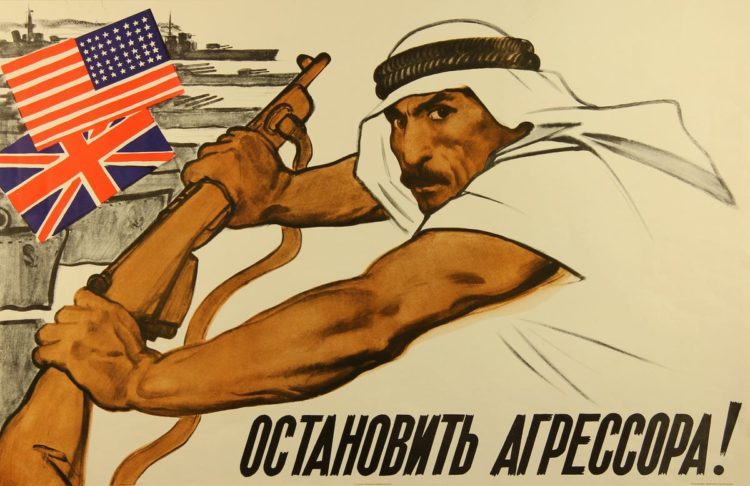
Propaganda can be both true and false, and while it has a negative connotation, it can come through official channels, such as White House or Kremlin statements, or from seemingly ordinary sources, such as a tourist guide.
A Battle for Your Mind
Russia has a long history of information operations. Throughout the Cold War, the primary goal of Russian intelligence services, mainly the KGB, wasn’t intelligence-gathering but to subvert the U.S. and the West.
They did so with “active measures,” which are similar to covert action. The goal was to drive wedges within and between Western countries, especially NATO members. Equally important was the effort to discredit the West in the eyes of the rest of the world, especially in Asia, Africa, and South America.
Russia fell into disarray after the Cold War, but Moscow has in recent years grown more focused and aggressive in its information operations directed at the U.S. and the West.
Russia views information operations as a key warfare domain — it already sees itself as in conflict with the West in this regard — and its approach is now more holistic as it targets both the methods of communication, such as computers and networks, and the information itself.
China uses information operations to achieve more traditional goals, such as bolstering perceptions of the Chinese Communist Party and its policies and undermining foreign governments and their policies.
Like Russia, China wants to undercut social cohesion within the U.S. and sow discord between Western countries. U.S. Special Operations Command has already set up a task force to counter Chinese information operations in the Indo-Pacific region.
Information Commandos
When it comes to U.S. military information operations, it’s SOCOM that does much of the work, mainly through two units: The Army’s Psychological Operations Groups (4th and 8th) and the Civil Affairs Brigade (95th).
These aren’t your door-kicking commandos but rather special operators with language and cultural training who identify local needs and perceptions and then work to influence them.
“PSYOP in the Army goes a long way back. We first established the capability right after World War I and have refined it ever since. PSYOP guys have deployed in all the conflicts and did some great ‘peacetime’ work in Europe during the Cold War,” a retired special operations PSYOP soldier told Insider.
Psychological operations are part of information operations and can occur in peacetime and during war. The U.S. military divides them into three categories — White, Gray, and Black — depending on the target and operational and political considerations.
Such operations are also divided into phases of competition: 0 for shaping perceptions, 1 for deterring foes, 2 for seizing the initiative, 3 for dominating the enemy, 4 for stabilizing environments and populations, and 5 for enabling local civil authorities.
“What’s great about PSYOP is their ability to satiate all appetites. We can target audiences in the tactical, operational, and strategic levels depending on the need. This gives PSYOP a great advantage as it’s always relevant, and ever more so in phases 0, 1, 4, and 5 of competition — that is, before and after a war,” said the retired PSYOP soldier, who requested anonymity to discuss operations.
What makes it hard to do effective IO is the time and effort required to train troops, special operators or not, to excel in the domain. To conduct or counter information operations, practitioners need native or near-native understanding of a culture and language, in addition to knowledge of psychology and behavioral science.
PSYOP used their skills very effectively against ISIS, even deploying a special leaflet that could play and listen for audio.
“To counter Chinese and Russian IO, we need to be aware of the threat and educate the public,” the retired special operations PSYOP soldier said. “Americans need to understand that this is a real, ongoing threat. Sometimes war doesn’t mean gunfire and explosions.”
This article was written by Stavros Atlamazoglou and originally published on the Insider.








COMMENTS