Cold War legacies, moral force, and the limits of American power
American intervention is often debated as if it were a single moral act, repeated across history with interchangeable results. It is not. The Balkans War vs Afghanistan offers a clearer comparative lens because the United States acted in what many would consider a defensible moral direction in both cases, yet the outcomes diverged sharply. One intervention helped produce an imperfect but durable peace. The other collapsed after two decades of effort. The difference lies not in intent, but in structure, legitimacy, and historical inheritance.
This distinction matters as Washington confronts new foreign policy challenges. Questions about Iran, or about Venezuela, where the United States has already acted against the Maduro regime, cannot be answered in the abstract. Intervention must be judged comparatively, against past cases where force aligned with local realities and against those where it did not. Treating U.S. power as either inherently virtuous or inherently corrupt obscures the only question that history reliably answers: under what conditions does intervention stabilize, and under what conditions does it unravel?
Cold War relationships mattered more than is often admitted
U.S. relations with Yugoslavia during the Cold War were pragmatic rather than ideological. Josip Broz Tito was no American proxy. He broke with Stalin in 1948, rejected NATO membership, and built a genuinely non-aligned state that leveraged both blocs without submitting to either. Yugoslavia traded with the West and received aid, but it was never a client state. That independence mattered when the federation later fractured.
Afghanistan followed a different path. The Soviet invasion in 1979 shattered an already fragile state. U.S. involvement during the Cold War was indirect and deliberately constrained, largely mediated through Pakistan’s intelligence services to avoid escalation with Moscow. The anti-Soviet Mujahideen were never a unified force, and the war ended without a political settlement. When the Soviets withdrew, Afghanistan was left hollowed out, armed, and abandoned.
Yugoslavia collapsed. Afghanistan imploded.
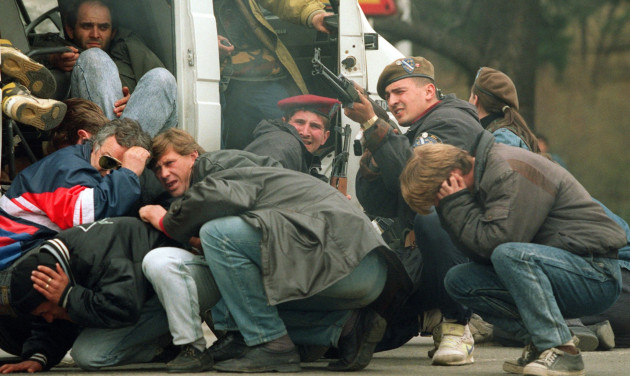
By the early 1990s, Yugoslavia had ceased to function as a state. Its collapse produced nationalist violence driven by leaders like Slobodan Milošević, who exploited ethnic grievance rather than ideology. When NATO intervened in Bosnia in 1995 and Kosovo in 1999, the wars were already well underway. The objective was limited. Stop mass killing. Impose costs. Force negotiation. The result was the Dayton Accords, followed by a fragile but lasting peace.
Afghanistan never reached that moment. After 2001, the United States expanded from counterterrorism into full-spectrum state building. Unlike the Balkans, there was no regional institution waiting to absorb Afghanistan. No equivalent of European integration. No shared political horizon. What emerged instead was a centralized system dependent on foreign security and funding, grafted onto a society where power remained local and transactional.
The Taliban were not the Mujahideen reborn
One of the most persistent historical errors in this debate is the claim that the Taliban were simply the Mujahideen transformed. They were not. The Taliban emerged in the mid-1990s, years after the Soviet withdrawal, largely composed of young men educated in Pakistani madrassas who had grown up amid war and displacement. Some former Mujahideen later joined them. Many fought against them. The Taliban’s ideology and legitimacy came from postwar chaos, not from the anti-Soviet jihad itself.
This distinction matters because it underscores the real failure. The problem was not that the United States opposed the Soviet invasion of Afghanistan. That objective succeeded. The failure came afterward, when Afghanistan was left without a viable political settlement and regional actors filled the vacuum.
Lived experience reveals the gap between capital and countryside
When I lived in Serbia, I heard the war narrated not as triumph or defeat, but as grievance. NATO bombing is remembered viscerally. Civilian casualties are personal. Yet the wars themselves feel historical, not ongoing. The anger endures, but it does not mobilize armies. The Balkans today struggle with corruption, demographic decline, and unresolved nationalism, but not with existential violence.
In Afghanistan in 2013, the contrast between Kabul and the countryside was stark. In the capital, many people welcomed the security presence. Markets functioned. Schools were open. Life, while tense, continued. Outside the city, the state barely existed. Loyalty followed local power, not national institutions. The Taliban thrived in that gap, offering predictability where the government offered corruption.
Two moral interventions, two very different outcomes
Both interventions were morally motivated. One succeeded because it intervened into wars with finite objectives, identifiable belligerents, and a regional framework capable of sustaining peace. The other failed because it attempted to create those conditions while fighting an insurgency rooted in geography, ideology, and cross-border sanctuary.
Already have an account? Sign In
Two ways to continue to read this article.
Subscribe
$1.99
every 4 weeks
- Unlimited access to all articles
- Support independent journalism
- Ad-free reading experience
Subscribe Now
Recurring Monthly. Cancel Anytime.










COMMENTS