

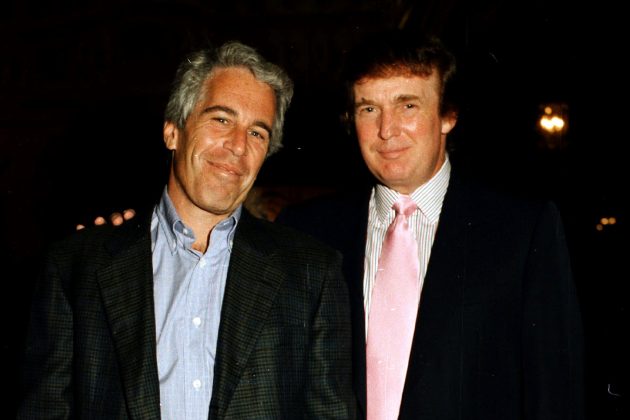
Allegations and testimony suggest he curated compromising situations and preserved their residue, whether through documentation, witness networks, or strategic association. The material did not need to be uniformly criminal to be effective. The threat of exposure often outweighs evidence. Fear is efficient; silence is durable.
What sustained Epstein was not secrecy, but control. Leverage, once established, attracts protection.
The Wexner Relationship and Elite Leverage
The relationship between Epstein and Leslie Wexner remains among the most revealing features of the case. Epstein was granted extraordinary authority over Wexner’s multibillion-dollar empire, including power of attorney. This was not symbolic. It amounted to near total financial control.
By conventional standards, the arrangement defies logic. Epstein had no publicly demonstrated investment expertise commensurate with such trust. What he did possess was discretion; elite access; and a rare ability to move through high-trust environments without friction.
This is how leverage behaves. It does not demand; it insinuates. It embeds quietly, compounds over time, and opens doors merit alone cannot.
Intelligence Adjacency and the Limits of Proof
There is no public evidence proving that Epstein was formally sponsored by any intelligence service. That must be stated plainly.
There is also no serious argument that an extortion apparatus touching heads of state, financiers, and politically exposed individuals would escape the attention or interest of intelligence actors. Intelligence services do not need to build such systems to benefit from them. They exploit what already exists.
Compromising material retains value regardless of who first gathered it. Ownership is not required; awareness and access can suffice. History is unambiguous on this point.
The most disciplined conclusion is not that Epstein was “run” by intelligence, but that his network was plausibly intelligence-adjacent, intersecting with interests larger than one man’s crimes.
What the Files Still Refuse to Answer
Perpetrators should be prosecuted. Sex trafficking demands accountability, without exception.
But fixation on individual villains offers false closure. It exhausts outrage while leaving the structure intact. The deeper failure of the Epstein files is not what they reveal, but what they avoid confronting.
Extortion is not a momentary offense. It is a condition. Leverage does not vanish when its architect dies.
The unresolved question, and the one that matters, is this: who remains compromised, and to whose advantage does that compromise still operate?
That question goes to the heart of democratic legitimacy. Ignore it, and the rot deepens. Confront it, or accept a system in which power answers only to itself.








COMMENTS