

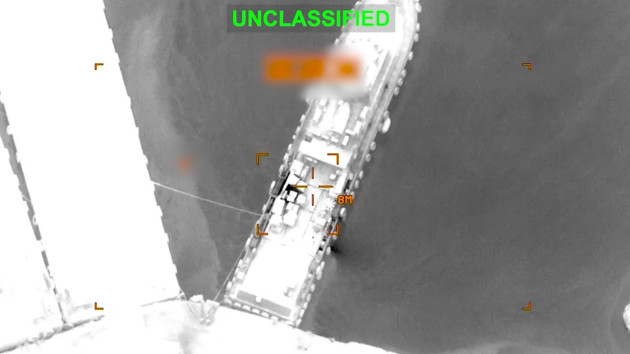
A multi-domain framework for understanding how conflicts evolve
Most people recognize escalation only when it becomes visible—when missiles fly, or ships burn.
Conflicts like the one unfolding with Iran do not escalate overnight, nor do they escalate along a single axis.
In my previous article, I focused on vertical escalation—the familiar ladder of increasing military intensity, from limited actions to sustained operations and, potentially, regional war.
But that is only part of the picture.
Escalation also moves horizontally, spreading across multiple domains—military, maritime, economic, cyber, informational, and political. These domains interact, reinforce one another, and shape how a conflict develops long before it reaches its most visible or destructive phases.
In this piece, I build on that earlier framework by integrating horizontal escalation into the analysis and introducing a simple visual tool to map how a conflict is actually evolving in real time.
Escalation Across Multiple Fronts: Beyond the Military Lens
What this conflict looks like in practice reinforces the need for a broader view.
Since mid-March 2026, escalation has unfolded across multiple domains, not just through traditional military exchanges. The initial phase included coordinated strikes and counterstrikes, but the conflict quickly expanded beyond those visible actions.
In the maritime domain, the Strait of Hormuz has emerged as a central pressure point. Multiple outlets have reported attacks on commercial vessels, including fires aboard ships and suspected drone or missile strikes, contributing to reduced traffic through one of the world’s most critical energy chokepoints. Shipping companies have altered routes and risk assessments in response to the threat environment, in some cases halting transit through the strait altogether (Reuters, March 2026; The Guardian, March 2026).
At the same time, the military domain has seen a rapid increase in intensity. U.S. and Israeli strikes targeting Iranian military infrastructure—including facilities associated with missile systems and maritime capabilities—have been followed by Iranian missile and drone retaliation across the region. These exchanges represent the highest level of direct state-on-state military activity observed in the current phase of the conflict (Associated Press, March 2026; U.S. Department of Defense statements, March 2026).
Beyond these visible actions, escalation has also appeared in less visible domains. Iran-linked cyber activity has been reported targeting U.S. and international entities, including a cyber incident involving a major American medical technology company (Wall Street Journal, March 2026).
Economic effects have followed closely behind. Disruptions and perceived risk in the Strait of Hormuz have contributed to volatility in global energy markets, with oil prices reacting to uncertainty surrounding supply routes and regional stability (Reuters, March 2026).
At the political level, international responses continue to evolve. Major powers and regional actors have issued calls for restraint while positioning diplomatically, reflecting an environment in which escalation is occurring not only through force, but also through signaling, alignment, and strategic messaging (BBC News, March 2026).
Taken together, these developments show a conflict that is not simply intensifying—it is expanding. Activity is occurring across multiple domains simultaneously, with each reinforcing the others. This is precisely the type of environment where a purely vertical model of escalation falls short.
Mapping Escalation: A Multi-Domain Framework
Traditional models of escalation, focused primarily on vertical movement along a military ladder, do not fully capture this dynamic. They describe how conflicts intensify, but not how they spread. In a multi-domain environment, that spread can be just as important as intensity.
To address this gap, the following matrix integrates both dimensions. The vertical axis represents escalation intensity, while the horizontal axis captures the domains in which activity is occurring. Each marker reflects observed activity within a domain at a given level, based on publicly available reporting.
This assessment is based solely on publicly available reporting and general analytical frameworks, without reliance on classified or non-public information.
Figure 1: Escalation Matrix — Multi-Domain Assessment
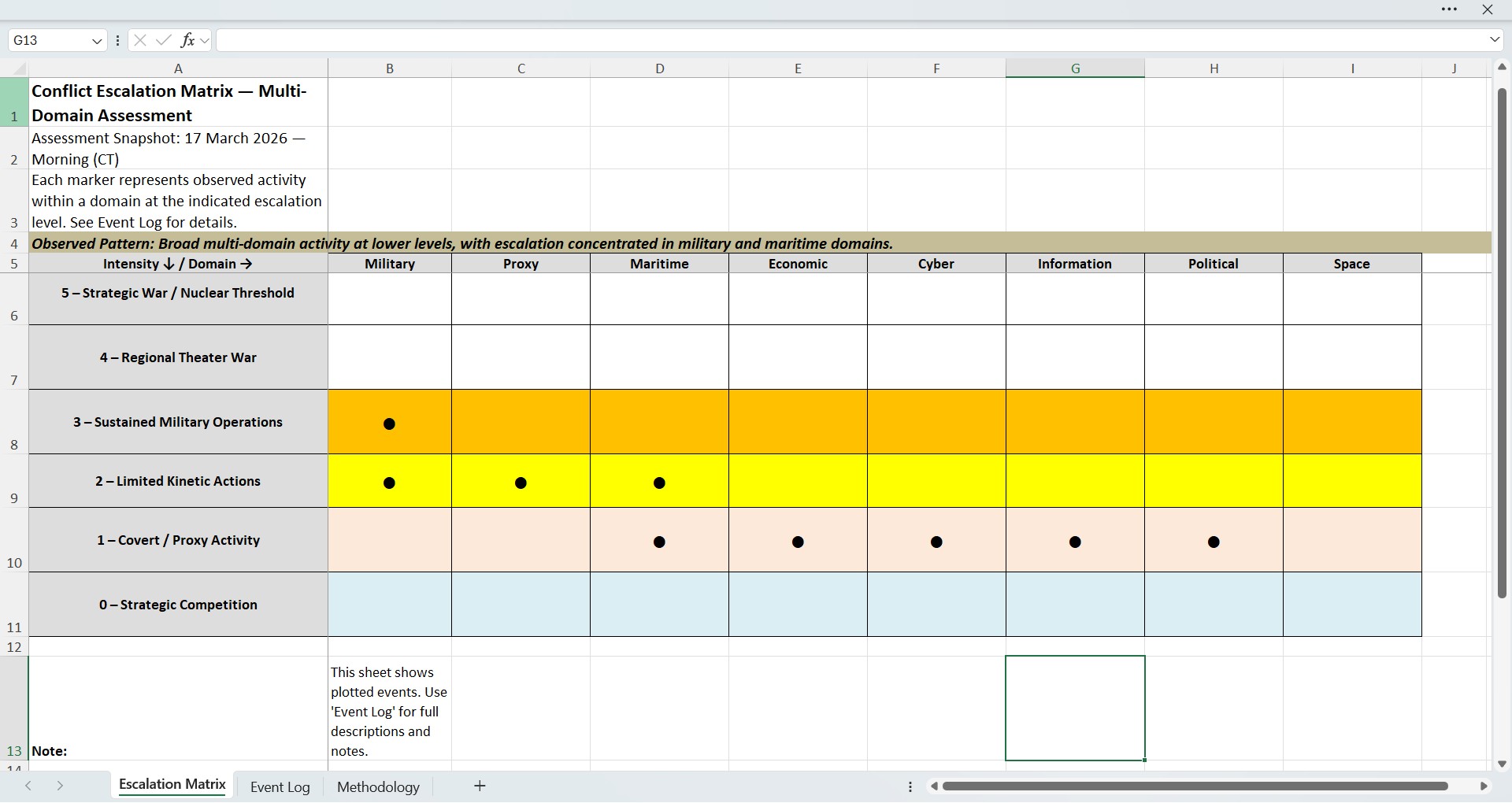
The matrix shows where escalation is visible—but it also suggests where it could appear next.
At present, activity spans multiple domains, but higher-intensity escalation remains concentrated in the military and maritime domains. At the same time, the absence of activity at the highest escalation levels suggests that, while the conflict is expanding, it is not yet approaching full-scale regional war.
While the current matrix shows escalation concentrated in the military and maritime domains, that pattern is not fixed. In some cases, escalation may emerge first in other areas—cyber, economic pressure, or information operations—before it becomes visible through traditional military activity.
The value of this model is not limited to a single conflict. It is designed as a general framework—one that can be applied to any situation where escalation unfolds across multiple domains.
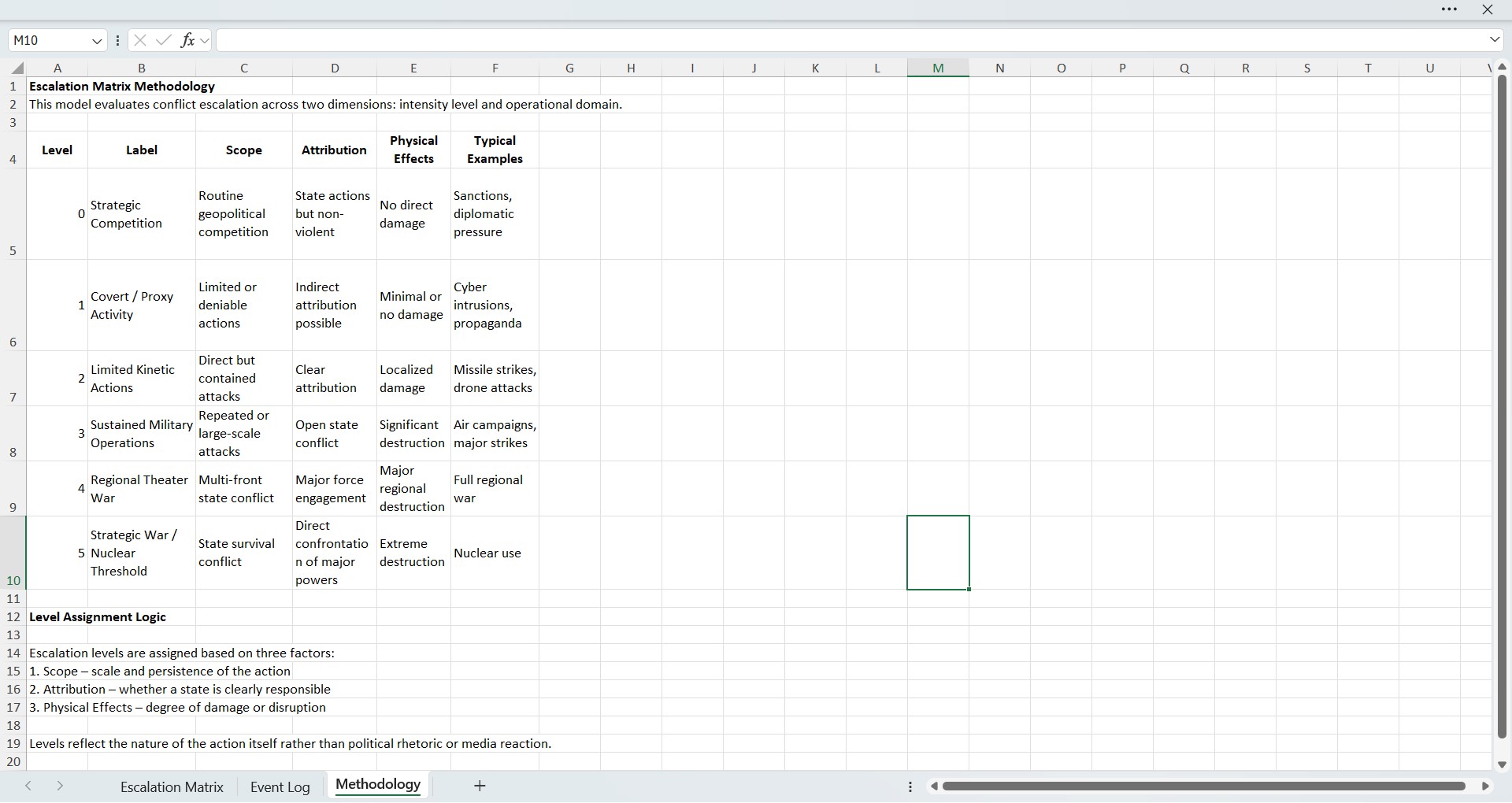
To provide full transparency, the underlying event log and methodology used to construct the matrix are included below.
Figure 2: Event Log
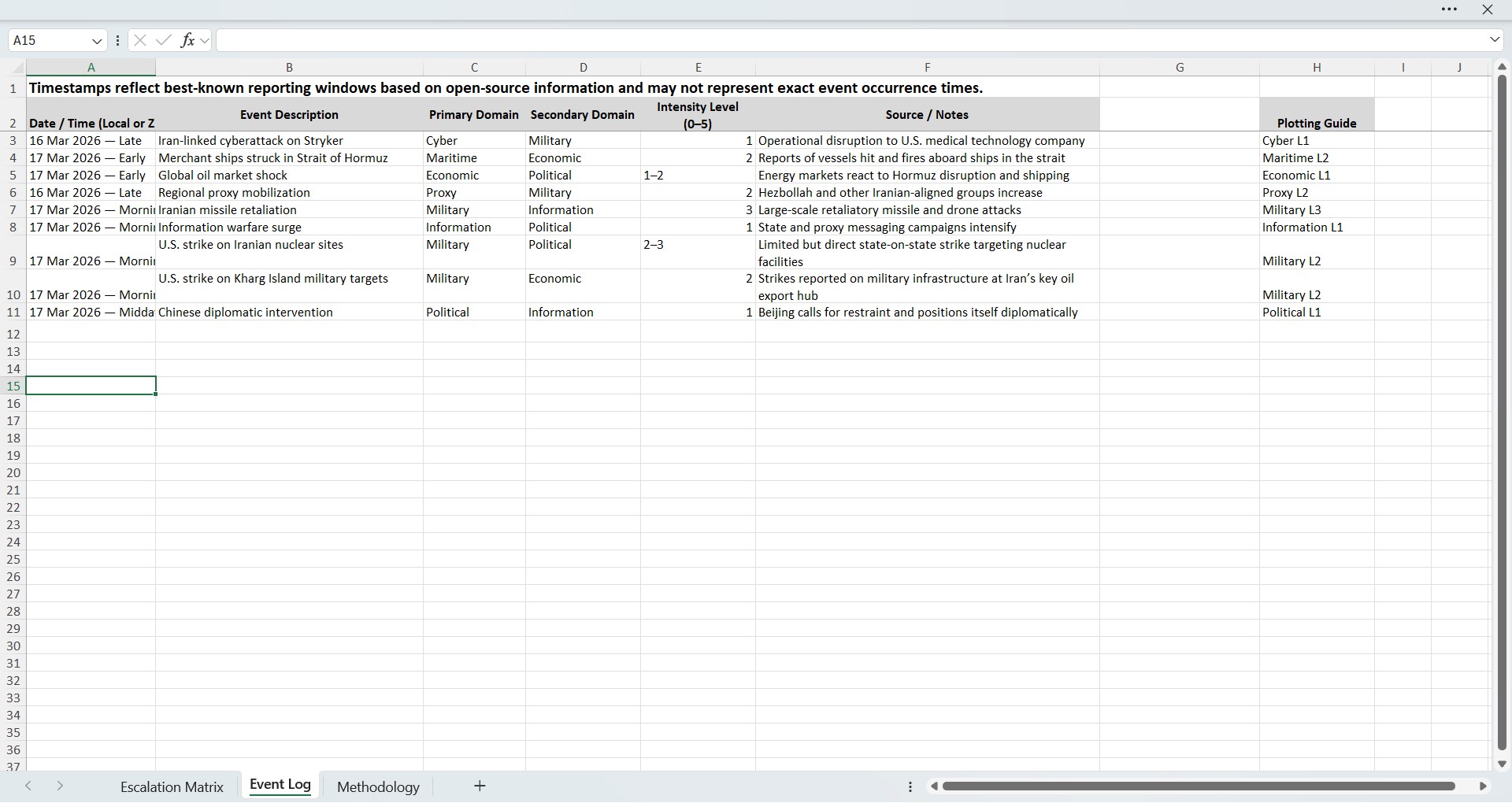
Figure 3: Methodology
Insights Beyond the Snapshot
It is also important to recognize that not all conflicts develop at the same pace. Some escalate rapidly over days, while others evolve gradually over weeks or months. In those slower-moving cases, capturing early indicators across domains may require applying this framework well before escalation becomes visible in traditional military terms. Used over time, the model can help reveal patterns that might otherwise go unnoticed until much later.
This matrix represents a snapshot in time—a structured view of how this conflict appears at the moment of assessment. As with any dynamic situation, conditions may evolve quickly. New events may emerge, existing patterns may shift, and escalation may move into domains or levels not yet observed.
For that reason, the value of this model is not in predicting specific outcomes, but in providing a disciplined way to track and interpret change as it happens. By updating the underlying event log and reassessing the matrix over time, it becomes possible to see not just where a conflict stands, but how it is evolving.
—
Disclaimer
All statements of fact, opinion, or analysis expressed are those of the author and do not reflect the official positions or views of the U.S. Government. Nothing in the contents should be construed as asserting or implying U.S. Government authentication of information or endorsement of the author’s views.
About the Author
Steve Gottlieb is a retired U.S. Navy Medical Service Corps officer, former CIA analyst, and prior firefighter/paramedic.
References
Reuters. “Oil prices rise amid Strait of Hormuz disruption concerns.” March 2026.
Reuters. “Shipping companies alter routes as Gulf tensions escalate.” March 2026.
The Guardian. “Ships report fires and damage in Strait of Hormuz incidents.” March 2026.
Associated Press. “U.S. and Iran exchange strikes as regional tensions rise.” March 2026.
The Wall Street Journal. “Iran-Linked Cyberattack Targets U.S. Medical Company.” March 2026.
BBC News. “Global reaction to escalating tensions in the Gulf.” March 2026.
U.S. Department of Defense. Press briefings and public statements on regional operations. March 2026.








COMMENTS