Dust hung in the room, a gray film that softened the jagged edges of everything. A toilet lay on its side near the doorway, porcelain splintered like bone. Each concussion from the guns outside sent a tremor through the floor and a slow drift of ash from the ceiling. The air tasted of lime and smoke. Somewhere down the street, a wall gave way, and the sound rolled through the ruins until it dissolved into quiet. I tightened the strap on my helmet and waited for the next barrage.
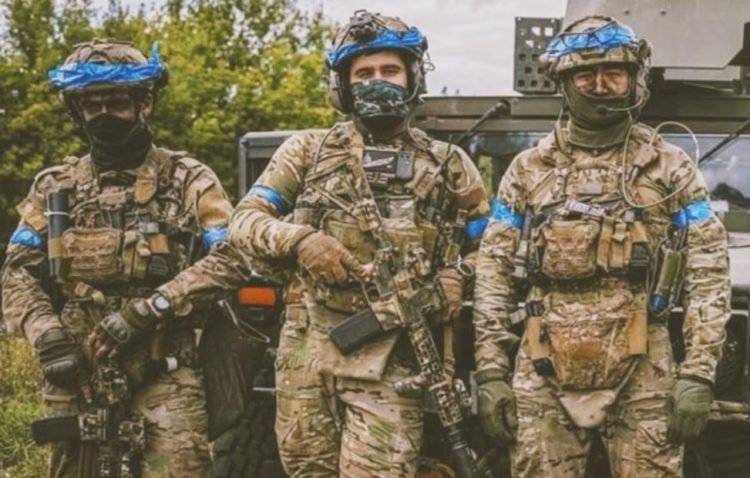
Out beyond the village, Azov fighters were setting fire to the fields. They mixed gasoline with polystyrene until it thickened, then poured it into jerry cans. The flames caught and spread through the dry grass. From our position we couldn’t see the trenches, only the reflection of the fires flickering against the haze. In that light, something in me shifted: a wire pulled loose that would never quite reconnect.
I spent fifty-five days at the zero line. Others—Ukrainian and Russian alike—have lived there for months or years, their skin etched with mud and sun. For them, war has become the most reliable form of employment. A Ukrainian soldier at the zero line earns between four and five thousand dollars a month; their Russian counterparts are paid roughly the same. When the fighting ends, they will be told to return to ordinary life: to the factories and the farms and the taxi queues. Yet in a world sliding toward automation and short-term work, many will find there is no place left for them.
This war carries the worst habits of the last century into the new one. The artillery never stops. The trenches flood, and the gas burns the eyes. Drones circle like insects, their cameras unblinking. Algorithms select targets, and the results are broadcast in real time. The killing is industrial but intimate. Every death can be watched, replayed, and shared.
The front has become a stage where survival itself is performance.
When the maps finally settle and the diplomats call it peace, the quiet will not hold. Veterans trained to kill efficiently will scatter across the world, carrying their skills to new conflicts. Some will surface in Africa, others in the Caucasus or the jungles of Latin America. A few will join private security firms or criminal networks, selling what they learned in the trenches for a steady wage.
History rarely ends with the last shot. Violence leaves a mark that work and time cannot erase. The Donbas will not stay buried within Ukraine. Scores will be settled, though not through courts.
Rogues always find a new stage after war. One man with a grievance—Gavrilo Princip, a Bosnian Serb nationalist—shot Archduke Franz Ferdinand in Sarajevo and set the world on fire. After the First World War, embittered veterans of the defeated German army gathered in Munich beer halls, nursing humiliation and loss. Their anger gave birth to a new ideology and, soon after, another war.
When the killing finally stopped at Sachsenhausen, Auschwitz, and Treblinka, the hunt for justice began. The Simon Wiesenthal Center and the Mossad spent decades tracking Nazi fugitives into the 2000s. Many who committed atrocities slipped back into normal lives in post-war Germany. The pursuit of them never stopped.
There’s no reason to believe this war will end differently. Ukrainians will remember Bucha, where Russian troops slaughtered civilians in the early days of the invasion: over 500 confirmed dead in the town itself, with hundreds more across the surrounding district buried in mass graves or shallow pits. Those soldiers were regulars from Russia’s 64th Motorized Rifle Brigade, later awarded the title of “Guards” for their actions. That fact makes the cruelty harder to understand and harder to forgive. Others will remember Olenivka, where Ukrainian prisoners of war were burned alive in their barracks, or Kherson, where civilians have been hunted by Russian FPV drones as if for sport.
The season for war crimes in Ukraine has never closed, and Russians are not the only ones guilty. The New York Times exposé on Chosen Company—where I was profiled as a whistleblower—proved that rot exists on every side. I will never excuse war crimes, but morality in war comes in degrees, some darker than others.
Already have an account? Sign In
Two ways to continue to read this article.
Subscribe
$1.99
every 4 weeks
- Unlimited access to all articles
- Support independent journalism
- Ad-free reading experience
Subscribe Now
Recurring Monthly. Cancel Anytime.
There will be no lasting justice at The Hague when this ends. Both sides will shield their own for as long as they can. And when the courts fail, men with long memories will take up the hunt themselves.
These post-war shadows will extend beyond vendettas. Russian PMCs such as Wagner’s remnants—now rebranded as the Africa Corps—already operate in Mali and the Central African Republic, trading combat experience for mineral rights. Ukrainian veterans, including foreign legionnaires from Colombia and Georgia, face similar paths. Persecution risks at home push them toward mercenary contracts in resource wars or cartel enforcement roles. Intelligence work will blur those lines further. Ukraine’s HUR has already claimed hits on Russian commanders inside Moscow, including the December 2024 scooter bomb that killed Lt. Gen. Igor Kirillov. After a ceasefire, such operations become deniable—proxies in Prague cafes or London streets, settling scores that tribunals cannot reach.
In the end, wars do not conclude; they metastasize. The men who will not go back are neither villains nor heroes. They are the residue of a system that consumes lives and spits out operators. Societies that fail to reintegrate them invite the next cycle. For Ukraine and Russia, the real fight may begin when the guns go quiet.










COMMENTS