Watching Pokrovsk ground to dust meter by meter, I see Washington and Budapest flirting with an alliance of convenience that would codify the stalemate into Western policy and rename exhaustion as realism.
Read the full article for more on:
Important insights and detailed analysis
Expert commentary on current events
Breaking developments and updates
Updating summary...
Trump, Orbán, and the Price of Peace in Ukraine
Benjamin Reed
Speed
1x
Listen
COMMENTS
Watching Pokrovsk ground to dust meter by meter, I see Washington and Budapest flirting with an alliance of convenience that would codify the stalemate into Western policy and rename exhaustion as realism.
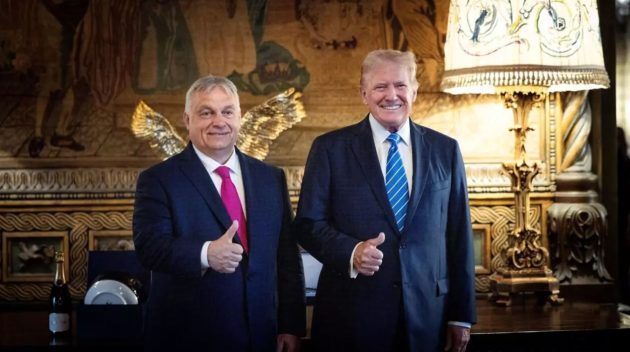
Two populist allies, Hungarian Prime Minister Viktor Orbán and U.S. President Donald Trump, share a thumbs-up moment in Washington as they discuss a controversial “peace plan” that could reshape the war in Ukraine. Image Credit: Zoltan Fischer via X
As Russia grinds through Pokrovsk’s ruins, a new alliance of convenience between Washington and Budapest risks turning battlefield stalemate into Western policy.
Advertisement
Hungarian Prime Minister Viktor Orbán’s visit to Washington this week is more than a courtesy call. It’s a stress test of the West’s will. As Ukraine’s front lines dissolve into autumn mud, Russian artillery and glide bombs are pulverizing Pokrovsk—what’s left of it—while in Washington, leaders debate whether holding the line is still worth the cost. The city’s pre-war population of 60,000 has fallen below 1,300. Nearly a third of all active battles now take place there, and roughly half of Russia’s glide-bomb attacks target it. Pokrovsk has become shorthand for attrition: Russia advancing by meters, Ukraine bleeding by battalions, and Western leaders talking about “peace.”
Into this moment walks Orbán, Putin’s most reliable ally inside the EU, meeting President Donald Trump to discuss “ending the war.”
The signals are unmistakable. Orbán has blocked European aid to Kyiv, delayed Sweden’s NATO accession, and railed against sanctions that restrict Hungary’s Russian oil imports. Now he is being hosted at Blair House, an honor normally reserved for visiting heads of state. He is pushing a “road map to peace” that includes energy exemptions and the possibility of a Budapest summit with Putin. For Kyiv’s diplomats, it is an insult wrapped in ceremony. For Moscow, it is validation: a NATO member lobbying the American president to codify what the Kremlin could not achieve on the battlefield. The alignment resonates with populist movements across Europe and the United States—those eager to recast exhaustion as realism.
Advertisement
The choreography of power is familiar: the backroom diplomacy, the shifting red lines, the allies tested and left waiting. I have seen this pattern before.
Advertisement
War has been the one constant in a life that has spanned Iraq, Afghanistan, and now Ukraine. My 180 combat patrols through the Sunni Triangle almost feel like a reprieve compared with what I saw near Velyka Novosilka, where the artillery never stopped. GRAD rockets leveled grid squares until the landscape dissolved into smoke and mud; the air reeked of propellant and churned earth. I thought I understood modern war. I didn’t. Ukraine revealed what happens when technology, attrition, and politics collide in real time. Yet all three wars share a single truth: when the costs rise or the politics sour, Washington walks away.
I passed through Pokrovsk in October 2023 on my way to Avdiivka. It was still functioning then, a battered but vital transport hub where convoys threaded between shell-scarred warehouses and half-collapsed rail yards. I was picked up there by the foreign volunteers of Chosen Company. The city was tense but alive, soldiers moving between platforms as trains unloaded ammunition and fuel. Civilians cooked in cellars and charged phones from car batteries. Seeing it now, two years later and reduced to rubble, drives home how much ground Ukraine has lost: Russian units have infiltrated from the north and east, establishing fire-posts amid the ruins.
Today Pokrovsk is again the hinge of the front. Russian troops have seized parts of the southwest and pushed thin columns through the center, according to battlefield mapping by DeepState, a group linked to Ukraine’s military. The rest is a contested gray zone. DeepState describes Pokrovsk as “gradually being absorbed.” If it falls, it will be the largest Ukrainian city to collapse since Bakhmut in 2023 and the last barrier before Sloviansk and Kramatorsk, the industrial heart of Donetsk.Two years of unbroken bombardment; two years of Western hesitation.
For Orbán, Pokrovsk is political cover. He can point to crumbling defenses and call it realism, framing the battlefield as proof that Kyiv must trade land for peace. Trump echoes that logic, selling his proposal to “freeze the front lines” as pragmatic statesmanship. Both ignore what is visible to anyone who has fought there: Russia’s progress is built on bodies, not strategy. More than one million Russians have been killed or wounded, according to Western estimates, yet Putin still has not conquered the Donbas he vowed to seize in 2022.
The October 17 meeting between Trump and Zelenskyy made this logic explicit. According to The Financial Times, it devolved into a shouting match after Trump urged Zelenskyy to accept the de facto front lines and “cut our losses.” Zelenskyy left without the Tomahawk missiles he had requested—systems capable of hitting drone factories deep in Tatarstan. Trump called it pragmatism. On the ground, it looks likemanaged defeat.
Orbán’s Washington trip only sharpens that script. He arrived denouncing new U.S. sanctions on Russia’s oil sector as a “mistake,” insisting Hungary cannot sever pipeline imports rooted in Soviet-era infrastructure. Reports suggest he will press for exemptions his own EU partners rejected, while hinting that a Trump-Orbán-Putin meeting in Budapest could deliver peace “within days.” If Pokrovsk falls, Orbán will frame it as vindication; if it holds, he will still claim Ukraine is dying on Western charity. Either way, the narrative serves Moscow, especially as Trump’s energy overtures promise Budapest relief without denting Putin’s war chest.
Along the Pokrovsk line, the fight has become what Ukrainian officers call “a war of moles.” Both sides dig and fire, often at ranges so close coordinates blur into noise. The ground shudders under constant barrages; heavy guns and GRAD batteries flatten neighborhoods in squares, not streets. Tanks rarely move. There is no cover left. It isn’t maneuver warfare anymore. It’s endurance measured in craters.
This is the world’s first post-modern war: fought with data, sanctions, and perception, yet managed with Cold-War caution. A lifeline without strategy. For those of us who have fought America’s long wars, the pattern is all too familiar. Courage can hold a line, but only conviction can secure peace. Washington’s paralysis—its habit of mistaking stalemate for stability—has become appeasement by another name.
Advertisement
What readers are saying
Generating a quick summary of the conversation...
This summary is AI-generated. AI can make mistakes and this summary is not a replacement for reading the comments.










COMMENTS