

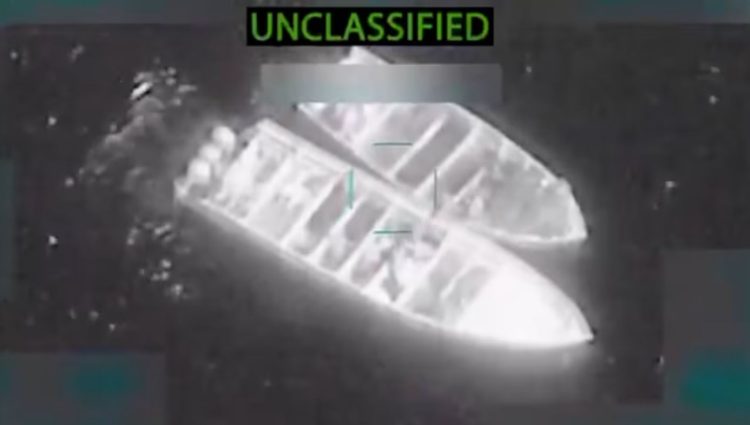
Legal scholars note that the administration has invoked self-defense and an armed-conflict theory against nonstate actors tied to narcotics flows. They point out that such claims typically require a showing of imminent threat and careful distinction between combatants and civilians. Members of Congress have asked for briefings and possible oversight hearings.
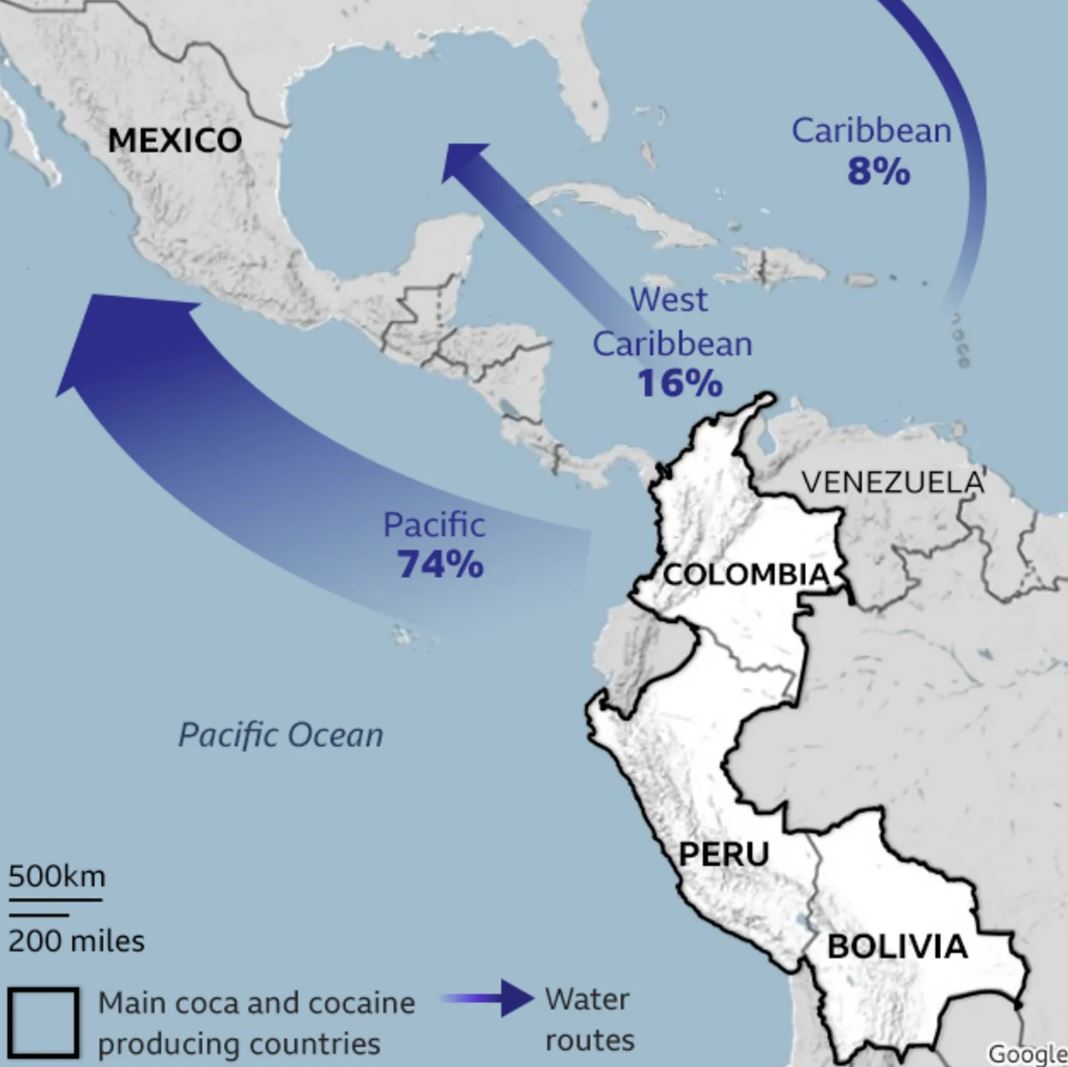
What Critics Say
The loudest critique is evidence. Families of some of the dead from earlier strikes say their relatives were fishermen, not cartel crews. Human rights advocates argue the government has not shown that the boats posed an immediate threat or that capture was infeasible. They warn that secrecy, minimal after-action detail, and strike video without context do not meet a standard the public can trust.
The First Multi-Strike Day
Until Monday, these maritime attacks were spaced days or weeks apart. Announcing three distinct strikes that destroyed four boats in a single day signals a sharper operational tempo and a willingness to engage serial targets during one continuous hunt. Associated Press reporting called it the first day with multiple acknowledged strikes, a marker that stands out even in a month of rapid expansion into the Pacific.
Nothing New: A History of SOF Involvement in Counter-Narcotics Operations
The United States has been waging a shadow war against drug trafficking in the Western Hemisphere for more than half a century. Long before drones and satellite surveillance became standard tools of the trade, American special operations forces (SOF) were already hunting cartel networks in the jungles of South America and the waters off Central America. Their mission has evolved, but the underlying fight—a battle against narcotics networks that threaten regional stability and bankroll global crime—has remained constant.
The Early Years: From Support to Combat
In the 1970s, SOF involvement in counter-narcotics was limited to providing muscle and mobility to the Drug Enforcement Administration (DEA). Green Berets trained local police in Colombia, Navy SEALs helped interdict smuggling routes, and Air Force operators handled logistics. It was a quiet but growing collaboration between law enforcement and the military.
Then came the 1980s. President Ronald Reagan’s “War on Drugs” turned that limited partnership into an outright campaign. The Department of Defense took on a direct role in detecting and monitoring drug flows from Latin America. U.S. Southern Command (SOUTHCOM), headquartered in Panama at the time, became the nerve center of anti-drug operations. The effort wasn’t just about catching smugglers—it was about countering what Washington saw as an existential threat: drug money funding leftist insurgencies and destabilizing friendly governments.
The 1980s–1990s: SOF Steps Out of the Shadows
By the late 1980s, the gloves were off. Special operations units were given expanded authority to engage in operations across the Andean Ridge—Bolivia, Peru, and Colombia. Operations like Blast Furnace in Bolivia showcased what this new model looked like: a fusion of Army aviation, Special Forces A-Teams, and DEA agents working side by side to burn coca fields, destroy labs, and arrest traffickers.
The creation of Joint Interagency Task Force South (JIATF-S) further cemented SOF’s role in the drug war. This joint command structure pooled the intelligence power of multiple U.S. agencies and foreign partners, bringing together satellites, aircraft, and elite operators under one roof. In practice, it meant that when a fast boat left the Colombian coast or a jungle lab went hot, the Americans knew—and often, a SOF team was already moving to intercept.
The Post-9/11 Shift: When Narcos Became Terrorists
After September 11, 2001, the United States redrew its strategic map. Drugs were no longer seen as just a law enforcement issue; they were national security threats. The term “narco-terrorism” entered the lexicon. The Taliban’s heroin empire, Hezbollah’s money laundering networks in South America, and Mexican cartels arming themselves like militias—all of it began to merge under a single umbrella of asymmetric warfare.
The DEA’s Foreign-Deployed Advisory Support Team (FAST) was born in this era. These teams embedded with SOF units—Green Berets, Navy SEALs, Marine Raiders, and 160th SOAR Night Stalkers—to hit drug labs, capture cartel leaders, and gather intelligence on transnational networks. It was the kind of work that looked more like special reconnaissance than police work, and it often took place in the murky space between law enforcement and warfighting.
The Modern Fight: Operation Martillo and the Global Stage
Today, operations like Martillo—a U.S.-led, multinational effort headquartered under SOUTHCOM—represent the modern face of this long war. Martillo uses maritime patrol aircraft, SOF teams, and partner-nation forces to track and interdict drug shipments moving by sea and air from Central and South America toward the United States.
SOF’s contribution is no longer limited to direct action. They train partner forces, fuse intelligence between countries, and quietly shape the battlespace. American special operators have become the connective tissue linking the military, intelligence community, and law enforcement.
Lessons and Legacy
Five decades in, the lessons are both hard-earned and sobering. Every time the U.S. clamps down on one corridor, another route opens. Every time a cartel boss is taken down, another rises to fill the void. Yet the SOF contribution has proven indispensable. Their ability to adapt, to train local units, and to strike surgically where law enforcement cannot has made them a cornerstone of America’s hemispheric strategy.
The United States didn’t just militarize its drug war—it professionalized it through its most capable operators. From the jungles of Bolivia to the Caribbean Sea, these missions have shaped the modern doctrine of counter-narcotics warfare.
It’s a fight that never makes the evening news but defines a quiet front line of American foreign policy. For the men and women of U.S. Special Operations, the War on Drugs isn’t a metaphor—it’s an endless campaign fought in the shadows, one interdiction at a time.
Today: The View From The Waterline
Tactically, the Navy and its partners are using persistent surveillance, fast-moving aircraft, and quick-reaction targeting to find small, low-profile craft across huge ocean tracts.
Strategically, the White House is gambling that visible kinetic results will disrupt networks and deter future runs. That bet carries risk. Without transparent evidence and a tighter legal framework, every explosion at sea becomes a political charge.
If Monday is the new normal, Congress will have to decide whether this is an interdiction or a new kind of war.








COMMENTS