

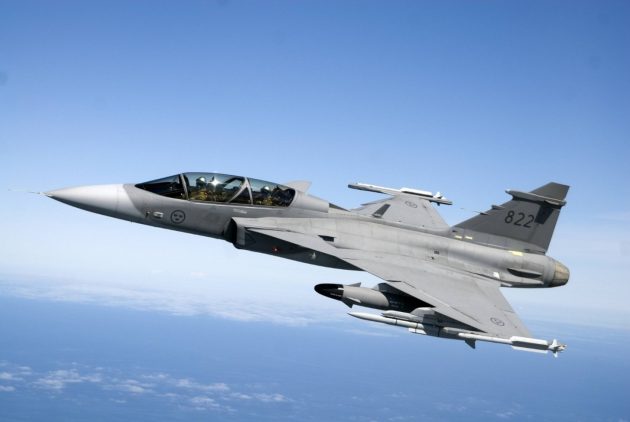
“Today, we are opening an entirely new and truly meaningful chapter in our…relations between Ukraine and Sweden…for Ukraine to acquire a substantial fleet of Swedish-made, fighter jets—Gripens. These are great aircraft, strong, aviation platforms capable of performing a wide range of missions…the future contract will enable us to obtain at least 100 of these jets.” — Volodymyr Zelenskyy, President of Ukraine, October 22, 2025.
On Wednesday, October 22, 2025, at the Saab aircraft factory in Linköping, Sweden, Swedish Prime Minister Ulf Kristersson and Ukrainian President Volodymyr Zelenskyy jointly announced a defense cooperation agreement for Ukraine to purchase at least 100 to 150 Saab JAS-39 Gripen (“Griffin”) jet fighters, Sweden’s largest export order ever, with deliveries to begin as early as 2026, and extend until approximately 2029. Ukrainian pilots have already test-flown Gripen fighters in Sweden since 2023.
The JAS-39 Gripen is a truly impressive, fourth-generation, multirole fighter, which is lightweight, very fast (Mach 2.0), highly maneuverable (9 to 12 gs), ultra-modern, and able to operate from remote airfields or short highway strips only 1,600 feet long. The Swedish Air Force currently operates 74 JAS-39C single-seat fighters, 24 JAS-39D two-seat fighters, and has ordered 70 advanced JAS-39E/F models, which include new engines, a new radar, and a new electronic warfare system, being delivered between 2018 and 2027.
It’s also presently flown by the Brazilian Air Force (10 F-39E/JAS-39E so far, with 26 still on order, and possibly 12 to 15 more later), the Czech Air Force (14 JAS-39C/D leased from Sweden), Hungarian Air Force (also, 14 JAS-39C/D leased from Sweden), South African Air Force (26 JAS-39C/D), and Thai Air Force (11 JAS-39C/D, with an August 2025 order for four JAS-39E/Fs.) Peru is also purchasing 24 JAS-39E/F aircraft from Sweden, after an announcement made on July 4, 2025, and Colombia confirmed a deal for 18 JAS-39E/F fighters on October 2, 2025.
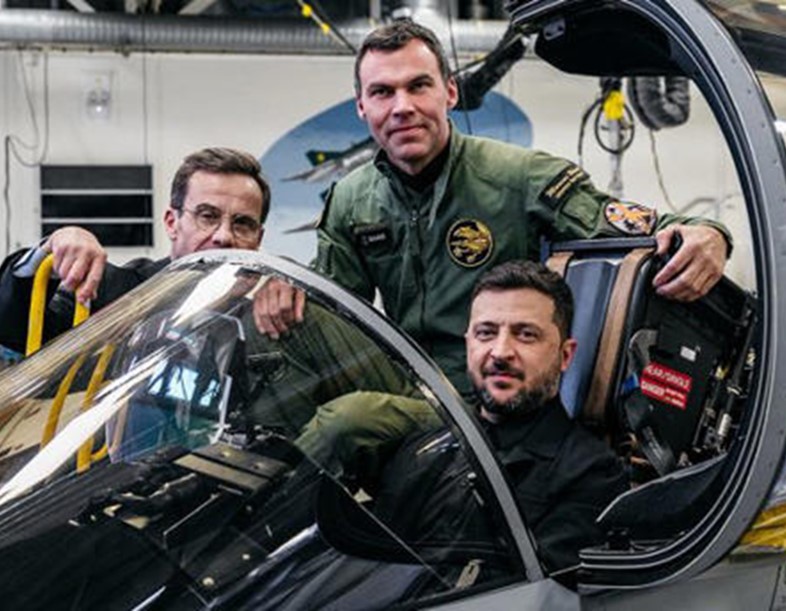
President Zelenskyy of Ukraine announced, “For our army, Gripens are a priority. It’s about money, about maneuvers.” He later added through social media channels that, “We consider the JAS-39 Gripen aircraft to be one of the most effective elements of this effort, and count on the first deliveries of Gripens already in 2026.”
Due to the urgency of the new, fighter contract, with Ukraine still at war against Russia, it’s likely that the initial 100 fighters delivered will be existing, JAS-39C/D Gripen-C/D aircraft, possibly retired from the Swedish Air Force as it upgrades to more-advanced, JAS-39E/F models, with Ukraine ultimately acquiring the JAS-39E/F later in the acquisition process. Prime Minister Kristersson declared, “We fully realize it’s a long road ahead of us, but from today, we are committed to exploring all the possibilities in providing Ukraine with a large amount of Gripen fighters in the future.”
The JAS-39C Gripen-C is a comparatively small, simple, very rugged fighter, costing less than $30 million per aircraft, with a very quick, combat turnaround time (refueling and rearming) of just 10 minutes for air-to-air missions, or 20 minutes for ground-attack missions. In addition, it has the lowest operating cost per flight hour of any frontline, NATO fighter, at $4,700 to $5,800, compared to $8,700 for an F-16CM Fighting Falcon, or $25,950 for an F-35A Lightning II stealth fighter, listed in 2022 dollars.
It’s powered by a Volvo Aero RM12 turbofan engine, a derivative of the General Electric F404, with 18,100 pounds of thrust, has a PS-05/A pulse-Doppler radar with a range of 74 miles, and the BAE Systems/Denel Cobra HMDS (Helmet-Mounted Display System), based on the Striker HMDS used on the Eurofighter EF-2000 Typhoon.
The brand-new, JAS-39E Gripen-E is significantly upgraded to the very latest standards, but at a significant cost of $85 million per aircraft, and higher operating cost of up to $8,000 per hour. It features a General Electric F414-GE-39E turbofan engine with 22,000 pounds thrust (a 21.5-percent improvement), and the ability to supercruise at Mach 1.25 without afterburner, and is equipped with the new, Leonardo Raven ES-05 active, electronically-scanned array (AESA) radar with a wider field of view, and Finmeccanica-Selex ES Skyward-G infrared search-and-track set (IRSTS) passive, thermal sensor.
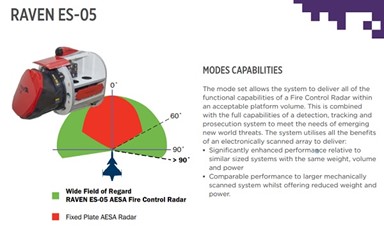
In May 2025, the Gripen-E was the first fighter aircraft in the world to be piloted by an artificial intelligence model, named Centaur, to demonstrate beyond-visual-range (BVR) combat capabilities. A Targo II (Brazilian subsidiary of Elbit, an Israeli company) HMD/S replaces the earlier, Cobra model.
Every single-seat variant of the Gripen is armed with an internal, Mauser BK-27 revolver cannon in 27x145mm, with 120 rounds of ammunition, firing at selectable rates of either 16 or 28 rounds per second. Air-to-air missiles include the MBDA (French) Meteor (Rb.101), with an official range of 75 miles, but an estimated, maximum range of 120+ miles. Meteor missiles first entered service on the Swedish Air Force’s JAS-39C/D Gripens in April 2016, and officially achieved initial operating capability (IOC) in July 2016. At the time, their range and performance exceeded those of the vaunted, American AIM-120C-7 “Slammer” missile, quite an accomplishment.
But the Gripen’s armament may be custom-tailored for each individual country, so it’s also able to carry and launch the AIM-120C/D AMRAAM/”Slammer” (Rb.99), AIM-9X/X-2 Super Sidewinder (Rb.74), AIM-2000 IRIS-T (Rb.98), or South African A-Darter. Air-to-surface weapons include the AGM-65 Maverick, Taurus KEPD 350, and RBS-15F anti-ship missile. Bombs include the unguided Mark 82 (500 pounds), laser-guided GBU-12 or GBU-49 (also 500 pounds), and GPS-guided GBU-39/B Small-Diameter Bomb (285 pounds).
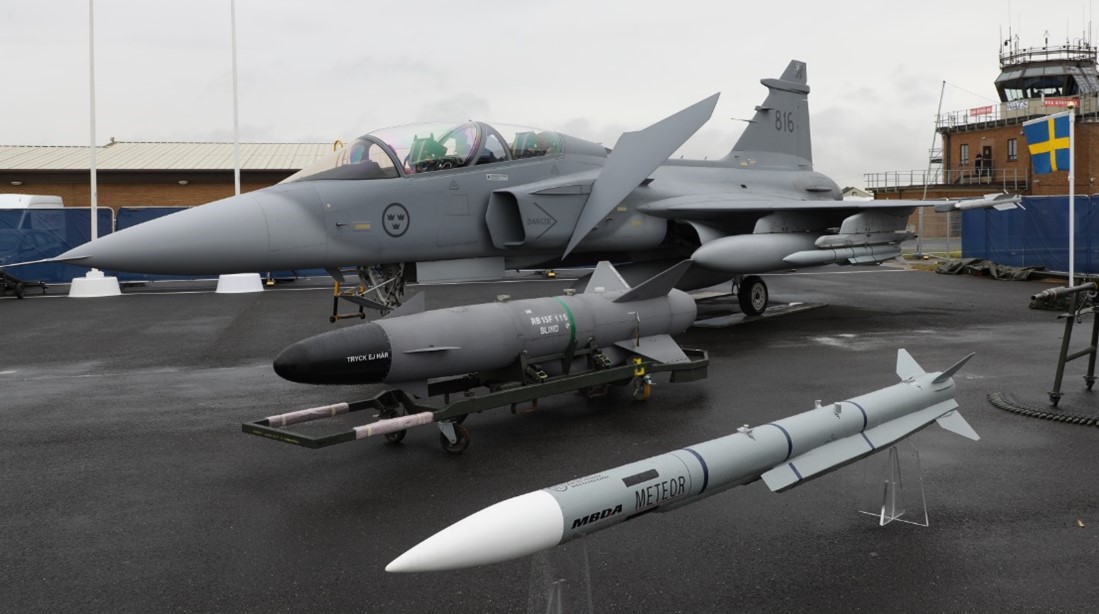
The JAS-39C/D/E/F Gripen series may also employ Saab’s (Swedish) Modular Reconnaissance Pod System for recon missions, Thales’ (British) Digital Joint Reconnaissance Pod, or Rafael’s (Israeli) AAQ-28 Litening targeting pod, clearly demonstrating remarkable versatility in the aerial reconnaissance role.
In addition, the JAS-39C/D Gripen carries an ALQ-TLS electronic countermeasures (ECM) pod, and the newer JAS-39E/F utilizes the Arexis electronic warfare suite and the Arexis electronic attack jammer pod.
Eight Swedish Air Force Gripens participated in an operational deployment from April through October 2011, to support the U.N.-mandated, no-fly zone over Libya, during the First Libyan Civil War. During that time, they flew more than 650 combat missions, accrued nearly 2,000 flight hours, and delivered approximately 2,000 reconnaissance reports to NATO commanders. So, the Gripen series has a proven track record of successful combat capability.
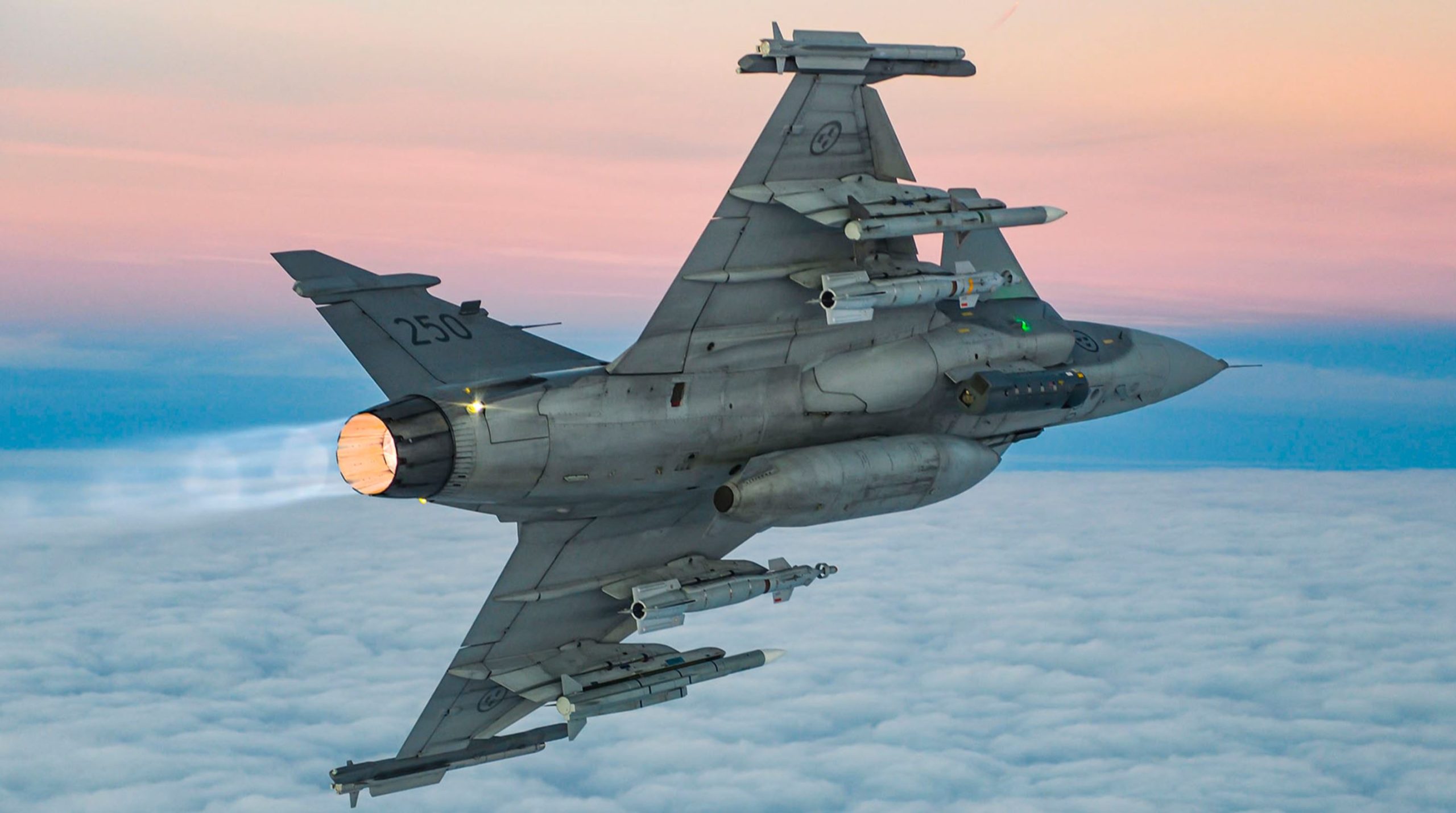
In conclusion, the Saab JAS-39 Gripen is an absolutely perfect choice for the embattled nation of Ukraine, simple, rugged, combat-proven, more affordable to buy and maintain than most other frontline, fourth-generation fighters, with a powerful engine and gun, advanced avionics, and the very latest, long-range missiles in production. This latest defense cooperation agreement will certainly benefit not only Ukraine but the NATO member nation of Sweden as well and strengthen European resolve in the face of blatant, ongoing Russian aggression.








COMMENTS