

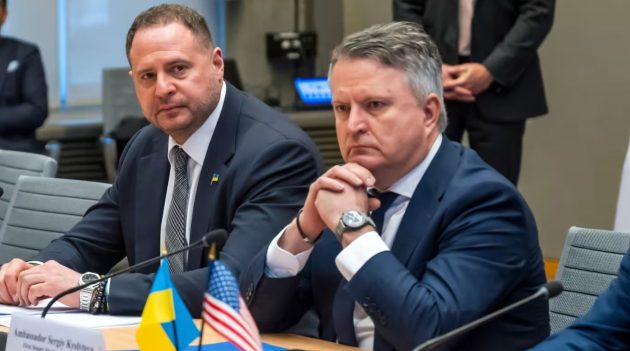
Ukraine appears ready to move forward with a revised U.S.-backed framework to end Russia’s occupation, but the real story lives in the edits. Washington’s original 28-point proposal has been stripped down to 19 points after hard diplomatic rounds in Geneva and follow-on U.S.–Russia contacts in Abu Dhabi. Kyiv now says it is prepared to work from this new version — as long as its core red lines remain untouched.
What is emerging is not a treaty and certainly not a capitulation. It is a working document, the kind negotiators hold up to the light like a map with half the roads redrawn.
From 28 Points to 19: What Changed?
The original 28-point plan, drafted with input from U.S. and Russian intermediaries, asked Ukraine for sweeping concessions. Public reporting from multiple outlets describes requirements that included:
- Ceding significant territory, including parts of Donbas and Crimea;
- Accepting troop and weapons caps;
- Ruling out future North Atlantic Treaty Organization (NATO) membership, and
- Providing Russia a path to sanctions relief and political reintegration.
Those conditions triggered immediate resistance from Kyiv and from European allies who had been largely cut out of the early process.
The revised 19-point framework — the version Ukraine is now engaging with — includes several major shifts confirmed by the most recent reporting:
The territorial demand has been softened.
Outlets, including the Financial Times and New York Post, report that the new draft no longer requires Ukraine to surrender the entire Donbas region. The most challenging territorial questions are being deferred to a potential future meeting between President Donald Trump and President Volodymyr Zelensky.
A permanent NATO ban is no longer in the text.
European and U.S. reporting says clauses that would have locked Ukraine out of NATO indefinitely, or restricted NATO presence around the country, were removed from the revised draft.
Limits on Ukraine’s armed forces have been dropped.
The Financial Times and Le Monde note that the proposal to cap Ukraine’s troop levels — a Kremlin priority — is no longer being considered in the 19-point version.
No automatic recognition of Russian territorial gains.
The new draft does not ask Ukraine to formally recognize Russia’s annexations. Instead, the status of occupied regions is left for later negotiations, not pre-decided in the document.
The consensus from European analysis is clear: the revised plan is more favorable to Kyiv than the original 28-point concept — though still incomplete and politically sensitive.
What the 19-Point Framework Covers — and What Remains Unknown
The full 19-point text has not been released. What exists publicly comes through leaks and briefings rather than a point-for-point publication. That means only some elements can be stated confidently.
Based on reporting from Financial Times, Le Monde, The Guardian, and others, the revised framework appears to include:
A ceasefire and stabilization along current front lines.
Most reporting describes a freeze in place rather than detailed territorial swaps or phased withdrawals.
A path toward security guarantees for Ukraine.
The revised framework retains language about bilateral or multilateral guarantees — likely involving the United States and European states — short of NATO membership but aimed at deterring future Russian attacks. Exact mechanisms are not yet public.
No permanent veto on Ukraine’s strategic direction.
Kyiv’s red line remains intact: no binding prohibition on future NATO membership.
Discussion of international “reassurance” forces.
European governments, not the U.S. draft itself, have floated the idea of deploying a reassurance force to help enforce a ceasefire. Whether this appears directly in the 19-point text is still unclear.
Sanctions relief tied to Russian compliance.
While the original 28-point proposal explicitly linked sanctions relief to Russian behavior, current leaks do not specify how much of that structure remains. Most experts expect some version of conditional relief to survive.
Ukraine’s postwar reconstruction and possible U.S.-Ukraine economic agreements — including minerals — are being discussed separately, not as confirmed numbered points inside the revised draft.
In short, we know the broad categories and the political direction of travel, but the full 19-point menu remains partially obscured.
Kyiv’s Position: A Difficult Tentative “Yes”
President Zelensky has acknowledged that Ukraine is facing one of the most difficult strategic decisions since the invasion began. In recent public statements, he has promised not to “betray” national interests while also signaling a readiness to work through the U.S. proposal.
In the last 48 hours, Zelensky has said Ukraine is “ready to move forward” with the revised U.S. framework and is prepared to address remaining “sensitive points” directly with Trump and with European partners. Ukrainian officials have reiterated that there will be no recognition of Russian annexations and no permanent restrictions on Ukraine’s long-term security choices.
The clearest way to understand Kyiv’s stance is this: Ukraine has accepted the concept of the operation, but the details — the coordinates on the map — remain a fight of their own.
Europe and Russia React
European leaders, largely sidelined early in the process, are demanding a direct role in shaping the final framework. Their message has been blunt: peace cannot be capitulation, and Ukraine must make its own territorial decisions.
Russia, for its part, has complained that key elements of what it considered prior “understandings” have been stripped out. At the same time, it continues missile and drone attacks across Ukraine even as back-channel discussions continue in the Gulf.
The battlefield and the negotiating table are moving in parallel — a dynamic that has defined this war from the start.
Where Things Stand Now
Factually, the situation boils down to three points:
- The U.S. and Ukraine now share a revised 19-point framework that removes the most objectionable demands from the original proposal.
- Ukraine has signaled a conditional “yes in principle” and is ready to negotiate the unresolved issues.
- Russia has not accepted the revised plan, and no peace agreement has been signed.
For now, this remains an evolving blueprint — a document that could shape the beginning of the end of the war, or simply mark another turn in a conflict defined by uncertainty.
Keep an eye on SOFREP for the latest developments and breaking stories on this front.








COMMENTS