

I am grateful to Sweden and minister @PlJonson for a new artillery package for Ukraine. The package includes 18 Archer howitzers and 5 Arthur artillery hunting radar systems worth approximately USD 300 million.
Together, we are stronger! Thank you for support!
🇺🇦🤝🇸🇪— Rustem Umerov (@rustem_umerov) March 14, 2025
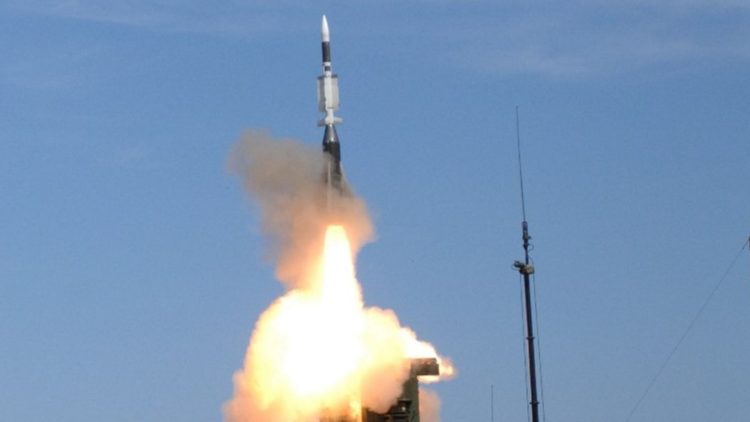
As part of his visit, Umerov also met with executives from Eurosam, the consortium responsible for manufacturing the Aster-30 missiles.
Eurosam is a joint venture comprising MBDA Italy, MBDA France, and Thales, and its limited production capacity has been a major bottleneck in supplying additional missiles.
Challenges in Missile Production and Performance Limitations
One of the key obstacles to meeting Ukraine’s demand is the limited production rate of Aster-30 missiles.
Unlike the widely used Patriot system from the US, the SAMP/T system is deployed only by a handful of European and Middle Eastern nations, including France, Italy, the UK, Algeria, Egypt, and Qatar. This restricted deployment has resulted in a slower production cycle, limiting the availability of new missiles.
Additionally, according to The Wall Street Journal, SAMP/T systems have exhibited performance limitations compared to US-made Patriot batteries. The report highlights that SAMP/T has struggled in large-scale missile interception scenarios, particularly against complex Russian attacks.
While the system has successfully shot down Russian aircraft—as confirmed by Ukrainian Air Force official Yurii Ihnat—the growing intensity of the war has put Ukrainian air defenses under increased pressure.
Recognizing the urgent need for more Aster missiles, France, the UK, and Italy recently placed an order for 218 additional Aster missiles, including Aster-15 and Aster-30 variants. While this move signals a commitment to strengthening air defense capabilities, it remains uncertain how soon Ukraine will benefit from these new munitions, as production timelines remain unclear.
Russia’s Tactical Shift: Targeting Ukraine’s Air Defenses
Ukraine’s urgent call for more missiles also comes amid a shift in Russia’s military strategy.
According to Yurii Ihnat, after several Russian aircraft were shot down by SAMP/T and Patriot systems, Russian forces have adjusted their tactics to prioritize targeting Ukraine’s air defense infrastructure. This tactical shift has put additional pressure on Ukraine to reinforce its missile defenses as quickly as possible.
Conclusion
Ukraine’s call for Aster-30 missiles highlights the critical state of its air defense systems as it faces continued Russian aggression. While diplomatic efforts with Italy and France continue, the challenges of limited stockpiles, slow production, and strategic constraints make resupplying Ukraine a complex issue.
The recent order for more Aster missiles by European nations is a step in the right direction, but whether Kyiv can receive reinforcements in time to maintain its defense capabilities remains uncertain.
As the war drags on, Ukraine’s ability to protect its skies will depend heavily on how quickly its allies can deliver critical military aid—a question that remains unanswered as the battlefield dynamics continue to evolve.








COMMENTS