

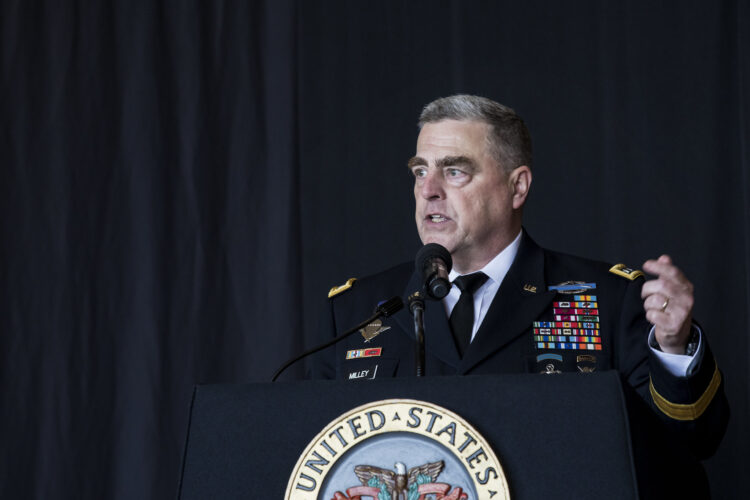
“There is nothing more expensive than fighting a war. And preparing for war is also very expensive, but fighting a war is the most expensive. Preparing for war will deter that war,” he said.
“The United States military has developed multiple options for our national leadership to consider if or when Iran decides to develop a nuclear weapon,” he said.
As for deterring Russia, he said that it is in the best interest of the nation’s security support for Ukraine to go on.
General Milley added that Iran, if so chose, could manufacture the sufficient fissile material for a nuclear weapon in less than two weeks. Additionally, it would only take a few more months to construct an actual nuclear weapon.
“From the time of an Iranian decision, Iran could produce enough fissile material for a nuclear weapon in less than two weeks. And it would only take several more months to produce an actual nuclear weapon,” Milley said.
“The United States military has developed multiple options for our national leadership to consider if or when Iran decides to develop a nuclear weapon,” he said.
As for other potential threats, he emphasized that it is a policy of the United States to ensure that Iran will never acquire a nuclear weapon. In addition, they’re also monitoring North Korea’s ballistic missile trials and nuclear weapons growth continue to be a menace to the United States, its allies, and associates.
“We stand shoulder to shoulder with the Republic of Korea to continue to deter North Korea aggression,” he said.
Apart from South Korea, the United States has formed bilateral alliances with countries like Japan, Australia, Thailand, the Philippines, and other partner nations to enhance security in response to China’s aggressive behavior.
Moreover, General Milley pointed out that around a quarter of a million soldiers are assigned to various locations worldwide, including Europe, Asia, Africa, the Middle East, and South America, to participate in the fight against terrorism and collaborate with allied nations and associated parties.
“Operational readiness rates are higher now than they’ve been in many years. Currently, 60% of our active force is at the highest state of readiness and could deploy to combat in less than 30 days, well exceeding the minimum of the one-third standard that we’ve always had. Ten percent of our force could deploy in less than 96 hours. The United States military is ready,” he said.
On the other hand, Lloyd J. Austin III, the Secretary of Defense, testified that the necessity of promptly passing the budget was formulated based on a strategic approach.
The proposed budget, he said, is designed to not only meet the readiness and modernization needs but also to support servicemembers and their families.
Austin declared that the most beneficial action this committee can take to assist the department and its remarkable troops is to guarantee they receive a suitable appropriation on schedule and for the entire year.
“We are probably not going to be able to do anything to stop, slow down, disrupt, interdict, or destroy the Chinese nuclear development program that they have projected out over the next 10 to 20 years,” Milley said. “They’re going to do that in accordance with their own plan. And there’s very little leverage, I think, that we can do externally to prevent that from happening.”








COMMENTS