

It’s like peering into a crystal ball, seeing the future of warfare, and sculpting it with digital hands.
.@CAE_Inc today announced that CAE Defense & Security is under contract with Bell Textron Inc. to support the @USArmy Future Long Range Assault Aircraft (FLRAA) program.
Read full release: https://t.co/A4O53NvBjQ pic.twitter.com/32Yk96oyN0
— CAE Defense & Security (@CAE_Defence) January 9, 2024
This approach aligns perfectly with the FLRAA’s ambition to redefine what’s possible and to stretch the wings of each mission beyond what we thought attainable.
But it’s not all about the flash and dazzle.
The contract also anchors itself in the nitty-gritty of advanced maintenance training systems.
Because what good is a state-of-the-art bird if no one knows how to keep it soaring?
A Bird’s Eye View of the FLRAA Program
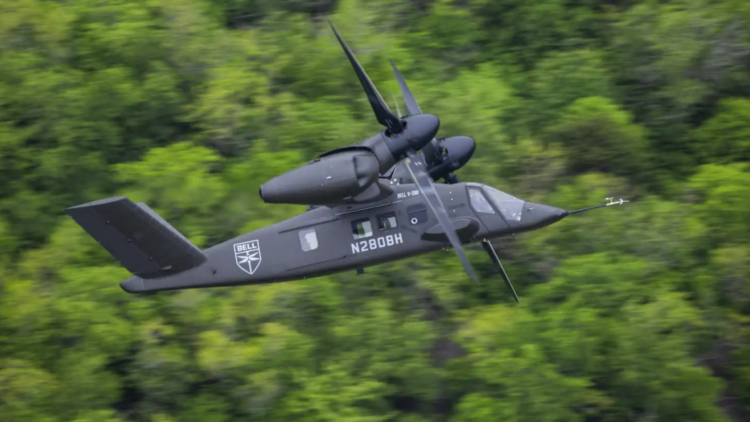
The FLRAA program is the Army’s bold bet to replace its aging fleet of Black Hawks and Apaches with the V-280 Valor, a bird so advanced it makes its predecessors look like paper planes.
Bell Textron snagged a $1.3 billion contract in December 2022 to bring this vision to life.
The V-280 promises to double the speed and range of current choppers, a leap in capabilities that could redefine the battlefield.
Here's a peek at the game-changing tech behind the U.S. Army's Future Long-Range Assault Aircraft (FLRAA). #GEAerospace's Digital Backbone network serves as the ultimate nerve center, facilitating seamless data flow on board. https://t.co/xsmmi0Pxiw
— GE Aerospace (@GE_Aerospace) January 5, 2024
However, not everyone’s steps are in sync in this high-stakes dance.
Boeing and Sikorsky previously threw a challenge flag, protesting Bell Textron’s win against its Defiant X helicopter concept.
But their appeal hit a wall at the US Government Accountability Office (GAO), which found their proposal lacking.
“The Army reasonably evaluated Sikorsky’s proposal as technically unacceptable because Sikorsky failed to provide the level of architectural detail required by the [request for proposal],” GAO concluded in April last year.
This paved the way for Bell Textron’s unobstructed flight path, leading to collaborations like the one with CAE.
A Salute to Modernization
This partnership between CAE and Bell Textron isn’t just a contract; it’s a declaration of intent.
It’s a signal that the Army is dead serious about arming its warriors with the best tools for the job.
Dan Gelston of CAE put it best – this is about transforming capabilities and fortifying the nation’s defense.
“The FVL program demonstrates the US Army’s commitment to aviation modernization and providing transformational capabilities to support joint force operations and strengthen deterrence,” said Gelston.
The focus on top-tier training cements the belief that a well-trained soldier is the most lethal weapon in the arsenal.
Wrapping Up the Mission
CAE’s entry into the FLRAA theater is more than a business move; it’s a strategic play in the grand game of military supremacy.
Teaming up with Bell Textron, CAE sets the stage for a revolution in how the Army fights, moves, and maintains its aerial might.
As the FLRAA program unfolds, CAE’s role in sculpting the future of warfighting will be pivotal.
This isn’t just about building better helicopters; it’s about forging warriors fit for the battles of tomorrow.








COMMENTS