How Crisis, Memory, and Fire Revived an Old Scapegoat at the End of the World
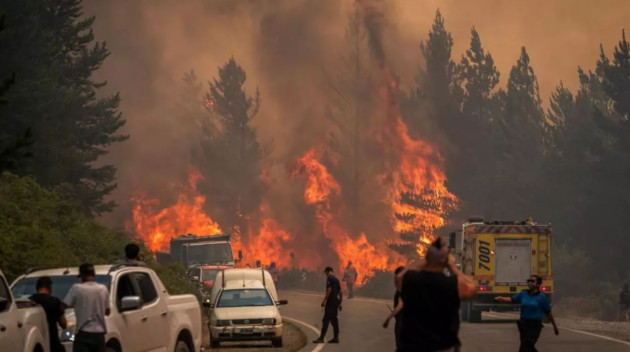
2026 is not shaping up to be a forgiving year for Israelis, domestically or abroad. In Argentina, wildfires tearing through Patagonia have reignited something older than climate stress or land disputes: a conspiracy theory that never quite went away. Across Argentine media, and more aggressively across social platforms, Israeli tourists are being blamed for deliberately setting fires in the south, often tied to a familiar allegation that Jews are plotting to acquire Patagonian land once it is cleared by flame.
This is not fringe speculation. Provincial officials in Chubut have publicly hinted at foreign involvement, and international outlets such as The New Arab have reported on how Israeli backpackers have become the focal point of suspicion, even as evidence remains circumstantial and incomplete. The story travels quickly because it arrives prepackaged. Patagonia has long been haunted by myths of Jewish colonization, a paranoid inheritance that resurfaces whenever the region is under strain. Fire gives it oxygen.
I was supposed to be there. Patagonia had been penciled into my internal map of places to disappear for a while, somewhere where the horizon is wider than your past. As a man formally labeled a wanted war criminal by the Russian Federation, fleeing toward Argentina carried a certain dark historical symmetry. Predictable, really. Plans fell apart. They usually do. Instead, I watched the accusations unfold from a distance, recognizing the rhythm immediately. When a country is stressed, explanations get sloppy. Blame becomes cheaper than repair.
I learned that lesson the hard way in Argentina.
On January 1, 2025, I woke up on a public park bench in Florence with dried blood on my face and no memory of how I had gotten there.
The night before had been unremarkable. My longtime friend, who I was supposed to fly with to Buenos Aires, had quietly left a New Year’s Eve gathering with a blonde woman from Milan and never mentioned it. He had invited me to the party and then executed a flawless disappearing act, leaving me alone with Florence and my own bad instincts. I decided to walk. Florence in January feels like a private museum if you head in the wrong direction early enough. I did.
I came to disoriented, my face swollen and split, my wallet gone. Emergency services took me to the hospital. I remember fluorescent light, voices speaking slowly, questions repeated when my answers made no sense. My passport was not on me; it was back in my friend’s apartment. At some point, before anyone formally discharged me, I slipped out. Not bravely. Just quietly. The kind of decision you make when judgment is compromised and momentum feels safer than stillness.
I still had a plane to catch. I retrieved the passport, scraped together what cash I had left, and flew to Argentina with a wrecked face, two hundred and fifty dollars, no phone, and the peculiar confidence you only have when you are too concussed to reconsider your plans.
Arriving in Buenos Aires like that recalibrates your sense of the world. I asked strangers for directions. I borrowed phones. I explained myself in Spanish good enough that no one clocked me as a Yankee unless I wanted them to. Porteños met me with patience and small, unremarkable kindnesses that add up: a handwritten address, a coffee I had not ordered, a cab driver who waved away exact change. It is a strange thing to arrive broken and broke and still be treated gently.
Argentina met me halfway. It is a country with immense charm and chronic malfunction. Nothing works particularly well, and everyone knows it. Trains limp along. Inflation eats savings faster than people can earn them. Trust is rationed. When systems fail long enough, people stop blaming the system and start blaming one another. You feel it in conversations that turn sharp without warning, in jokes that cut closer than intended.
That context matters now. When the Patagonian fires broke out, the jump from disaster to accusation was immediate. Israeli tourists, highly visible in southern Argentina, were cast as arsonists. Some claims pointed to a controversial law concerning land sales after environmental destruction. Others did not bother with policy at all. They went straight to motive. Jews want the land. Jews always want the land.
Already have an account? Sign In
Two ways to continue to read this article.
Subscribe
$1.99
every 4 weeks
- Unlimited access to all articles
- Support independent journalism
- Ad-free reading experience
Subscribe Now
Recurring Monthly. Cancel Anytime.
As of now, there is no publicly available evidence proving that Israeli tourists deliberately set these fires. That distinction has done little to slow the narrative. It rarely does. Suspicion is enough when it fits a story people already recognize.
South America has a short fuse when it comes to Israeli travelers. That fuse is shortening elsewhere too. Thailand, where I live now, has its own quiet resentments. Young Israelis travel in packs after completing mandatory military service. It is a rite of passage, meant to decompress years of discipline and threat. The idea is understandable. The execution often is not.
Anyone who has done their own version of compulsory wandering understands the risk. When recently discharged soldiers hit the road together, they do not always become ambassadors of restraint. I say that as someone who watched American veterans behave badly abroad after Iraq and Afghanistan. Add alcohol, entitlement, and cameras everywhere, and the outcome is predictable.
There is ample documentation showing Israeli tourists behaving poorly overseas. Pretending otherwise insults the intelligence of everyone involved. At the same time, leaping from bad behavior to collective guilt is how prejudice keeps its footing. If a group of American veterans finished their first contracts and decided to drink their way across the world, we would not expect applause. We would hope for context.
Context is what disappears fastest online.
What makes this moment darker is how neatly it fits into a global atmosphere already thick with antisemitism. Gaza has reopened discussions in the United States that were once unthinkable. Figures like Nick Fuentes have dragged openly fascist language back into circulation. Kanye West released a song titled “Heil Hitler” and still commands attention. These are not isolated incidents. They are indicators. There is an added irony in Argentina, a country that once offered refuge to thousands of Nazi and SS officers after World War II, now drifting toward older antisemitic reflexes under the pressure of crisis.
In Argentina, a struggling state facing a natural disaster, Israelis have become a convenient villain. In Europe, they are treated as avatars of a war many people only half understand. In Southeast Asia, they are increasingly viewed as abrasive guests who arrive already armored in defensiveness. None of this proves arson. All of it explains why the accusation sticks.
Patagonia is burning. Forests are turning to ash. Firefighters are working through the night. The real causes, climate conditions, negligence, local arson, accident, will take time to establish. Time, however, is not what conspiracy theories require. They thrive on speed and familiarity.
I have seen what happens in countries where nothing works and everyone is looking sideways. Eventually, someone gets named as the reason things are falling apart. It is rarely the right someone.
Patagonia does not need myths right now. It needs water, infrastructure, and patience. Blaming foreign backpackers may feel satisfying, but it will not put out a single fire. It will only make the smoke thicker.










COMMENTS