Venezuela, after Maduro, and Iran’s unrest, recall how regime change has unfolded before.
Americans have lived through enough regime changes to know how rarely they conclude the way they are imagined in advance. Yet each new case seems to arrive with fresh confidence that this time will be different. The fall of a strongman is often treated as resolution rather than transition, as if power naturally reorganizes itself once the apex is removed. Venezuela and Iran now sit at moments that invite comparison, not because their outcomes are known, but because history suggests how uncertain the aftermath can become.
Venezuela After Maduro
In a post-Maduro Venezuela, following the raid that captured Nicolás Maduro, a familiar optimism surfaced in American commentary. The assumption was that Venezuela would revert to something legible: a functional government, cooperative diplomacy, and oil flowing as commerce rather than leverage.
But removing Maduro did not dismantle chavismo as a system. It severed the head while leaving the body intact.
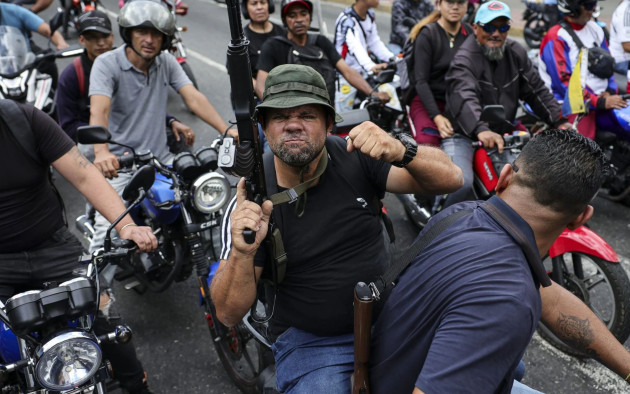
In Caracas, the security apparatus did not dissolve in the immediate aftermath of the raid. It remained staffed, armed, and alert. Loyalist militias known as colectivos moved into neighborhoods, establishing informal checkpoints and searching for suspected internal collaborators. Ministries continued their routines. Intelligence files did not disappear. For ordinary Venezuelans, daily life remained governed by caution. Speaking freely, organizing locally, even searching the wrong name on a phone still carried risk. The removal of a single figure altered none of that arithmetic.
It is worth stating clearly what Venezuela is not. It is not an ethnically fractured Middle Eastern state with centuries of communal violence waiting to erupt. It is a largely cohesive national society. But cohesion does not preclude instability. Venezuela’s danger lies in power structures forged through ideology, patronage, and force.
Latin America offers its own cautionary examples. For more than half a century, leftist insurgents in Colombia sustained a war from the jungle against a state that remained formally intact. They did not require ethnic division to endure. They relied on ideology, territory, financing, and a population caught between fear and fatigue. Venezuela’s radicalized militias and security networks operate on a similar logic. They do not need national fragmentation to impose localized coercion.
This reality helps explain why claims of spontaneous, nationwide celebration rang hollow. Much of what circulated online after Maduro’s capture consisted of diaspora rallies abroad, clipped and recirculated by commentators eager to declare closure. Inside Venezuela, the response was more restrained. People waited to see whether power had genuinely changed hands or merely redistributed itself within the same architecture.
Washington’s response has followed a well-worn script. Sanctions mixed with inducements. Oil framed as leverage. Pressure applied to regime insiders in the hope that fear produces compliance. But this is often the moment when external pressure hardens the wrong actors.
When internal security elites believe transition threatens not only influence but survival, they do not moderate. They consolidate. They close ranks. Coercion replaces accommodation. This dynamic is not theoretical. It has played out before.
The Patterns We Prefer Not to Remember
In Iraq, the removal of Saddam Hussein was intended to unlock democratic renewal. Instead, the dismantling of Baathist institutions stripped the state of experienced administrators and alienated armed men with no clear exit. The vacuum was filled by insurgents, militias, and sectarian entrepreneurs. External pressure did not tame resistance; it multiplied it.
Libya followed a similar path. The fall of Muammar Gaddafi eliminated a dictator but shattered the coercive monopoly that held the country together. Militias became sovereign actors. Foreign backing fragmented authority rather than unifying it. More than a decade later, Libya remains divided, its sovereignty diluted by armed factions and external patrons.
Already have an account? Sign In
Two ways to continue to read this article.
Subscribe
$1.99
every 4 weeks
- Unlimited access to all articles
- Support independent journalism
- Ad-free reading experience
Subscribe Now
Recurring Monthly. Cancel Anytime.
Egypt offered a different variation. Popular revolt briefly opened political space, only for the security services to reassert control with greater force and legitimacy. The lesson drawn was not to liberalize, but to ensure no future opening could threaten dominance. The result was a more entrenched security order than the one it replaced.
In each case, American influence mattered. It simply did not operate as intended. Pressure concentrated resistance. It taught armed institutions that compromise invited extinction.
Venezuela now sits at a comparable inflection point. The risk is not stagnation. It is mutation, a shift toward deeper militarization, hardened militias, and narrower civilian space.
Iran’s Uncertain Moment
Half a world away, Iran is entering its own unstable phase. Protests that began around specific grievances have expanded into broader expressions of defiance. Economic collapse has intersected with long-standing anger over repression, corruption, and clerical rule. The bazaars have stirred. The streets have followed.
American instincts, once again, tilt toward optimism. Many assume that if the Islamic Republic falls, Iran will transition smoothly into a pro-Western democracy eager to reintegrate globally. That belief rests on hope more than history.
Iran is not an empty shell awaiting replacement. It is a densely securitized state with overlapping centers of armed power. The Revolutionary Guard is not simply a military institution. It is an economic empire, an intelligence apparatus, and a political actor built for self-preservation. The Basij and internal security services exist precisely to manage moments like this.
If clerical authority collapses, these institutions do not dissolve. They choose.
Some may fracture. Others may attempt to impose order through force. Regional and ethnic fault lines could widen, particularly in Kurdish and Baluch areas where long-standing grievances intersect with smuggling routes and Guard-linked economic interests. These dynamics do not reliably produce liberal democracy. They produce bargaining among armed actors, localized control, and prolonged uncertainty.
Here too, external pressure risks narrowing the field. When sanctions and rhetoric frame compromise as surrender, security elites interpret transition as prosecution. Civilian reformers are sidelined. Politics contracts into contests among men with guns.
What Is Actually at Stake
In both Venezuela and Iran, the stakes are not whether leaders fall. That spectacle is easy to dramatize. The real question is whether coercive systems are dismantled or merely rebranded. Whether oil and sanctions stabilize institutions or ignite internal conflict. Whether security services are folded into accountable structures or entrench themselves before the window closes.
Washington often treats regime change as a punctuation mark, an event complete in itself. Reality renders it a process, shaped by fear, institutional memory, and incomplete information. Impatience does not shorten that process. It distorts it.
Opposing brutal systems requires no apology. Assuming their removal delivers order invites delusion.
The fall of a strongman lifts the lid. What follows depends less on declarations or pressure campaigns than on institutions, armed networks, and the slow, contested work of rebuilding legitimacy. Foreign policy, stripped of illusion, begins where the drama fades, in the aftermath, where power reveals its true shape and order must be constructed rather than announced.










COMMENTS