

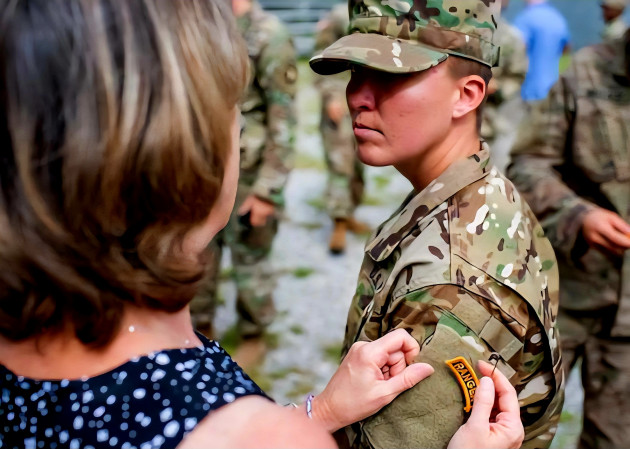
One of the lazier counterarguments goes like this: “Ranger School is just a leadership course. It does not mean combat readiness.”
Fine. That argument cuts both ways.
Ranger School has never been a guarantee of combat excellence for men either. Plenty of tabbed men have been mediocre leaders. Plenty of untabbed men have been outstanding in combat. That has always been true.
The Ranger tab means you endured, you performed under stress, and you were evaluated against peers doing the same thing. It is a credibility marker, not a magic spell.
RASP is different. RASP is a unit gate. RASP decides who is allowed into the Regiment. Women who passed RASP 2 did not get in because of ideology. They got in because the Regiment let them in.
If your argument is “Ranger School does not count,” then you have to deal honestly with RASP. If your argument is “RASP counts,” then you already lost the standards debate.
The question we keep pretending to ask
Army Times frames this as the Pentagon asking again, whether women belong in combat roles.
That is not the real question anymore.
The real question is this: If a woman meets the same physical and professional standard as a man, what reason remains to keep her out?
Once you remove standards from the argument, everything else becomes uncomfortable very fast.
So let’s talk about the things men only usually talk about behind closed doors.
The emotional reaction
A lot of men react more strongly to female casualties. That is not a theory. That is reality. Seeing a woman killed or wounded hits differently for many people, even seasoned ones.
That reaction does not come from policy. It comes from instinct.
But instinct is not a standard. Combat leadership is the ability to function despite instinct.
If a leader cannot fight effectively because the wounded soldier is female, that leader has a problem. The solution is not excluding capable soldiers. The solution is fixing leadership.
Hygiene in the field
Yes, women have different hygiene needs.
The field is miserable for everyone.
Everybody stinks. Everybody bleeds. Everybody deals with infections, rashes, and bodily functions they would rather not talk about.
If a unit can manage ammo resupply, casualty evacuation, and comms under fire, it can manage hygiene and privacy with clear SOPs and adult supervision.
If it cannot, it is not combat ready regardless of gender. Does it complicate the mission? Sure. Does facing a well equipped and determined enemy complicate the mission? Also yes. If units can’t function due to complications, women are the least of their problems.
Favoritism and relationships
This is the objection with the most substance, and it still collapses under scrutiny.
Some men will favor women. Some leaders will make bad calls. Some soldiers will form relationships they should not. That already happens in male-only units, just with different dynamics.
The presence of women does not create discipline problems. Weak leadership does.
Strong NCOs shut this down early. Weak ones blame the environment instead of enforcing standards.
The wounded-man carry argument
The idea that women should be excluded because they cannot drag a fully kitted wounded man is a fantasy scenario masquerading as a principle.
Battlefield casualty movement is almost never a clean one-person lift. It is drags, straps, litters, vehicles, cover, and teamwork. Plenty of men cannot lift larger men either. Nobody suggests banning them from combat roles.
If casualty movement is mission-critical, then set a mission-specific standard and apply it to everyone. Pass or fail. No gender carve-outs.
Are we considering banning particularly large men? If a Ranger is a 290 pound linebacker of a guy, should he be banned because no 165 pound Ranger is throwing that fully kitted up dude over their shoulder either.
What is left when the excuses run out
This is the part Army Times hints at but does not fully confront.
Once women have met the same standards, passed the same schools, and served in the same units, the remaining objections stop being about performance.
They become about comfort. Identity. Tradition. Control.
That is where the word chauvinism enters the conversation. Not as a slur, but as a description of what is happening when all practical objections have been answered and resistance remains anyway.
If your position is “I do not want women in combat even if they can do the job,” then your argument is no longer about readiness. It is about preference.
Own it. Do not hide behind standards you refuse to apply honestly.
The Pentagon review
Army Times reports that the Department of War says the current review is about effectiveness and maintaining high standards.
That claim lives or dies on transparency.
If the review measures mission-specific performance, controls for training pipelines, and applies the same criteria to men and women, then its conclusions deserve respect.
If the review starts with the assumption that women do not belong and works backward, it will destroy trust across the force.
Female soldiers are not angry because they fear standards. Many of them have already beaten standards. They are angry because they recognize a rigged question when they see one.
This debate will not end with another study. It ends when men answer a simple question honestly.
If a woman can carry the same load, run the same distance, endure the same conditions, and perform under fire, what exactly do you believe should keep her out?
If your answer is effectiveness, show your work.
If your answer is discipline, fix your leadership.
If your answer is discomfort, at least have the spine to say so.
Combat has never been about fairness. It has always been about competence. On that front, women who meet the standard have already done the work.
The rest of the argument is not about combat. It is about whether the institution is willing to accept the evidence in front of it.
But hey, this is just me talking.
If you’re a female soldier, I would love to hear your opinion. If you’re a male soldier who has served with females in combat rolls, I love to hear from you too.
Let me know what you folks think in the comments.








COMMENTS