


“He (the cardiologist) did tests on me immediately and when they came back I was rushed to the hospital to have surgery for Pericarditis. They removed over a liter and a half of fluid from around my heart and I was in the hospital for over a week dealing with the fluid draining with a chest tube.” –Wojciechowski
The US government and their contractors are required, under the Defense Base Act (DBA), established in 1941, to provide overseas contractors with life insurance and workers compensation insurance. The government and companies select the insurance policies and have a practice of putting them out to the lowest bidder. The incentive in this case is for companies and the US Government to pay as little as possible for bare minimum coverage, and as we’re seeing now, this often comes at the expense of the people and their families covered under these policies.
The family and estate of my own friend, Glen Doherty (KIA Benghazi, Libya 2012 on assignment with the CIA’s GRS), still has not received any reimbursement for his burial expenses after he died protecting CIA and State Department diplomats in 2012.
A large problem with DBA insurance is that the people covered have very little visibility into the insurance policies themselves. In most cases, it appears that these insurance policies are administered through the government or the company that holds a government contract requiring DBA coverage.
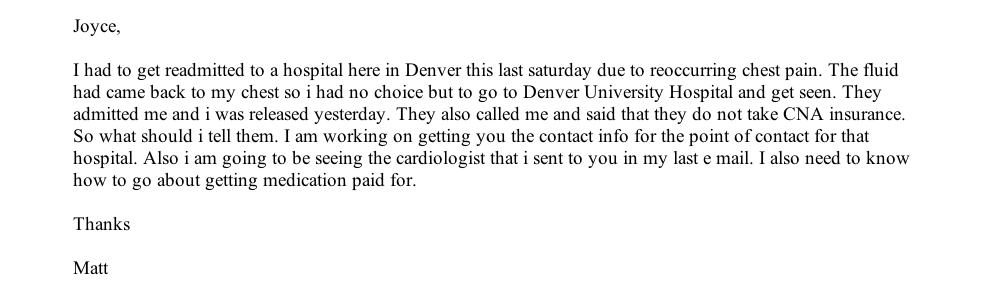
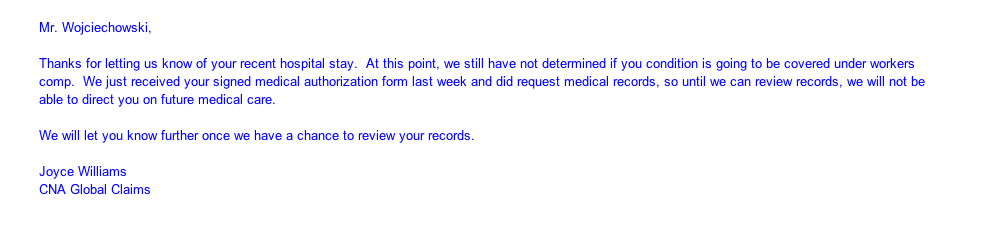
In Matthew Wojciechowski’s situation, he’s 100% disabled, and Continental Insurance of Chicago (CNA) has refused to give him a copy of the policy he’s covered under. The same policy under which CNA continues to deny medical coverage and makes reduction of workers compensation payment coverage, according to Matthew.
CNA could not be reached for comment but we did obtain a copy of this message.
The Defense Base Act Explained
The Defense Base Act, P.L.77-208, was enacted in 1941 and extended workers’compensation coverage under the Longshore and Harbor Workers’ Compensation Act (LHWCA) to persons working on American military bases that were either acquired by the United States from foreign countries or that were located outside of the continental United States.
DBA provides benefits in the event that civilian contractors are injured, killed, or kidnapped in the course of their work for US government agencies such as the various branches of the Department of Defense (DOD), U.S. Agency for International Development (USAID), or the State Department.
According to government documents, the DBA “program was created to provide workers’ compensation protections for categories of workers who were outside the jurisdiction of other state or federal workers’ compensation systems.”
Source-Wikipedia
SOFREP spoke with a former Special Operations veteran, CIA GRS contractor-turned-CIA-staff who is now retired, and he had this to say about Matthew Wojciechowski:
“My feelings how this was handled was I’m totally not surprised. They treat contractors in all the GRS AOs in general, on a much lower level than blue badger/staff personnel when it comes to tactical supplies (gear needed to do the job), and medical care, as well as even counseling/reprimands on people that get in trouble for doing something stupid.”
“How Matt got treated on all levels is absolutely ridiculous. Public hospitals that are payed by taxpayer dollars can’t turn away patients, and I’m pretty sure everything overseas is payed by taxpayers, so that should be no different. The reality is that they should have seen him because it was life-threatening and, if needed, send him a bill just like any other hospital. The PA to the staffers that handled Matt didn’t follow protocols and treated a man that was there to protect them like a third-class citizen.
I remember on one occasion when we were doing some live fire training in Iraq that I had a filling on my molar break out, leaving my nerves exposed and in excruciating pain. The blue-badger took me over to a State Dept building where they had a dentist on staff. We spoke with the dentist and he refused to see me because I had a yellow badge, which meant that I was a contractor and not CIA staff personnel.
It didn’t matter that I was in tears and that having an exposed nerve in the mouth can cause serious problems. So I sweet-talked one of the girls who worked there to score me a couple vials of derma bond, at which point I took my broken filling and bit it back into place, and almost passed out in front of my buddy. I took the derma bond, which is a plastic formula that can cover small surgical wounds, and put it in my mouth over my teeth until I could get home (two weeks later) and see a dentist.
I also couldn’t go home early because we didn’t have enough area famed (e.g. Operators familiar with the area of operation) people for the big site.
The reality is that, if any of the things that have happened to many contractors with whom I’ve worked over the years happened to staff personnel, and they were treated like us, there would be multiple class action lawsuits happening because they have internal affairs people and in-house lawyers to take care of them.”
-Former CIA GRS Staffer.
Conclusion
US Government agencies and companies under contract with the government need to ensure that their contractors are covered in the event that a contractor is severely disabled or killed while working for them overseas. Getting a competitive bid is an acceptable practice, but coverage should be clear and concise and shared with the contractors and their families.
Security contractors need also to take responsibility and ask to receive a copy of their insurance packages from their government or company sponsors. File a copy away for future records and get it reviewed by an insurance professional and lawyer.
A lawyer who is experienced in these matters will review your policy to ensure that proper coverage is in place, and if there are coverage gaps you’ll be informed so that you can consider providing coverage of your own to fill the void. Failing to do this will invite disaster and grief in your own life or the lives of loved ones who are left behind to clean up the mess.
As for the State Department, you may want to re-think your rules of treatment for TDY Americans. Refusing medical treatment to Wojciechowski and others is not a good practice, and next time a State Department call for help goes out, as it did during the Benghazi attack in 2012, there may not be many takers.
(Featured Image Courtesy: NPR)








COMMENTS