

By the time McCarley moved out at 4 a.m. for day three, Sept. 13, 1970, Rose was tending to more than 30 wounded men: two with deadly, serious wounds that required almost constant attention, fluid rejuvenation, and pain management. Rose was also running low on bandages, IVs and morphine syrettes. “We were so low on morphine that I reused morphine syrettes, which is a no-no under normal circumstances. But, there was nothing normal about this operation, so I would give two or three of the wounded morphine from the same syrette. I only gave them enough to dull the pain, but allowed them to be somewhat alert.”
As Rose focused on the wounded, first platoon engaged the enemy as they moved toward a potential LZ for a much-needed medivac while the third platoon deployed one squad to maintain contact with another squad of NVA attacking the company’s rear. After several gun runs by Scarface and A1 Skyraiders from Da Nang and Thailand, the rear action force rejoined the company as it pushed ahead into a good LZ site and began clearing some trees with Claymore mines and C-4 plastic explosives.
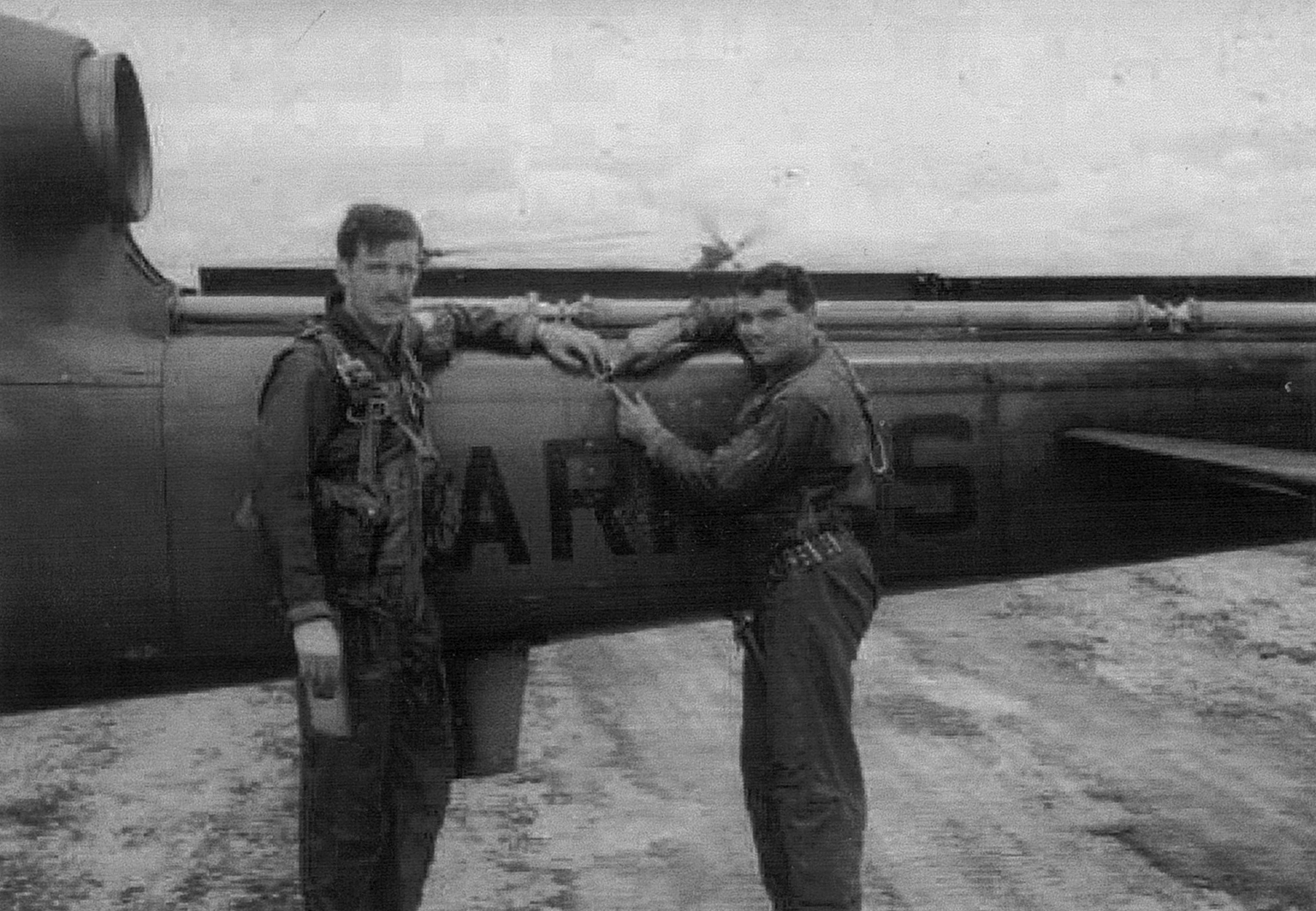
At noon, after Scarface and SPADs performed gun runs on enemy positions near a small LZ, the first Marine Corps CH-53D approached the LZ. As the large chopper descended into the LZ, the pilot, Bill Beardall, was concerned that it might not be large enough to land. As he maneuvered the chopper slowly downward, Rose moved toward the rear tailgate of the CH-53D with his most seriously injured soldier, the South Vietnamese lieutenant with the horrific thigh and hip injury. Inside the chopper, SF medics SSG John “Doc” Padgett and Sgt. John Browne moved onto the back tailgate as it was lowered, with Browne supporting Padgett by holding his belt. “I was trying to reach the patient that Mike was lifting toward us and just at that moment in time, the pilot pulled pitch and lifted to the left.”
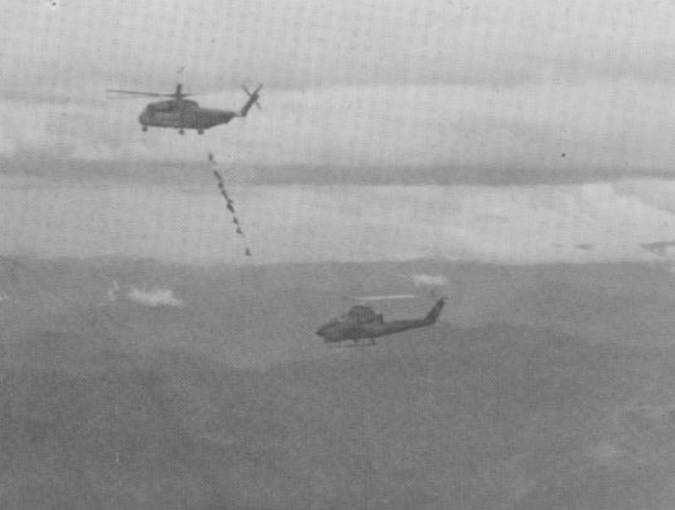
Rose said, “The tail rotor struck a tree and as I was lifting the patient up toward Doc, the chopper lifted upward suddenly. As it was lifting up, it took enemy small arms fire and a B-40 rocket hit it.”
Padgett said, “When that B-40 hit us, it went through the fuel cell but didn’t explode. There was aviation fuel everywhere. How it didn’t ignite, I’ll never know, but surely God was riding with us.” Groah and Lt. Bill Beardall, pilot of the CH-53D YH-14, said the fluids were from cut hydraulic fluid lines. “I’ll never forget it,” Beardall said, “when I looked back toward the tailgate, all I saw was a curtain of red from the hydraulic fluids.”
Beardall radioed, “May Day! May Day! We’re going in!” as the CH-53D began losing altitude due to a loss of hydraulic fluids. YH-14 crashed without any injuries to the medics or crew members. “We were lucky, I was able to find shrubs that softened the landing for us,” Beardall said. Everyone immediately exited the wounded bird and set up a defensive perimeter, with Padgett overseeing the impromptu team on the ground. As the NCOIC for SOG’s CCC dispensary at Kontum, Padgett could have pulled rank and stayed behind, “But that wasn’t how I did things. I usually took my turn riding on the chase medic ship.”
As they set up their perimeter, Scarface Lt. Col. H.E. Newton called CH-53D aircraft number YH-20 piloted by Mark McKenzie, met them at a rally point, and led them to the crash site, where Scarface and SPADs made gun runs in preparation for the chase medic aircraft—called SAR by the Marines—to arrive for the downed crew and SF medics.
“While en route to rescue the crew of YH-14, I was admiring the beautiful countryside,” said YH-20 door gunner Larry Groah, “and, I couldn’t help thinking of all the bad guys down there waiting for us. My M-60 was locked, loaded, and ready for action. As we got closer to the pickup site, I could see that it was surrounded by smoke laid down by the Scarface Cobras along with their rockets and 40mms to protect the crew of the downed chopper.”
As YH-20 was about to settle into a hover over the downed crew, a NVA .51-caliber anti-aircraft heavy machine gun opened up on the aircraft’s left side. Groah’s left-side window was “only about 25 yards away from it.” The muzzle flashes from that gun were huge and the rounds “seemed to be the size of a basketball.” Groah pulled the trigger on his M-60 and held it until the .51 was silenced.
The CH-53D started to “bounce around, and I knew that we had taken some bad hits. Sgt. Whitmer was working his gun on the right side as Capt. Cipolla and Sgt. Spalding were at the rear ramp throwing out the (120-foot aluminum) extraction ladder.” Meanwhile, Scarface Cobras were making gun runs, SPADs following suit, hitting enemy firing sites. “Everything seemed to slow down as the action heated up,” Groah said. “Everything was in slow motion.”
When the ladder landed on the ground, Padgett told everyone to climb it and hook on to it. “There was so much confusion and noise that no one moved to the ladder,” he said. “Finally, I said ‘follow me’ and up I went. Then they followed suit. Again, we were lucky we had landed in the middle of a NVA fortification. Fortunately, nobody was home.”
Groah said the lift-off from the LZ wasn’t easy and “we had no idea just how bad the battle damage was, but we were bouncing all over the sky and we had a huge ‘beat’, meaning that there was something terribly wrong with our main rotor blades.” Now the crew of YH-20 was concerned about the safety of the aircraft and the men below, riding on the extraction ladder.
Lt. McKenzie radioed Scarface commander Lt. Col. Sexton and explained their situation to him. Sexton lead his Cobras down to clear an LZ where YH-20 could land. Lt. McKenzie settled the CH-53D down gently, giving the men on the ladder time to unhook and move away from it, before the big bird settled down onto terra firma. Crew Chief Spalding gave the chopper a quick visual inspection before radioing pilots McKenzie and Lt. R. Bustamante, giving the okay to fly back to base. An Army helicopter picked up Padgett and the Marine air crew from YH-14 and returned to Kontum.
As to aircraft YH-20, “In hindsight, there was really no way that we or anyone else could know how bad the damage was,” said Groah. “Only when we finally made it back did we learn just how badly we’d been hit.” Numerous rounds had cut the hydraulic lines to the tail rotor, one round from the .51 caliber had almost cut the main tail rotor drive shaft in half. That round had hit next to the “Thomas coupling,” which connects the tail rotor drive shaft sections together. “We were extremely lucky to have made it back to base.” As Padgett had said, “God was with us that day.”
For the men on the ground during the night of day three, there was no rest. The NVA intensified their attacks against the men of B Company, throwing an estimated 600-plus hand grenades into the defense positions of the hatchet force, even as it moved a few times during the night. By now, the B Company men had gained an important tactical advantage over the NVA. They learned the NVA combat signals during the close-in fighting. The NVA would hit two bamboo sticks together or use a whistle for signals.
The hatchet force men learned that one click or whistle signaled the NVA to move, two meant to throw hand grenades, and three meant withdraw. Hatchet force men would then radio what the signal was to other team members so they could adjust accordingly. More than once, when the NVA signaled withdrawal, the Hatchet Force men would then attack where the NVA were vulnerable and pulling back. It was one more tactical advantage that they used to their advantage against an enemy force that continued to grow on the battlefield despite losing hundreds of men to air strikes, bombing runs, and team ground fire.
Meanwhile, back in Da Nang at their air base, the Marines returned to repairing their aircraft as the warning order came down for day four: The weather and NVA hordes were closing in on B Company.
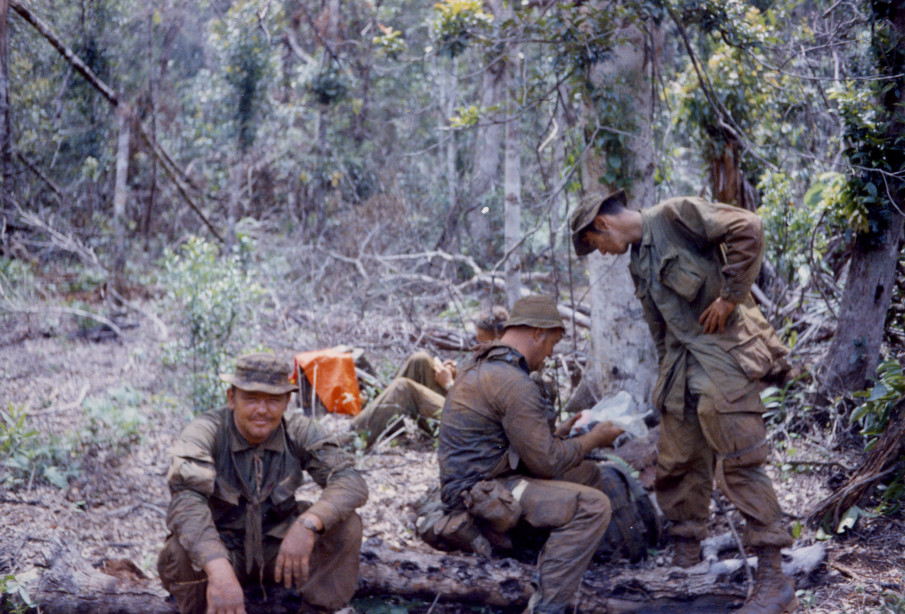
(Featured image: After a series of firefights with the NVA, SOG hatchet force B Company from CCC in Kontum takes a brief break to plot the next line of march for the 130-plus SOG warriors during Operation Tailwind. From left: Sgt. Dave Young, B Company commanding officer Capt. Gene McCarley, seated reviewing his map with SSG Donald Boudreau. In the background, also checking his maps is B Company First Sgt. Morris Adair. Photo courtesy of Gene McCarley)








COMMENTS