
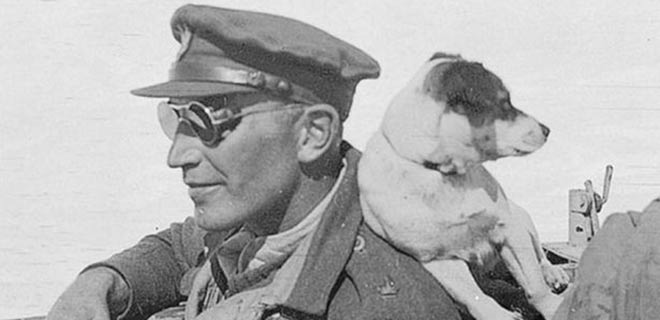
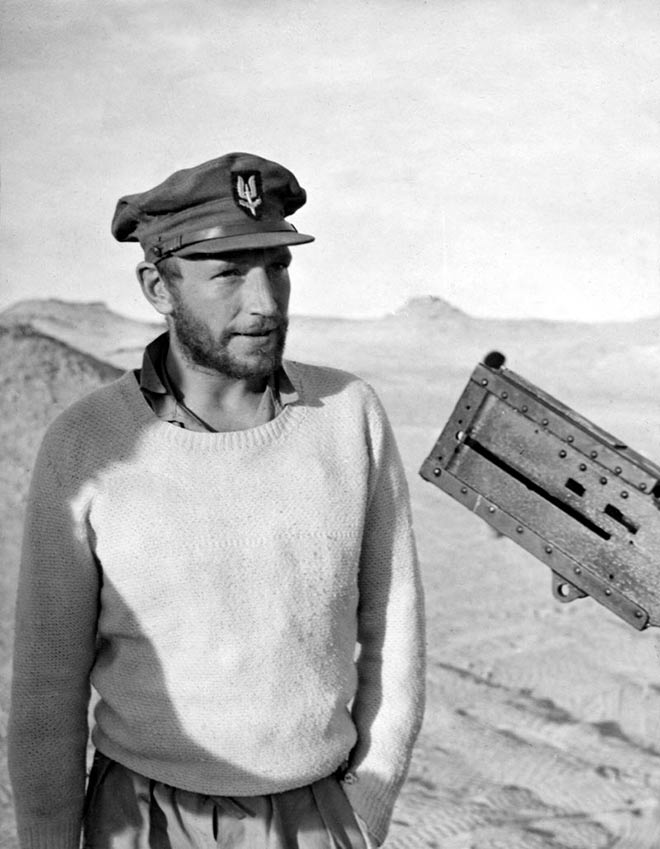
A short while later he led his men against another airfield. With guns blazing to pin the down the enemy, they hurled charges into engine intakes and anything else that looked inviting. The result was becoming typical of Mayne’s daring leadership: over 100 aircraft up in flames, with 27 credited to himself.
It is believed that by the time he left Africa, Mayne had singlehandedly destroyed over one hundred aircraft.
The unit suffered a huge loss when David Sterling was captured on a desert mission, leaving Mayne to lead the S.A.S. and continue molding it as his leader would have wanted, this time, away from Africa for even more dangerous missions, in support of Allied landings in Sicily and Italy in 1943-44 as part of the Special Raiding Squadron.
Starting off, Mayne and his men were tasked with knocking out a coastal installation as part of their assignments. In the chill of night, with the sound of breakers below them, they climbed a large vertical rock face and hit the position, taking the defenders by complete surprise. In the ensuing firefight, they killed 300 Italians, blew up the guns and took 700 prisoners, as well as indulged in their wine.
Afterwards, it was officially reported as:
“On 10 July 1943, Major Mayne carried out two successful operations, the first the capture of CD battery the outcome of which was vital to the safe landing of 13 Corps. By nightfall SRS had captured three additional batteries, 450 prisoners, as well as killing 200 to 300 Italians. The second operation was the capture and hold of the town of Augusta. The landing was carried out in daylight – a most hazardous combined operation. By the audacity displayed, the Italians were forced from their positions and masses of stores and equipment were saved from enemy demolition. In both these operations it was Major Mayne’s courage, determination and superb leadership which proved the key to success. He personally led his men from landing craft in the face of heavy machine-gun fire. By this action, he succeeded in forcing his way to ground where it was possible to form up and sum up the enemy’s defenses.”
On October 2nd and 3rd, Paddy Mayne led his detachment and Royal Marines off landing craft and into the town of Termoli where they held off German counterattacks, including armor, for three days before their relief on the 7th. They later continued their arts deeper in the Italian mainland, as German defensive lines continued to shrivel up under the Allied onslaught.
In the run up to D-Day, June 6, 1944 in France, Mayne parachuted into occupied territory and worked with the French resistance before and after the invasion, coordinating their efforts to slow the German military’s movements around the country, ambushing convoys and rail lines, and gathering intelligence.
After the invasion moved inland, and eventually into Germany itself, he used the S.A.S. to probe avenues of advance for the main Allied spearhead, which forced upon him his greatest accomplishment.
Lead elements of his unit became ambushed and cut off around the town of Oldenburg. Hearing this dire news over the radio, he retrieved a Bren light machine gun, ordered another man to use his jeep’s mounted machine gun and sped off toward the fighting. Resting the Bren on the dash he fired it with one hand and steered with the other as he bore through the ambush, bullets zinging around his head and peppering the jeep. His gunner tried to pin down locations of the fire as the jeep bounded at its speed limit, Mayne was unfazed by the withering fire trying to track him. All he focused on was reaching his men. And that he did, proceeding to load casualties and race them out of harm’s way, again and again. Once finished, he gathered the remainder of his unit, only a handful by this point, and led them back, flanked the German ambush, and wiped it out, allowing them to capture Oldenburg.
Hostilities in Europe ceased a few months later on May 7, 1945. It is likely that by now Mayne knew his days in the military were numbered. What his men did not know was that he had been dealing with chronic back pain which had started during his desert days. This he somehow managed to keep hidden from them through all the ordeals they had shared. But no longer. He left later in the year to go back and try the most difficult task for many who survive the travails of war…Lead a peacetime existence.
He joined the British Antarctic survey in the Falkland Islands before his back sent him home. He became a solicitor, then secretary to the Law Society of Northern Ireland. It did little to ease him in both mind and body. Peacetime seemed boring. To cope with this, he drank excessively, became withdrawn and talked little of his wartime service. He found only gardening somewhat of a release before heading back to bars where he could be found singing, storytelling and reciting poetry. Yet, that aching need in his heart was too big to fill, and on the night of December 13, 1955, after a night of drinking with friends, he was on his way home when he collided with a farmers truck and was killed. He was just 40.
Paddy Mayne left this world after having once worn a uniform bearing four Distinguished Service Order medals for bravery – the most in the history of Britain – and a bevy of other medals he earned during his time as a bleeding wound in the enemy’s side. In addition, there was the absence of something on that cloth that still causes controversy to this day – a Victoria Cross, Britain’s highest combat honor – for his actions at Oldenburg. He received a fourth bar to his DSO for this, but many believe it warrants the ultimate decoration.
A foundation in his name has been set up trying to get it done. So far they have been unsuccessful, with parliament turning them down in 2005. Still they remain undaunted, convinced it will be awarded some day.
In the meantime, Paddy Mayne’s legend lives on.
This article previously published on SOFREP 03.10.13 by Mike Perry.








COMMENTS