

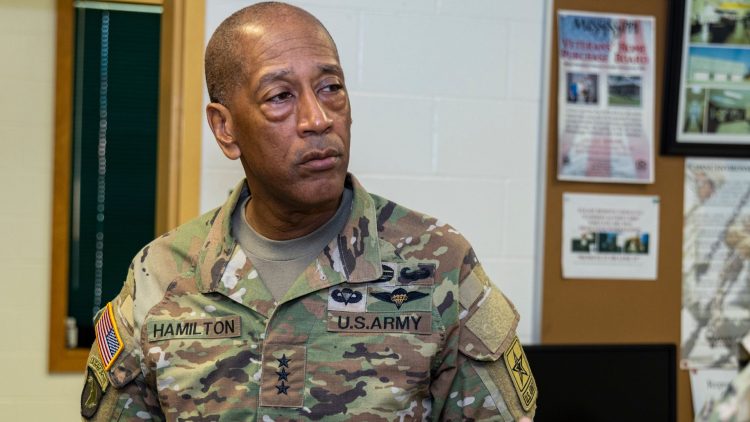
His actions included securing a second evaluation for the lieutenant colonel—a move unprecedented in BCAP history outside of administrative errors—and lobbying senior Army officials, including Army Chief of Staff Gen. Randy George and Lt. Gen. Walter Piatt.
The lieutenant colonel was ultimately placed on the command selection list, but Secretary Wormuth removed her following Military.com‘s investigative reporting.
SCOOP: First Army 4 star outright fired in nearly two decades is relieved following a @Militarydotcom investigation. An Army IG inquiry confirmed my reporting. Gen. Hamilton subverted the commander selection process for a subordinate deemed unqualified https://t.co/lXNZqvuGvq
— Steve Beynon (@StevenBeynon) December 10, 2024
The IG investigation also found evidence of a potentially inappropriate relationship between Hamilton and the subordinate, though it could not conclusively determine any misconduct. Hamilton’s advocacy reportedly included granting inflated performance evaluations and awarding her the Legion of Merit under questionable circumstances.
Hamilton’s Defense: Addressing Systemic Bias
Hamilton has openly acknowledged his actions, framing them as an effort to address “systemic bias and racism” within the Army’s promotion processes.
In a letter to Secretary Wormuth in August, he argued that the BCAP failed to account for the “psychological effects of systemic bias and discrimination” on minority officers, cited from Defense News.
Hamilton maintained that his advocacy was aimed at leveling the playing field for a deserving officer and called for a broader review of the BCAP to identify barriers for minority candidates.
“Removing photographs from personnel files and providing unconscious bias training for panelists is not enough,” Hamilton wrote. “By the time a minority officer sits before a Command Assessment Program panel, the bias and racism that exists in our Army culture is already cemented into evaluation reports, peer assessments, and opinions of decision-makers.”
While his defense highlighted legitimate concerns about diversity and equity, the IG report concluded that Hamilton’s actions undermined the integrity of the promotion process.
Critics have argued that his lobbying efforts reflected favoritism rather than systemic reform.
The Fallout and Implications for Leadership
The dismissal of a four-star general is an extraordinary event, typically requiring the direct involvement of the president or secretary of defense.
Wormuth’s decision signals the Army’s commitment to preserving the integrity of its promotion systems and upholding standards of leadership accountability.
Hamilton’s actions also placed scrutiny on other senior leaders, including Gen. Randy George and Lt. Gen. Walter Piatt, who failed to question Hamilton’s lobbying efforts.
The IG report highlighted concerns about a culture of deference that allowed Hamilton’s actions to go unchecked.
In response, Secretary Wormuth has reinforced the Army’s commitment to the BCAP, formally establishing it as an enduring program with enhanced transparency measures to prevent similar incidents in the future.
Final Thoughts
Reflecting on his dismissal, Hamilton expressed gratitude for his decades of service and acknowledged the timing of his departure was beyond his control.
“It was my honor to serve our nation, and I’ve been blessed beyond what I’ve deserved to lead our troops for the past 43 years,” he said in a statement to Military.com. “While I wish I was able to complete my command, we all take the uniform off and we don’t always control the timing.”
Hamilton’s career, once marked by exemplary service and achievements, now ends under a cloud of controversy. His dismissal serves as a stark reminder of the responsibilities that come with senior leadership and the importance of maintaining ethical standards in positions of power.
Military.com was the first to report Hamilton’s dismissal.








COMMENTS