
The system’s development faced hurdles, including production delays attributed to sanctions against Russia and labor shortages, as reported by Defense News in October 2023.
The cost of the S-500 system also saw a significant increase, from an estimated $700-$800 million in 2020 to up to $2.5 billion in 2023.
Testing and Operational History
The S-500 has undergone rigorous testing to validate its capabilities.
In May 2018, Russia conducted the longest-range surface-to-air missile test to date with the S-500, reportedly achieving a target hit 482 km (300 miles) away, surpassing the previous record by 80 km (50 miles).
Subsequent tests, including the first public live-fire test in July 2021, have further demonstrated the system’s potential.
The first S-500 regiment was declared operational in Moscow in late October 2021, although it was noted that the system had not yet met the full set of operational requirements.
According to the Russian news agency TASS, on April 25, 2022, the Almaz-Antey Concern began mass production of S-500 air defense systems.
Most recently, the S-500 demonstrated its capabilities in firing tests, as announced by the Russian Ministry of Defense in an official statement to Izvestia, successfully intercepting and neutralizing hypersonic targets.
Advanced Aerial Threat Neutralization: The Versatile S-500 Prometheus
The S-500 Prometheus is engineered to intercept and destroy a wide range of aerial threats.
With a planned range of 600 km (373 miles) for anti-ballistic missiles and 500 km (311 miles) for air defense, the system can detect and simultaneously engage up to 10 ballistic hypersonic targets.
It can operate against targets at altitudes of up to 180–200 km (112–124 miles) and speeds higher than Mach 5, including hypersonic cruise missiles, spacecraft, and potentially low Earth orbit satellites.
The system’s mobility and rapid deployability enhance its operational flexibility, allowing for effective defense against enemy ICBMs during mid to late-flight phases.
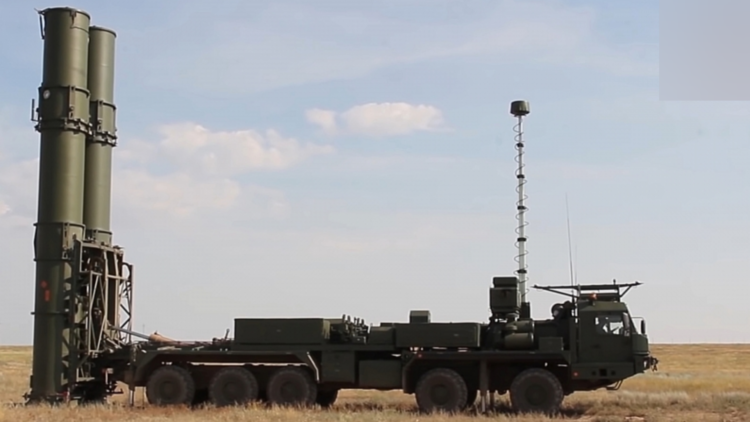
The S-500 system includes several key components such as the 77P6 launch vehicle, command posts (55K6MA and 85Zh6-2), acquisition and battle management radar (91N6A(M)), and engagement radars (76T6 and 77T6), among others.
Its missiles, including the 40N6M for anti-aircraft roles and the 7N6 / 77N6-N1 for anti-ballistic roles, underline the system’s versatility in addressing various threats.
Redefining Global Security: The Missile Systems’ Impact on Defense and Deterrence
The introduction of the S-500 Prometheus into Russia’s military arsenal represents a significant advancement in missile defense technology.
Its ability to intercept modern hypersonic weapon systems enhances not only Russia’s defensive capabilities but also alters the strategic balance, potentially affecting global security dynamics.
As the system continues to be deployed and further tested, its full capabilities and impact on international security will become more apparent.
In conclusion, the S-500 Prometheus is a testament to modern military engineering and strategic foresight.
Its development, despite challenges, underscores Russia’s commitment to maintaining a formidable defense against the evolving threats of the 21st century.
As it enters into broader service, the S-500 will undoubtedly play a pivotal role in shaping the future of aerial and missile defense strategies globally.








COMMENTS