

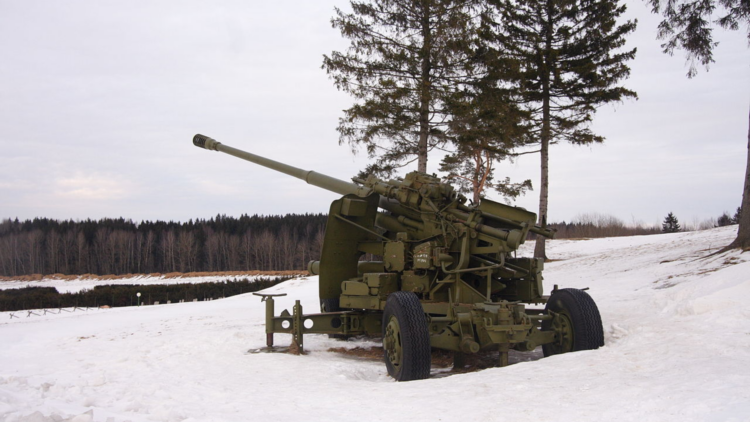
The older version of this rifled gun has a semi-automatic sliding wedge block, power rammer, and loading tray for quick ammo loading, and it can fire up to 15 rounds per minute.
Moreover, its fire control system incorporates the PUAZO-6/19 directional system and the SON 9 or SON-9A fire control radar, which improves accuracy.
The fixed ammunition type of the original KS-19 is compatible with other 100mm rifled guns, and it comes in high explosive, high explosive fragmentation, and anti-aircraft fragmentation varieties.
Despite Western allies providing weapons and ammunition, Ukraine’s arsenal still boasts relics from the Soviet Union—a testament to the nation’s resilience amid the ongoing conflict.
Integration of Advanced Technology
In March, the 241st Brigade’s acquisition of four KS-19s marked a pivotal moment in their arsenal enhancement.
Furthermore, the unit’s inventive approach went beyond simple refurbishing; they added electronic tablets, a $8,000 expenditure, to better targeting and coordination.
These tablets effortlessly blended with drones and operators, assisting in the precise tracking and engagement of Russian forces—a credit to the soldiers’ versatility and commitment to improving their capabilities.
Funding and Challenges
The financial backing for these initiatives didn’t stem from government coffers.
Instead, the soldiers themselves, along with contributions from donors and friends, spearheaded the funding for this groundbreaking project.
Iitvin highlighted the government’s inability to allocate such substantial funds to individual units for such ventures, emphasizing the soldiers’ self-reliance and determination to equip themselves against the aggressor.
“I’ve already fought on the front line. I already had the guns. I already understood their effectiveness, their safety, and that everything can be better and more convenient. I came up with the idea that I should put the gun on the truck. We brought, renovated, and installed it,” Iitvin told the publication.
Ukraine’s reliance on refurbished Soviet-era weaponry reflects the challenges stemming from delays in Western support, compelling the nation to bolster its indigenous production of missiles, drones, and ammunition.
There’s a palpable sentiment among Ukrainian soldiers and experts alike that the aid from Western allies falls short of adequately countering Russian aggression, compelling them to look inward for solutions.
Ukrainians invent homemade war machine to gun down Russians https://t.co/3QGyU6nSOK
— The Daily Beast (@thedailybeast) November 25, 2023
Expressing his frustration, Iitvin conveyed a poignant message, stating that the need for these improvised weapons would diminish significantly if greater support, particularly from the Biden administration, were forthcoming.
The reliance on crowdfunding for essential supplies like drones, night vision goggles, and medical necessities underscores the gaps in support that Ukrainian soldiers face in their critical fight for survival.
“If Biden provided weapons, I would not need these guns,” the Ukrainian officer stated.
Ukraine’s Looming Concerns and Future Implications
Beyond immediate concerns, Ukraine faces the looming specter of donor fatigue from its supporting countries, compounded by apprehensions surrounding external factors, including the impact of upcoming events such as the US presidential election.
In conclusion, Ukraine’s utilization of modified Soviet-era anti-aircraft guns stands as a testament to the nation’s resilience and adaptability in the face of adversity.
However, it also starkly outlines the challenges posed by inadequate external support and the imperative for self-reliance in fortifying its defenses.
The saga of the KS-19 transformation encapsulates a larger narrative—a tale of determination, resourcefulness, and the unyielding spirit of Ukrainian soldiers committed to safeguarding their nation’s sovereignty.
—
Check out:










COMMENTS