When the Pentagon starts shipping out a battalion of ticked-off Marines from 29 Palms to police protests in Los Angeles, you know the federal government’s not sending a message—they’re sending a warning.
Read the full article for more on:
Important insights and detailed analysis
Expert commentary on current events
Breaking developments and updates
Updating summary...
700 Marines Mobilized as California’s Streets Become the Nation’s Front Line
Guy D. McCardle
Speed
1x
Listen
COMMENTS
When the Pentagon starts shipping out a battalion of ticked-off Marines from 29 Palms to police protests in Los Angeles, you know the federal government’s not sending a message—they’re sending a warning.
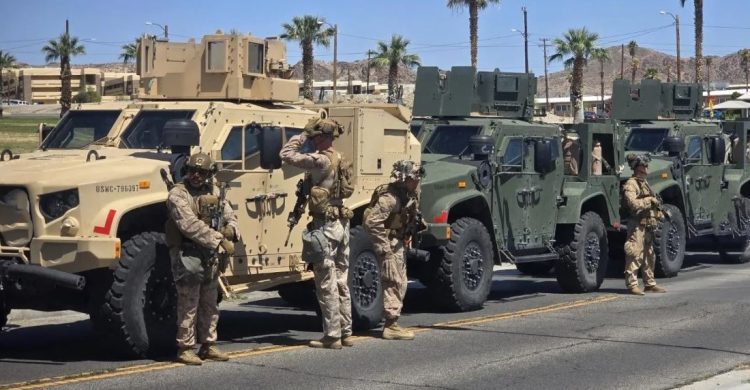
Marines preparing to make the trip from Twentynine Palms to Los Angeles. Image Credit: US Northern Command
If you ever wondered what it looks like when the gears of federal power grind into motion, look no further than Los Angeles this week. In a move that’s as subtle as a sledgehammer, over 700 active duty Marines from the 2nd Battalion, 7th Marines, based out of Twentynine Palms, have been mobilized to support National Guard troops as anti-ICE protests continue to roil Southern California. This is a serious matter, a whole Marine Corps battalion, boots on the ground, in America’s second-largest city.
Advertisement
A Show of Force
Picture the Marine Corps Air Ground Combat Center: a sprawling desert fortress east of Los Angeles, where Marines train for war, not crowd control. Now, those same Marines are being sent into the heart of a domestic crisis, their mission as clear as mud. Officially, they’re there to “support” the National Guard and protect federal personnel and property. Unofficially, their presence is a message: the federal government is not playing around.
The Marines are expected to supplement the 2,000 National Guard troops President Trump ordered to Los Angeles, though only about 300 Guardsmen had actually hit the streets as of Monday. The Marines’ arrival is meant to relieve some of the burden from the Guard, whose members have been stretched thin as protests over immigration enforcement have escalated into violence.
Advertisement
The most pissed off Marines in the whole USMC are leaving 29 Palms headed to LA. pic.twitter.com/b0bWjNhvMU
Here’s where things get stickier than a Humvee in a Louisiana swamp. The Marines, like the National Guard, are barred from direct law enforcement duties by the Posse Comitatus Act. That means no making arrests, no breaking up protests, unless President Trump invokes the Insurrection Act—a legal nuke that allows the military to quell domestic unrest. So far, Trump has stopped short of pulling that trigger, even as he refers to demonstrators as “insurrectionists” and boasts the situation is “very well under control”.
Their rules of engagement are simple but strict: self-defense, defense of federal property, and defense of federal personnel. Think of them as a heavily armed insurance policy standing behind the National Guard and local police, ready to step in if things go sideways.
Advertisement
Ultimately, it’s a show of muscle. Kind of like the 6’8″ muscle-bound guy standing with his arms crossed at the entrance of the club you want to get into. He keeps order without having to really do much of anything.
A Political Powder Keg
If you’re getting déjà vu from the summer of 2020, you’re not alone. But this time, the stakes are even higher. Governor Gavin Newsom has called the mobilization “completely unwarranted, uncalled for, and unprecedented”. He’s not just venting on social media—California is seeking a court order to halt the deployment, arguing that Trump’s federalization of the Guard is unlawful. The state’s lawsuit is a shot across the bow in a constitutional tug-of-war that’s as old as the Republic itself.
Meanwhile, the Pentagon’s decision to send in active-duty Marines—something reserved for the most exceptional circumstances—has legal analysts, lawmakers, and local officials raising eyebrows and sounding alarms. The move is seen by many as a provocation, a flex of federal muscle that risks escalating tensions rather than calming them.
I’m really not sure why so many people are flying foreign flags if they want to be integrated into the US so badly.
On the Ground: Marines in the Middle
For the Marines themselves, this isn’t the kind of deployment they signed up for. They’re trained for Fallujah, not Figueroa Street. Yet here they are, caught between a rock and a hard place, tasked with upholding order and “supporting” the National Guard without crossing the line into law enforcement. It’s like asking a linebacker to play chess—he can do it, but it’s not what he’s built for.
This whole mess reminds me of what the late Evan Wright wrote about the Marine Corps in the book, Generation Kill:
“We’re like America’s little pit bull. They beat it, starve it, mistreat it, and once in a while, they let it out to attack somebody.”
Their presence is meant to deter violence, but it could just as easily inflame it. In the fog of protest, perception is everything. To some, the Marines are guardians of order; to others, they’re the face of an overreaching federal government.
The Road Ahead
As the sun rises over Los Angeles, the city finds itself at the intersection of protest and power. The deployment of 700 Marines is a reminder that, in America, the line between military and civilian authority is both sacred and fragile. Whether this show of force restores calm or fans the flames remains to be seen.
One thing’s for sure: history is being written on the streets of LA, and the ink has yet to dry.
The Marines may be America’s 911 force, but this time, the emergency is at home.
Advertisement
What readers are saying
Generating a quick summary of the conversation...
This summary is AI-generated. AI can make mistakes and this summary is not a replacement for reading the comments.











COMMENTS