

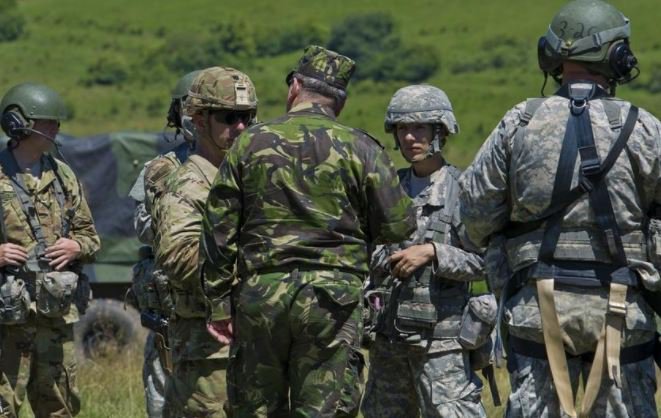
In Romania, Lupescu is a liaison and part-time translator between Romanian and American troops. While most Romanians speak some English, she said, she’s there to make sure nothing is lost in translation.
It’s a role that has taken some Romanian troops by surprise, especially when she talks in her native tongue.
“They pause and look me up and down,” Lupescu said.
Ultimately, the soldiers are proud to see one of their own in an American uniform, she said. They ask about life in America and her service in the Army. Lupescu tells them the truth.
“I’ve had nothing but good experiences,” she said.
Lupescu came to America in 2000 at age 21. It wasn’t her original plan to become an American, but she fell in love with the country, she said.
It took her a dozen years to become a permanent resident. And several more years to earn her citizenship.
Lupescu said she knew it was a long process, but didn’t expect it to take so long.
“It can take four years,” she said. “It can take eight years.”
For Lupescu, it took 16.
She doesn’t know why it took so long, and she said she had her doubts along the way. But she never considered giving up, even when she felt she had no control of her life.
Born in Bucharest and the daughter of two teachers, Lupescu said she grew up with a love of America fueled largely by Hollywood.
“I was always fascinated with the American culture,” she said. “Everything American.”
When the opportunity came to travel to the United States, Lupescu jumped at the chance.
In June 2000, she arrived in Lancaster, Pennsylvania, to serve as a counselor for a Girl Scout camp. There, Lupescu said, she fell in love with the country and applied for naturalization.
In Romania, Lupescu was trained on the violin and piano. She had gone to college for dentistry and could speak French, English and Spanish. But in America, as she waited for her citizenship, she had to settle for whatever jobs she could find.
“No job would be beneath me,” she said. “One does what one has to.”
Lupescu worked in construction, as a waitress and as a secretary. She cleaned houses, washed dishes and, for a time, even drove a delivery truck.
“I’ve even been one of those annoying telemarketers,” she said.”
We normally only hear about the other side of immigration, the illegal immigrants. But for the others, the ones who go about becoming Americans the right way, this is a familiar but still great story.
To read the entire article from The Fayetteville Observer, click here:
Photo courtesy US Army








COMMENTS