Army

Army Accelerates MV-75 Tiltrotor Program, Accepts Risk to Beat the Clock

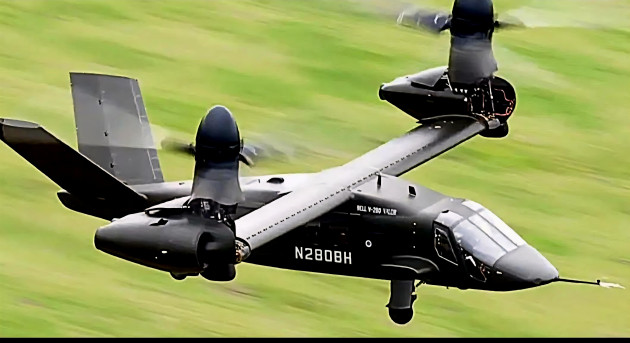
The Army is fast-tracking Bell’s MV-75 FLRAA tiltrotor to get prototype aircraft flying by late 2026 and push fielding years ahead of schedule, betting digital engineering and prior V-280 testing can manage weight and payload risks to deliver Indo-Pacific range and speed gains over the UH-60.

The U.S. Army is accelerating the fielding of its next-generation MV-75 tiltrotor aircraft at a pace that would have been unthinkable a decade ago, compressing a modernization timeline originally projected into the mid-2030s down to the latter half of this decade.

Advertisement

The move reflects growing urgency inside the Department of War to prepare aviation units for long-range, high-end conflict, particularly against China in the Indo-Pacific.

The MV-75 is the Army’s Future Long-Range Assault Aircraft (FLRAA), developed by Bell and derived from the V-280 Valor demonstrator that has been flying since 2017. Bell won the FLRAA contract in late 2022, beating out Sikorsky-Boeing’s Defiant X. The aircraft is intended to replace a large portion of the UH-60 Black Hawk fleet, including variants used by air assault units and select special operations formations.
Compared to the Black Hawk, the MV-75 promises roughly double the range and cruise speed, along with greater survivability and growth margins. Those improvements are central to the Army’s shift toward operating across vast, dispersed battlefields where short-range helicopters would struggle to survive or even reach their objectives. Senior leaders have repeatedly emphasized that speed and reach are no longer nice-to-haves, but baseline requirements.

In June 2024, the Army approved Milestone B for FLRAA, clearing the program to move into engineering and manufacturing development. Since then, service leaders have publicly pushed for aggressive timelines, with the first prototype aircraft now expected to fly by late 2026. That schedule represents roughly a five-year acceleration compared to earlier plans that envisioned initial operational capability in the early 2030s.

Advertisement

It is important to be precise about what that acceleration actually means. Despite some headlines suggesting “units in service” by 2026, the Army is not fielding combat-ready MV-75 squadrons next year. The first aircraft is still under construction and has not flown. What the Army expects in 2026 is prototype delivery and early testing, followed by operational evaluations with selected units.

The 101st Airborne Division is slated to be the first conventional unit to transition, with Army Special Operations Aviation elements expected to follow as the platform matures. Army Chief of Staff General Randy George has said he wants the aircraft in the hands of active-duty, National Guard, and special operations units as soon as possible, but that language refers to evaluation and experimentation, not deployed combat formations.

Advertisement

The Army’s confidence rests heavily on digital engineering, open-architecture systems, and the extensive flight data generated by the V-280 demonstrator. Those tools are intended to reduce developmental surprises and allow faster upgrades once the aircraft enters production.

Even so, risk remains. Government Accountability Office reviews have flagged concerns about weight growth, payload margins, and schedule pressure, noting that several critical technologies were still maturing as the program moved forward. Low-rate initial production is currently projected around 2028, with initial operational capability closer to 2030 if testing stays on track.

The difference now is that the Army appears willing to accept those risks. Faced with pacing threats and shrinking timelines, the service is choosing speed over perfection.

Advertisement

If the MV-75 stays even close to its current schedule, it will mark a fundamental break from decades-long acquisition cycles and serve as a test case for how quickly the Army can field major combat systems when it decides it cannot afford to wait.

Advertisement

What readers are saying

Generating a quick summary of the conversation...

This summary is AI-generated. AI can make mistakes and this summary is not a replacement for reading the comments.