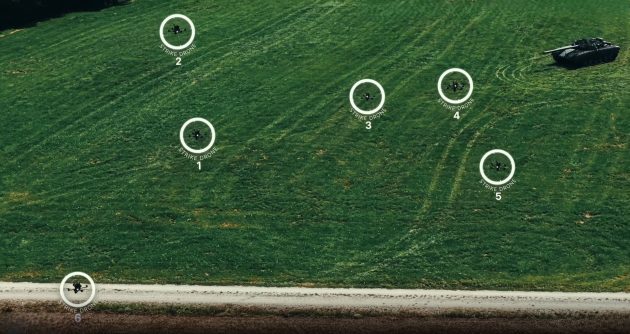
Somewhere over a test range near Munich, ten unmanned aircraft flew a pattern that looked less like a training sortie and more like a dress rehearsal for the next big war. Eight short-range first-person-view munitions and two medium-range fixed-wing drones, built by three different manufacturers, moved through a shared target deck as one coordinated strike package. No pilot juggling sticks. No frantic radio calls. Software silently pulled the strings.
Auterion says this December 11 demonstration is the world’s first hybrid swarm strike involving multiple manufacturers flying as a single combat unit. Using the company’s Nemyx swarm engine, the mixed formation carried out a complete find, fix, and finish kill chain, including vision-guided terminal attacks and synchronized effects on target in front of government observers.
Nemyx as the Brain Behind the Formation
Nemyx is Auterion’s cross-platform swarm strike engine, powered by the company’s AuterionOS autonomy stack. The system allows compatible drones to be upgraded through software and treated as nodes in a larger distributed weapon system. Auterion has already shown Nemyx in action against armored targets, using mixed formations that hit nearly simultaneously. That public work set the stage for the Munich event, which demonstrated the same coordinated logic operating across aircraft from several vendors rather than a single integrated family of systems.
During the live demonstration, FPV drones handled rapid low-altitude approaches while fixed-wing aircraft provided intelligence, surveillance, reconnaissance, and longer-range strike support. Each drone carried the same mission logic and timed its role inside the kill chain without human micromanagement, according to Auterion’s description of the test.
The Kill Chain Moves Faster Than Human Hands
Auterion argues that modern kill chains outpace manual coordination. Their approach shifts the human role toward command decisions and rules of engagement while the autonomy manages routing, timing, and deconfliction at machine speed. Nemyx feeds mission data and live video into the Android Team Awareness Kit and uses Cursor on Target messaging, tying its picture into the same digital ecosystem that many partner militaries already rely on. That gives operators situational awareness while allowing the swarm to maneuver and strike as a coherent formation.
The autonomy is not confined to the air. Auterion recently completed work on the Defense Innovation Unit’s Artemis project, delivering a long-range deep-strike drone built on the same open, modular autonomy stack. The company has also shifted its headquarters to Arlington, Virginia, and secured major investment to expand AI-enabled operations across air, land, and maritime systems.
Building Mass With Interoperable Swarms
The Munich demonstration also connects to an increasingly urgent theme in military planning: mass. Auterion’s technology is already linked to a Pentagon-backed effort to supply Ukraine with tens of thousands of AI guidance kits, converting commercial drones into coordinated strike assets at scale. For NATO planners watching Russian and Chinese production lines accelerate, the ability to build mass without reliance on a single manufacturer is strategic rather than academic.
Already have an account? Sign In
Two ways to continue to read this article.
Subscribe
$1.99
every 4 weeks
- Unlimited access to all articles
- Support independent journalism
- Ad-free reading experience
Subscribe Now
Recurring Monthly. Cancel Anytime.
Auterion promotes an open architecture that allows different nations and companies to bolt their platforms and payloads onto a shared digital backbone. The goal is simple. If forces can pool dissimilar drones into one swarm, they can scale production across industrial bases instead of relying on a single pipeline.
The Formation Is Changing
The company frames the evolution of warfare as a shift away from manned platforms with unmanned support toward unmanned formations under human command. The December 11 demonstration shows what that transition looks like in practice. A handful of operators, watching mission tiles on ATAK, directed a mixed group of expendable aircraft through a complete kill chain while autonomy managed the hard work underneath.
Today, the number is ten drones flying over a test range in Germany. Tomorrow the number grows.
The militaries that master open architectures, rapid production, and disciplined employment will not field drones as isolated tools. They will deploy them in clouds, coordinated by shared logic and built for contested airspace.
Tracking the companies that can turn these ideas into real combat power is not mere curiosity. It is preparation for the inevitable fight ahead.
—
** Editor’s Note: Thinking about subscribing to SOFREP? You can support Veteran Journalism & do it now for only $1 for your first year. Pull the trigger on this amazing offer HERE. – GDM










COMMENTS