

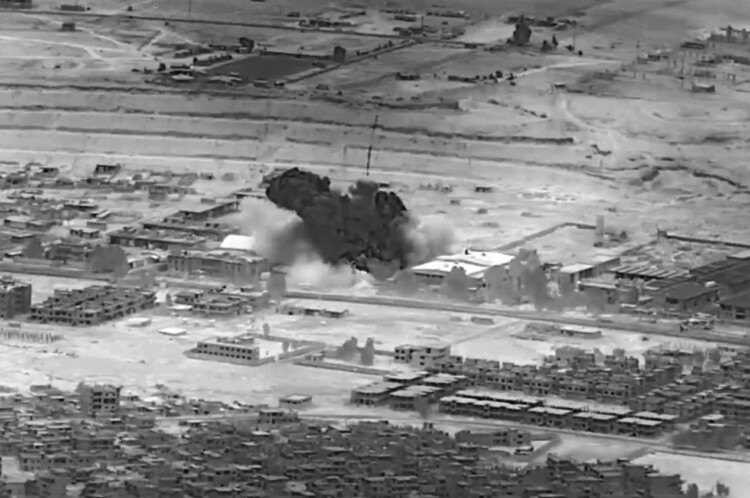
Watson emphasized, “The President places no higher priority than the protection of American personnel serving in harm’s way.” She warned, “The United States will act at a time and in a manner of our choosing should these attacks continue.”
These recent assaults on American troops are part of a set of escalating threats and actions targeting U.S. forces in the region, starting with the Hamas attack on Israel on Oct. 7, which ignited a devastating conflict in Gaza.
The perilous cycle of strikes has intensified since groups under the Islamic Resistance in Iraq and Syria, all backed by Iran, began targeting U.S. facilities on Oct. 17. This date coincides with an explosion at a Gaza hospital that claimed numerous lives. Over 100 attacks on U.S. bases in Iraq and Syria have been conducted by Iranian-backed militias since the start of the war over two months ago.
In November, American fighter jets hit a Kataib Hezbollah operations center and a command node following a ballistic missile attack on U.S. forces at the Al-Assad Air Base in western Iraq. Additionally, in October, a drone strike by Iranian-backed militias at the same base resulted in minor injuries.
Iran Backs Both Hezbollah and Houthi Terrorists
Iran, which provides financial and training support to Hamas, has also been implicated by the U.S. in attacks by Yemen’s Houthi militants on commercial and military vessels through a critical Red Sea shipping lane.
The Biden administration is striving to prevent the Israel-Hamas conflict from escalating into a broader regional crisis that could either introduce new battlefronts for Israel or directly involve the U.S. The administration’s restrained approach, not retaliating for every attack on American troops, has faced criticism from Republican factions.
The U.S. maintains thousands of troops in Iraq for training Iraqi forces and combating the remnants of the Islamic State group, with hundreds more in Syria primarily focused on the counter-IS mission. Despite numerous attacks, none have been fatal since the war commenced on Oct. 7, with the U.S. attributing these to Iran-supported groups.
Austin, in a statement, affirmed:
“While we do not seek to escalate conflict in the region, we are committed and fully prepared to take further necessary measures to protect our people and our facilities.”
These clashes put Iraqi Prime Minister Mohammed Shia al-Sudani in a precarious situation. Ascending to power in 2022 with the support of a coalition of Iranian-backed parties, some of these parties are affiliated with the militias that have been attacking U.S. bases.
The Popular Mobilization Forces, a coalition of Iranian-backed militias, played a pivotal role in countering Islamic State militants after the extremist group captured large parts of Iraq in 2014. While officially under Iraqi army command, these militias largely operate autonomously.
On Tuesday, Sudani condemned both the militia attack in Irbil and the American response. In his statement, he labeled attacks on “foreign diplomatic mission headquarters and sites hosting military advisors from friendly nations” as violations of Iraq’s sovereignty and unacceptable under any circumstances.
However, he also stated that the U.S. counterstrikes on “Iraqi military sites,” referring to the militia targets, “constitute a clear hostile act.” Sudani noted that civilians were among those injured in the strikes.
If that did indeed occur, the finger of blame points squarely back at Iran.








COMMENTS