

I thought about this for well over a year. Every now and then I jotted down an idea or two. And when it finally came time for us to dust off our notes and get serious about writing the book, the first thing I did was to spend a few weeks writing about Chief Finn, No-Last-Name.
Although he wasn’t “Finn” yet. At that point, I called him “X.” Finding his name was part of learning who he was, or at least who he seemed to be. Some writing teachers will tell you before you start actually writing your story, you need to build a complete, in-depth profile of the main characters. Good advice—but I’ve never been able to get very far in those profiles. For me, characters are never quite fleshed out, never quite fully there, until the story is well underway and I start seeing how they behave, what they do and say in the face of actual events and circumstances. I need to get the car out onto the highway, open it up, see what it can do before I start to understand what the hell it is.
Finding the right name is part of that.
True to his name, Finn is an echo of the classic American orphan/adventure hero (think Mark Twain’s Huck Finn), but there is also something dangerous about him, even lethal. (Think shark’s fin approaching you in the shallows.)
Early on we learn that he is there on “special assignment,” though he doesn’t (or can’t) say exactly what that is.
“Special assignment. An antiseptic term, crafted to cover a lot of sins. Could be as simple as briefing a high-level committee. Or as complex as extracting sensitive intelligence from deep inside hostile territory. Sometimes a special assignment concluded when two men walked into a dark alley and only Finn walked out.”
Finn is not just the hero of a mystery, he’s a mystery himself. A cipher in the middle of a riddle.
“A F***** Up Mass of Contradictions”
We first meet Finn through the helicopter pilot Monica’s eyes. Monica, who is copiloting the Knighthawk going to pick him up, has an intense dislike for SEALs. She spots him approaching in the distance, accompanied by an officer.
“Even from a hundred feet off, she had zero trouble identifying the SEAL. He was tall, muscular, powerful, carried his fully loaded backpack as if it weighed no more than a paper boarding pass. He didn’t stride so much as he loped, moving with a dangerous grace that made her think of the mountain lions she’d seen back home. Perfect specimen. Asshole.”-Steel Fear
As they get closer she spots the officer lagging a few steps behind, lugging the SEAL’s kit bag and gun case, and she can’t help reflecting on the contrast:
“This little guy was totally eclipsed by the SEAL, not just a head shorter but almost a different species: thin wiry limbs, knobby joints, oversize eyes. He looks like a marsupial, she thought. In the navy, rank was everything—who outflew, outperformed, outlasted whom—and SEALs were a breed apart. The short, awkward-looking officer might technically outrank the big guy, but the big guy outclassed him in every other way. The contrast was almost comical.”- Steel Fear
Except that when they touch down and it’s time for the SEAL to board, it’s a short, odd-looking guy, not the mountain lion, who hops on!
Monica’s assumptions have just been flipped upside-down—and so have the readers. This SEAL isn’t your typical Hollywood athletic-god military spec ops hero. In many ways, he is the opposite of what people expect.
Preternaturally observant, yet seems strangely absent any real empathy. Socially awkward (he can never seem to remember to include the “Sir” in his sentences when addressing an officer, and typically adds it as a fragmented afterthought), yet with an uncanny ability to make instant connections with nearly anyone (he calls it his HUMINT network, the military’s acronym for “human intelligence”).
He looks strange, yet blends in. Is an elite sniper, but has “a weird thing about guns.” Despises authority figures but worships his lieutenant. Loves water but hates big ships. He is, as his friend and life partner Carol tells him, “a f******-up mass of contradictions.”
His pre-navy past is a mystery. He apparently has no last name. Which is part of the puzzle of his origin. There are big chunks of his childhood he can’t remember. (Are his parents dead, or still alive? The book gives mixed messages.) There’s a dark secret back there, which has colored everything about him. Made him who and what he is.
And exactly what is that? Nobody is quite sure. In fact, even deep into the story, we’re still not sure whether he is falsely accused or even guiltier than anyone has guessed.
The idea of a serial killer on an aircraft carrier, inspired by Brandon’s mid-nineties experience on the USS Abraham Lincoln, was the engine that drove the concept of Steel Fear. But Finn was the missing piece, the X factor that, once we found him, caused the story to start sparking to life on the page.
He is, as we all are, the hero of his own story—but exactly what that story is takes some serious unraveling.
And isn’t that true for each of us?
Special Holiday Offer!
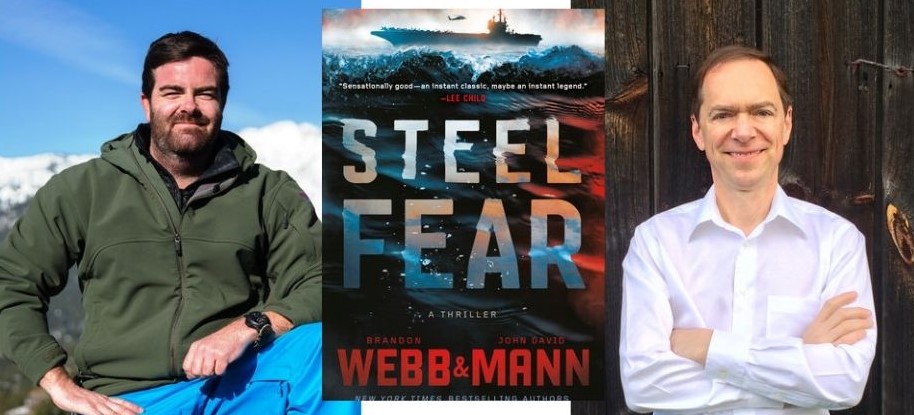
Purchase STEEL FEAR as a gift and John or Brandon will send a short personalized cameo-style video to your gift recipient if purchased before December 18th. Just send us a screenshot of your purchase on the SOFREP contact page here, include the gift recipient’s name, and a good email for us to send out your custom video.
John David Mann is the award-winning co-author of more than 30 books, including 4 New York Times bestsellers and 5 national bestsellers. His bestselling classic The Go-Giver (with Bob Burg) won the Living Now Book Award’s Evergreen Medal for its “contribution to positive global change.” Seven of his books are coauthored with SOFREP founder Brandon Webb, including their first thriller, Steel Fear, which Jack Reacher author Lee Child hailed as “an instant classic, maybe an instant legend.” You can order Steel Fear, and find links to interviews with Brandon and John, at SteelFear.com.








COMMENTS