


Once depleted, the entire container, including the barrels, is discarded.
This approach enhances loading speed, minimizes barrel wear, and maintains accuracy, enabling sustained, high-intensity operations.
To address the limitations of traditional mechanical triggers—which couldn’t meet the PLA’s requirement of 7,500 shots per second—Chinese researchers developed an electronic trigger system.
This advanced design uses coils to create a contactless trigger that generates a high-energy metal jet to ignite the bullets’ explosive charge.
The result? A firing time of just 17.5 microseconds, enabling the weapon to achieve its unprecedented firing rate.
The machine gun’s ability to fire at such high speeds makes it uniquely suited to intercepting hypersonic missiles, which travel at velocities so extreme that traditional missile defense systems often struggle to respond in time.
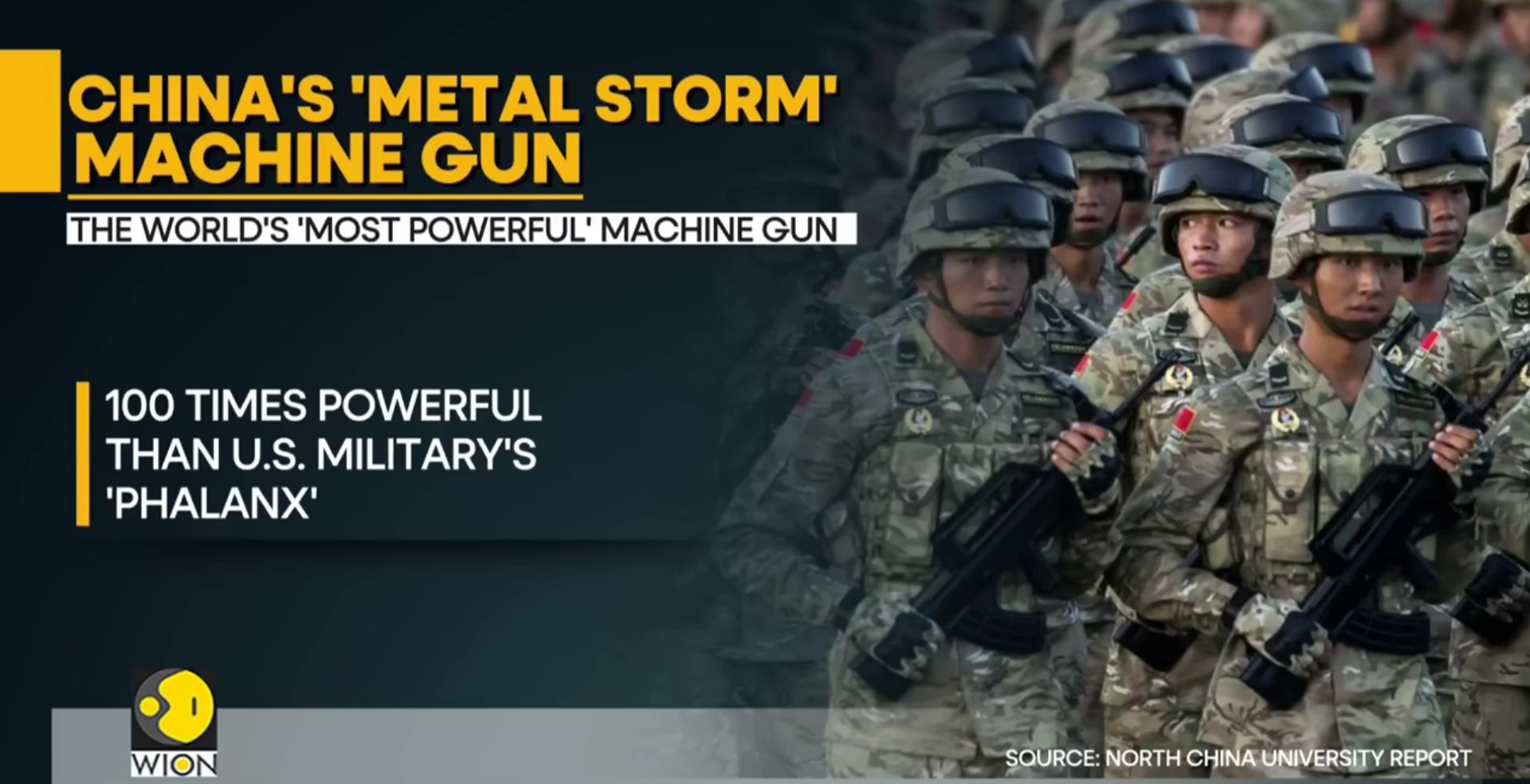
In comparison, the US military’s most advanced Phalanx close-in weapon system achieves a firing rate of just 4,500 rounds per minute—a mere fraction of China’s new machine gun.
The Hypersonic Arms Race: What This Means
Hypersonic missiles, capable of traveling at speeds over Mach 5 while maneuvering unpredictably, represent a new frontier in military technology. Their speed and agility make them difficult to detect and intercept, posing significant challenges for existing defense systems.
The ability to engage and destroy such threats is a critical component of the ongoing hypersonic arms race.
China’s unveiling of this machine gun signals its determination to maintain a strategic edge in this arena. By developing a weapon specifically designed to counter hypersonic threats, China is not only showcasing its technological prowess but also sending a message to its rivals.
The implications for the United States and other military powers are profound: this new system could potentially neutralize one of the most advanced forms of modern weaponry.
While the US has invested heavily in hypersonic missile development, its efforts in counter-hypersonic defenses lag behind.
The failure of the Metal Storm project highlights the challenges of developing such advanced systems, but China’s success suggests that these obstacles are not insurmountable.
A Double-Edged Sword?
Despite its promise, this weapon also raises significant questions.
The sheer volume of ammunition required for a weapon capable of firing millions of rounds per minute poses logistical and operational challenges.
Moreover, the disposable container system, while innovative, may limit the weapon’s sustainability in prolonged engagements.
The development of such a weapon also underscores the growing militarization of hypersonic technologies. As countries like China, the US, and Russia race to develop hypersonic weapons and defenses, the risk of an arms race spiraling out of control becomes increasingly real.
For nations seeking to maintain strategic stability, the deployment of such a machine gun could accelerate the proliferation of hypersonic capabilities, further complicating global security dynamics.
A Turning Point in Military Technology
China’s hypersonic-killing machine gun represents a significant leap forward in military technology. By addressing the challenges of hypersonic missile defense, this weapon positions China as a leader in the hypersonic arms race, potentially reshaping the global balance of power.
For the United States and its allies, it serves as a wake-up call to reinvigorate efforts in counter-hypersonic technology and to reconsider the implications of falling behind in such a critical domain.
As the world watches, this latest development in weapons technology reminds us that the future of warfare is being defined not just by who can build the fastest missiles, but by who can stop them.
With its claimed hypersonic-killing machine gun, China has taken a bold step in that direction—leaving its rivals to wonder how they will respond.








COMMENTS