Dr. Riyad Mansour, the Permanent Observer of Palestine, a role that’s easier to think of as the Palestinian Ambassador to the United Nations, shouldn’t have any trouble getting straight to the point. Having spent much of his youth in Ohio and racking up degrees from Youngstown State University, the University of Akron, as well as serving as an adjunct professor at the University of Central Florida in 2002, the man seems tailor-made for diplomacy. But when pressed on the one question everyone’s asking, his answer was about as clear as mud.
The question posed to him by the BBC was simple enough:
“The Israeli prime minister has said Israeli troops will stay in Gaza until Hamas disarms. Do you see that happening?”Sugg
It’s a direct question, one that goes to the heart of whether peace in the region is even possible. Yet Mansour’s response wandered everywhere but toward an answer.
To be fair, disarmament isn’t exactly Palestine’s top priority right now. The humanitarian crisis in Gaza is staggering, and any reasonable person would expect aid to be front and center. Mansour did just that, naming getting food, water, and medicine into Gaza as his number one concern. Hard to argue with that. When children are starving and hospitals are running on fumes, guns aren’t at the top of the list.
His second priority also made sense: the exchange of detainees and hostages. That’s another essential step toward building trust on both sides, and it’s something families, Israeli and Palestinian alike, are desperately hoping for.
But then came number three, and that’s where things got murky.
Instead of addressing the elephant in the room… Hamas and its weapons, Mansour pivoted. He spoke about the need for Palestinian detainees’ stories to be heard, for Israeli troops to withdraw completely, and for Gaza to be reconstructed. All valid points, but none of them answered the question. The one thing this peace plan hinges on – the disarmament of Hamas.
Then Mansour seemed to crumple up President Trump’s 20-point peace plan and toss it aside with this line:
“We will then need to be ready to move into the following stages with all of their complexities and lack of clarity, and try to navigate through them in a comprehensive way. Not only thinking of one side, but thinking of both sides.”
That’s diplomatic speak for, “We’ll cross that bridge if we ever get to it.”
Already have an account? Sign In
Two ways to continue to read this article.
Subscribe
$1.99
every 4 weeks
- Unlimited access to all articles
- Support independent journalism
- Ad-free reading experience
Subscribe Now
Recurring Monthly. Cancel Anytime.
The BBC reporter wasn’t satisfied and pressed again, asking whether Hamas would try to cling to its weapons or its grip on power in Gaza. Mansour’s response?
“We are clinging onto our national rights, the end of occupation, the independence of the State of Palestine.”
In other words: still no answer.
So the question remains: is disarmament even on the Palestinian to-do list?
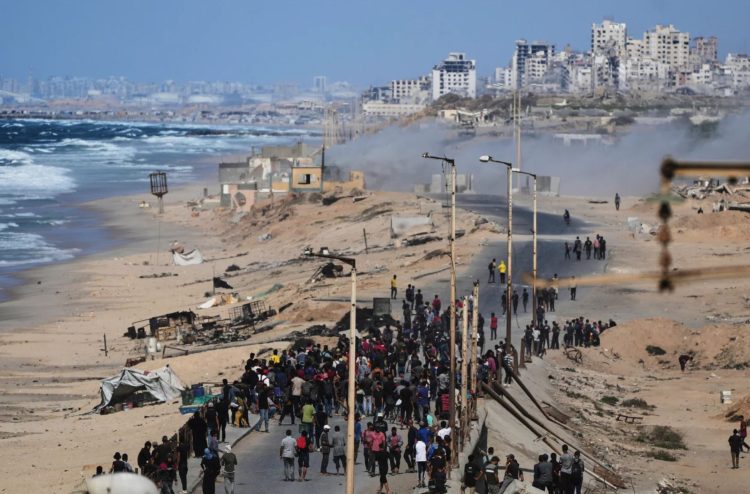
On the ground, reality is moving faster than diplomacy. Tens of thousands are making their way, many on foot, more than 20 kilometers north to reoccupy Gaza City. These aren’t soldiers. They’re families hauling what’s left of their lives in plastic bags and battered carts. Israel is watching carefully, waiting to see if Hamas will honor or even acknowledge President Trump’s plan.
Meanwhile, 170,000 metric tons of humanitarian aid are staged and ready to move into Gaza. Food, water, medicine, shelter materials, all of it hangs in limbo. Every hour of delay means more suffering for civilians caught between Hamas’ ambitions and Israel’s patience.
The uneasy ceasefire that’s currently in place is being held together by little more than exhaustion and international pressure. Both sides are battered. Both sides are wary. And both seem to be holding their breath, waiting for the other to make the first mistake.
If Hamas refuses to disarm, it risks turning Gaza into a perpetual warzone, a place rebuilt only to be leveled again. But if it complies, it risks losing the last shreds of control it has. That’s the trap, and everyone knows it.
For now, the ceasefire holds. Aid convoys are preparing to roll. Families are trying to rebuild. And diplomats like Dr. Mansour are still talking around the hardest questions instead of through them.
Peace, as always in this part of the world, remains clear as mud.










COMMENTS