

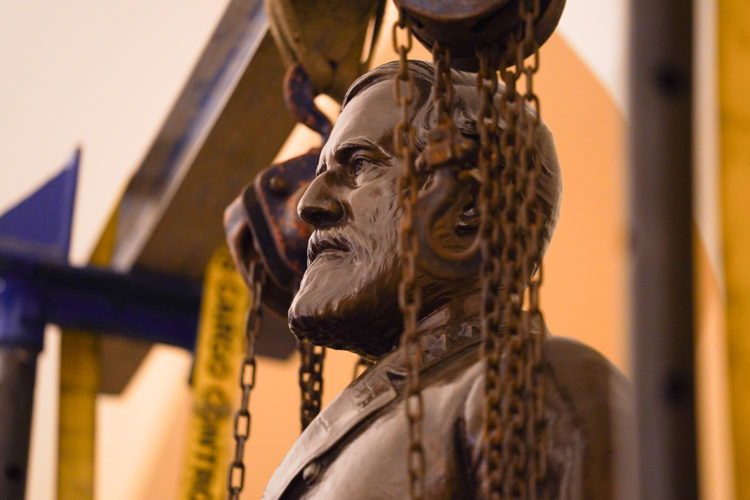
There is an awkward little presupposition that many proponents of removing the monuments bake into the foundation of their argument. The logic goes like this: If person X is offended, hurt, marginalized, discriminated against, etc. by the existence of a statue, it must hold that person Y is inspired, emboldened, buoyed, and made more powerful by it. In plain terms, if a person is made to feel marginalized by the presence of a statue of a Confederate general who “fought for slavery,” then there must be someone for whom the statue is a symbol of strength and power. Interestingly, as our country ages, less and less of our history makes it into the collective mind.
Wikipedia to the Rescue
Take Fort Bragg. Of the tens of thousands of soldiers serving at Fort Bragg, not to mention the hundreds of thousands of service members who have trained and lived there, what percentage actually knows that the base is named for General Braxton Bragg? Likewise, how many Americans recall that General Bragg was a West Point graduate who served in the U.S. Army long before the Civil War? The point is that in some cases, a statue or a name is just that, and if not for Wikipedia we’d probably not even know the difference. (Didn’t we learn this from watching Forrest Gump?)
The lack of education about these sites is not an argument to protect them. But by the same logic, the presence of these monuments is not a threat to our modern American culture. It’s the balance and tension between these opposing views that gives our nation its identity. Homogeny is not the answer, nor is painting over our history with a wide political brush. Our strength as a nation comes from the commingling of our disparate beliefs into one complex, nuanced whole.
Razing anything from our collective past should be a choice that is labored over, debated, and studied. It should neither be a knee-jerk response to a trend nor a social Golem intent on mass destruction.
The removal of these statues and the renaming of military installations won’t heal the hundreds of years of racial inequality in this country, nor will it bring closure or relief to those suffering from bigotry, discrimination, and hate. As long as they stand we have a reason to talk about our past — both good and bad — and engage with one another about how we want to shape our future.
We Should Remove the Confederate Monuments and Change the Names of the Bases
In considering these monuments and base names some historical context is needed. These monuments did not spring up in the South immediately following the Civil War.
Just a Lost Cause?
In the 1880s, some 15 years after the South’s defeat something called the “Lost Cause” theory emerged. It sought to portray the southern states as nobly resisting the federal government’s attempt to overthrow states’ rights as if something like human slavery could be the prerogative of a state legislature. The theory came in part because of public accusations in the South at the time that Confederate armies were badly led by their generals and politicians. It was the generals and politicians, with the aid of academia in Southern colleges and universities, that sought to rewrite that history. The basic idea of the Lost Cause was that slavery was a benign institution that benefited the slave; that Southern states had a right to secede and be independent; and that the war was lost because of the overwhelming economic and manpower resources of the North.
Civic organizations like the Daughters of the Confederacy and the United Confederate Veterans then sprang up, promoted this ideology, and sought to memorialize both the leaders of the South and the common soldier. They raised money to create the monuments and petitioned local governments for public land to situate them in courthouses, parks, and state capitol buildings. The Lost Cause theory that animated this effort has all but rewritten Civil War history. It has made its way into history books, school textbooks, and popular culture.
What the Lost Cause actually represents is a certain form of denial. The denial of defeated rebels who used the theory to simultaneously forgive and excuse themselves for the crime of treason against the Constitution and for keeping other human beings in a state of abject slavery. They dishonestly recast themselves and their military heroes as patriots who defended freedom and should be remembered alongside the Founders who fought to free us from the English Crown in a similar light. It ought to be remembered here that the Southern states did not leave the Union by the same deliberative process that admitted them as states. And when they did secede they did not affirm the U.S. Constitution in their new forms of government. Rather, they completely abandoned it to specifically enshrine slavery, something the original Constitution did not do by any means.
A Base is a Base is a Base
Regarding military bases, the U.S. military was seeking to build permanent training bases in the South in the run-up to WWI and then again in WWII. Wanting to recruit (or draft) enlistees in the South, the federal government believed these men would be more willing to serve if the bases were named after generals southerners regarded as heroes rather than Union generals like Grant, McClellan, or Sheridan. The U.S. Armed forces were not integrated at that point so little regard was given to how black recruits would feel about training at Ft. Bragg whose namesake fought to preserve slavery. This move by the U.S. government gives some indication of how pervasive the Lost Cause ideology was in the South. The theory persevered into the 20th century as well. The movie Gone with the Wind, adapted in 1936 from a novel by Margaret Michell, is the definitive Lost Cause movie in American history.
The best arguments for removing these monuments and renaming these bases are thus found in the reasons they were erected and so named in the first place.
First, Americans no longer see themselves as Virginians or Floridians before they see themselves as Americans as they once did in the 1860s. We are no longer a collection of unique state cultures and peoples, but rather a more homogeneous country. The Interstate highway system built in the 1950s gave Americans great freedom of movement to the point where states no longer have mainly homogenous, native-born populations. Americans move from state to state a lot. An American contemplating a move from South Carolina to Oregon gives little thought to being seen as an outsider who will be rejected or reviled by native-born Oregonians.
There really isn’t any fear that Army recruits in Georgia would refuse to go to a military base that isn’t named for a Confederate General. One would hope the Army would not tempt the fates by renaming Ft. Benning after General Sherman who burned Atlanta to the ashes. No need to rub in Georgia’s face.
These statues and monuments were erected originally as symbols of resistance to the policies of the Reconstruction Era and national reconciliation. And both of these times are long past in our history.
Choosing History, Not Erasing It
This is not to say that monuments to Confederate war dead and generals ought to be erased from our history altogether. It is history that informs us of the present and gives us warnings about the future. A monument to General Lee in a Confederate cemetery or as part of a battlefield monument ought not to be seen as an affront to anyone. Just as similar monuments to Union generals would not. But the locations of these statues sends a message that is intentional.
The other statue Virginia sent for display to the Capitol was of George Washington, victorious general of the Continental Army and first president of the United States. While it was true that Washington the Virginia planter was a slaveholder, it is also true that slavery was not an American invention. It was an institution we inherited from the British after the revolution and it had been in place for nearly two centuries. Unlike Confederate generals like Lee, Forrest, Bragg, or Benning whose claim to fame was fighting to support a Confederacy that seceded to preserve slavery as an institution and in doing so wrecked the United States, Washington fought to free all Americans from the crown’s tyranny, even though that freedom would be unequally felt by our People. Most of all, Washington was the Father of our Country, and rightly so. At the end of the Revolution, he stood as the most powerful man on the American continent. And he stood at the head of an army. Had he been inclined to follow the practice of the time he lived in, he could have proclaimed America a monarchy and himself King George I.
He was popular enough among the American people to have done so. Instead, he went to Annapolis where the Congress of the Confederation (of states) was meeting. He handed them his resignation and returned to his farm and private life. There is no need to defend Washington’s ownership of slaves by pointing to their generally good treatment or the fact that he freed them in his will. The contributions of Washington in actually creating our country far exceed his moral sin of owning slaves. Monuments to Washington were never erected to commemorate his slave ownership; they were erected because he freed our country as a whole. This is in contrast to Confederate generals who not only owned slaves but tried to dissolve the country treasonously. There is a big difference there.
Washington’s statue being the statuary hall of Congress is entirely appropriate to history and his place in it. The same cannot be said of General Lee, who may have been a great man in a certain archaic way of thinking in Virginia, but he was not a great American when it came to serving his country, the United States.
These base names ought to be changed along similar lines of thought. The U.S. military is fully integrated now. No black servicemember should have to pass under the arches of an Army post named after a general that would have opposed that servicemember’s freedom. And there is no need to fear that recruits from southern states would refuse to serve at a base named for Patton, Eisenhower, Abrams, or Schwarzkopf.
The culture and national circumstance that originally required the bases to be named as such no longer exist. If Ft. Hood has a different name, it will still be an Army fort doing the same training and housing the same troops that it did before.
This article was written by Sean Spoonts and J. W. Sotak.








COMMENTS