

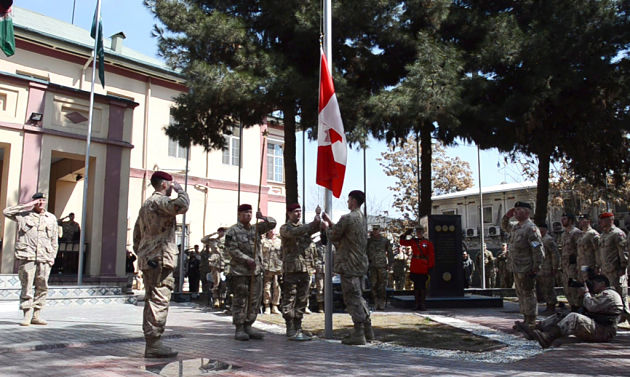
Our troops from the Provincial Reconstruction Teams (PRT), for the most part, worked very hard at improving Afghan living conditions by digging more wells, building schools for the future generation of Afghans and improving the transportation system by building new roads and speed bumps in crowded areas such as bazaars and around mosques. They were also patrolling the city of Kandahar and having contacts with the population almost every day. Their actions really brought the Afghan population’s opinion, especially in Kandahar city, about Canada to a level beyond imagination. Camp Nathan Smith, home of the PRT, was almost never attacked, a great sign of their reputation.
While the PRT was busy working on improving Afghan’s condition, the Operational Mentoring and Liaison Team (OMLT), with whom I deployed back in 2009, was busy conducting what I like to call “firefight mentoring.” The Canadian OMLT teams were on the frontline embedded with the Afghan National Army (ANA) in teams between four to eight soldiers. It was their role to coordinate assets between the ISAF troops and their ANA counterparts, and closely supervise them in their decision-making skills, both under fire and back in our strongpoints (which are the equivalent of combat outpost (COP)). We had a very good reputation within the ANA as we were always eager to go in and fight alongside them.
Although there was A LOT of corruption at every level of leadership in the ANA, the frontline Kandaks (equivalent of a battalion) were well-disciplined and had almost everything they needed.
As for my own opinion of the ANA, I ate with them almost every day, shared stories from back home while they would do the same, show pictures of our families, etc. They were, before being Muslims or even foreign soldiers to us, human beings, and very nice with us. Up until today, I still have a few of them on my Facebook page and keep in touch when they can. Anyone who has been in situations like that knows exactly what I am talking about here, as we became brothers-in-arms. Every time we had an ANA killed in action (KIA), we grieved with them and swore to seek revenge.
And then came the battle groups (BG). Canadian infantry companies, supported by the artillery and armor, who all did an AMAZING job, were the backbone of all combat operations in Kandahar. They would drive in LAV-3s, fly in with Chinooks or even conduct foot patrols to seek the enemy and kill it. Those guys (and I include the girls who were part of these BGs in that, too) would not leave the Taliban alone. They were out doing combat operations every week and sustained a fair amount of casualties.
A good example of their excellent combat skills and their will to push the Taliban out of Afghanistan was Operation Medusa. Many other operations the BGs have done were successful.
This article couldn’t be complete if I didn’t write about Canada’s elite. CANSOFCOM’s operators were the very first Canadians who set foot in Afghanistan. JTF-2 soldiers were the only foreign unit accepted to join Tier 1 special operations units, such as the D-boys and DEVGRU in Task Force 11, whose job was to hunt HVTs and conduct Sensitive Site Exploitation early in the war.
The exceptional work they’ve done in Afghanistan, alongside America’s elite Special Operation Forces, was recognized by the Americans when they were awarded the Presidential Unit Citation.
The Canadian Government, with CANSOFCOM help, keeps their doing really secret. I have the utmost respect for that as it protects the operators’ families, themselves, their training methods and, most importantly, their ways to complete the mission.
But did we leave Afghanistan when they needed us the most, I believe so. The Presidential election is just around the corner and the pro-Taliban movement is on the rise, again…
The Afghan National Security Forces (ANSF), who grew up very rapidly, are not ready to operate on their own. Most of the combat units are not able to sustain combat operations for a long period of time, as they both lack the resources to do so and the assets NATO provided them.
I am not even touching on the governmental side, as I could write a 50 page essay on their corruption and their inability to run a government who would support its population.
My big concern is that the Afghan war could easily become Canada’s next “forgotten” war, like Korea in the 50s. It is, and I really put a lot of emphasis on that, our job as combat veterans to keep the history alive and to make sure our future generations know about the sacrifice many soldiers, from every country who were in Afghanistan, did for their flag and the Afghan population.
http://www.youtube.com/watch?v=vnwp-U8jehw
(Featured Image Courtesy: GlobalNews.ca)








COMMENTS