

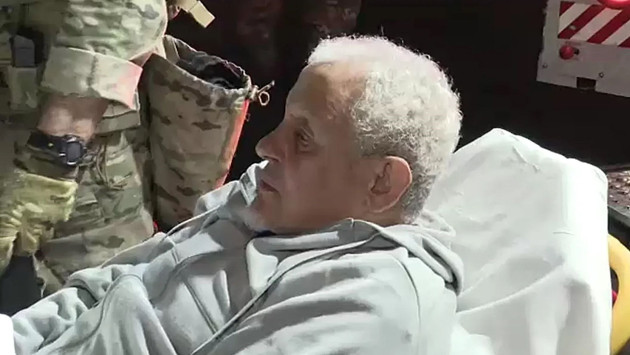
The Benghazi attack itself strained U.S. political fault lines, prompting years of congressional investigations into security decisions, diplomatic presence abroad, and interagency coordination, but the legal thread has been its steady, if slow, pursuit of individuals allegedly responsible.
As al-Bakoush awaits initial court proceedings in Washington, the case underscores a basic principle of U.S. criminal jurisprudence: even the most distant crimes against Americans can eventually be met with justice.
FRIDAY PRAYERS TURN DEADLY: DOZENS KILLED IN ISLAMABAD MOSQUE ATTACK
For Muslims, Friday prayers are meant to be a pause in the week, a moment of order and reflection. In Islamabad, they became a killing ground.
A suicide bomber struck a Shiite mosque on the outskirts of Pakistan’s capital on Friday, detonating explosives among worshippers gathered for midday prayers and killing at least 31 people, with well over 150 others wounded, according to Pakistani officials. The attack unfolded at the Khadija Tul Kubra Imambargah in the Tarlai Kalan area, a residential district that had not seen violence on this scale in years.
Authorities say the attacker was intercepted at the mosque’s entrance by security guards. He opened fire briefly, then detonated his explosive vest as worshippers crowded the gate and interior courtyard. The blast tore through the congregation with devastating effect. Bodies and debris were thrown across the prayer hall, and survivors clawed their way through smoke and dust to escape.
Ambulances, private cars, and even motorcycles ferried the wounded to hospitals across Islamabad. Doctors described scenes of mass trauma, with victims suffering blast injuries, shrapnel wounds, and severe burns. Officials confirmed that children were among the dead and injured, a detail that deepened the national shock.
🚨 BREAKING
The suicide bomber behind today’s Islamabad mosque attack was a Pakistani national, reportedly from Peshawar, Khyber Pakhtunkhwa, and is believed to have links to ISIS-K. pic.twitter.com/oeje8vGyTc
— Afghanistan Times – Commentary (@TimesAFg1) February 6, 2026
No group has claimed responsibility for the attack. Pakistani investigators say it is too early to assign blame, though the method and target fit a grim pattern of sectarian violence that has plagued the country for decades. Shiite communities in Pakistan have long been targeted by extremist groups, and mosques during Friday prayers remain among the most vulnerable civilian spaces.
Government leaders condemned the bombing in strong terms. Prime Minister Shehbaz Sharif and President Asif Ali Zardari called it a cowardly act of terrorism and vowed that those responsible would be hunted down. Security was tightened at religious sites nationwide within hours, an acknowledgment that the threat may not be isolated.
Islamabad has largely been spared the worst of Pakistan’s militant violence in recent years, which has been concentrated in provinces like Khyber Pakhtunkhwa and Balochistan. That relative calm made Friday’s attack all the more jarring. It also underscored a hard reality: geography alone does not confer immunity from extremism.
For the families burying their dead and the survivors filling hospital wards, the broader political and security debates matter little right now. What remains is the raw cost of a single attacker turning a place of worship into a mass grave, and a familiar question that Pakistan has been asking for far too long: how many more prayers will be answered with blood.
TRUMP, OBAMAS AND THE ‘APE’ CONTROVERSY: RACISM ALLEGATIONS ROIL POLITICS
In a late-night post on Thursday on his Truth Social account, President Trump shared a video that ignited a fierce political firestorm and accusations of racism, after a brief segment in the clip depicted former President Barack Obama and former First Lady Michelle Obama as apes. The imagery, even though it lasts only a second or two at the end of a roughly one-minute video, drew immediate backlash from lawmakers, civil rights groups, and commentators across the political spectrum.
The video posted on Trump’s account, on its face, promotes conspiracy theories about the 2020 presidential election, including, at the very end, a brief scene in which Obama and Michelle Obama’s faces are superimposed on primates, accompanied by the tune “The Lion Sleeps Tonight.” The clip appears to be AI-generated and was taken from a longer meme video previously circulated online that cast Trump as a lion and a wide array of Democratic figures as various jungle animals.
It’s there. You have to watch the video until almost the end and there is a quick, intentionally embedded clip, of the Obamas depicted as apes. pic.twitter.com/OYjTUrJwWb
— prof. (@prof_sai) February 6, 2026
Critics were swift and broad in their condemnation. Republican Senator Tim Scott called the imagery “the most racist thing I’ve seen out of this White House,” urging that the video be removed immediately and an apology issued. California Governor Gavin Newsom described the act as “disgusting behavior by the president,” adding that “every single Republican must denounce this.” Other Republican and Democratic lawmakers also denounced the post as offensive and inappropriate.
The White House initially defended the post through Press Secretary Karoline Leavitt, calling the backlash “fake outrage” and framing the video as a whimsical internet meme in which Trump is portrayed as “King of the Jungle” and Democrats as characters from The Lion King. However, facing escalating criticism, including from some members of his own party, the video was ultimately deleted from Trump’s Truth Social page.
A White House official later told reporters that a staffer had “erroneously” posted the video.
The controversy comes during Black History Month, heightening sensitivity to racial representation and historical context. Depicting African Americans as apes or primates has long been understood as a deeply offensive and historically racist trope used to dehumanize Black people.
That historical resonance fueled much of the public uproar.
Trump did not personally comment on the criticism, and representatives for the Obamas have not issued a response. But the episode has already sparked intense debate over the boundaries of political expression, the responsibilities of public office holders on social media, and the role of AI-generated content in political discourse.








COMMENTS