Gunfire at the Rink: Rhode Island Hockey Game Turns Deadly
A weekday youth hockey game in Pawtucket, Rhode Island, ended in gunfire Monday afternoon, leaving two people dead, several wounded, and a shaken community trying to understand how such violence walked through the doors of a neighborhood rink.
Police say the shooting unfolded Feb. 16 inside the Dennis M. Lynch Arena during a high school game. By the time it ended, two victims were dead, and three others were hospitalized with serious injuries. The gunman also died at the scene from what authorities describe as a self-inflicted gunshot wound.
Investigators have identified the suspect as Robert K. Dorgan (AKA Roberta Esposito), a Bath Iron Works employee from Maine. Early findings indicate the attack was targeted and rooted in a family dispute. Several victims were connected to the shooter, including family members. The dead were identified as Dorgan’s son and ex-wife. Officials say there is no indication of an ongoing public threat.
Witness accounts describe a sudden burst of gunfire echoing across the ice as players, parents, and spectators scrambled for exits or barricaded themselves in locker rooms. A livestream of the game briefly captured the chaos before being taken down. Nearly 100 witnesses have already been interviewed as authorities piece together the timeline.
Police credit a civilian bystander with helping stop the attack quickly. That intervention, according to investigators, likely prevented additional casualties. It is a reminder that in close-quarters violence, seconds matter, and individual action can change outcomes.
The shooter’s employment at Bath Iron Works, a major Navy shipbuilder tied to U.S. defense programs, has drawn attention but does not appear connected to motive. Still, it underscores a hard truth familiar to anyone who has served or worked around the defense world. The line between professional life and personal collapse can be thin, and when it breaks, it breaks fast.
For Rhode Island, a small state where high school sports still anchor community life, the shock is deep. Local officials have suspended games and activated counseling services for students and families. The arena itself remains closed as investigators continue their work.
There is no broader geopolitical angle here, no strategic chessboard to analyze. Just a targeted act of violence that unfolded in a place where parents expected a routine afternoon, and teenagers expected to play hockey.
Madness can rear its ugly head anywhere.
Iran on the Clock: Pentagon Builds Options as Washington Tests Diplomacy
The Pentagon is doing what it always does when tensions rise with Tehran: building military options while the White House tests whether diplomacy still has room to work.
Start with what has already happened. In June 2025, U.S. forces struck key Iranian nuclear facilities in an operation later identified as Operation Midnight Hammer, using long-range bombers and cruise missiles in coordination with Israeli strikes. Iran responded days later by firing missiles at Al Udeid Air Base in Qatar, a major U.S. installation. U.S. officials said there were no American casualties, and President Donald Trump described the response as limited while urging both sides to avoid escalation.
Already have an account? Sign In
Two ways to continue to read this article.
Subscribe
$1.99
every 4 weeks
- Unlimited access to all articles
- Support independent journalism
- Ad-free reading experience
Subscribe Now
Recurring Monthly. Cancel Anytime.
Since then, Washington has kept pressure on Tehran through a mix of warnings and military posture. On Jan. 28, Trump said Iran must quickly agree to a nuclear deal or face stronger action. “Time is running out,” he wrote, adding that any future strike would be “far worse.” In mid-February, speaking about renewed talks in Geneva, the president said he would be involved “indirectly” and warned again that Iran would face consequences if negotiations fail.
Secretary of War Pete Hegseth has echoed that message in more direct terms. During a Jan. 29 Cabinet meeting, he said the Pentagon is ready to carry out whatever course the president orders regarding Iran’s nuclear ambitions. “They should not pursue nuclear capabilities,” Hegseth said. “We will be prepared to deliver whatever this president expects.”
Military movements back up the rhetoric. The United States has increased its regional readiness posture, maintaining significant naval and air power within range of Iran and reinforcing defenses at bases across the Middle East. Officials have framed those steps as both deterrence and preparation, signaling that Washington intends to keep multiple options available.
Reuters has reported that Pentagon planners are reviewing potential scenarios that could involve sustained operations if diplomacy collapses, with U.S. officials expecting Iran would respond against American positions in the region. No decision to launch such operations has been announced, and administration officials continue to emphasize that negotiations remain the preferred path.
For now, the message from Washington is straightforward. Talks are underway. Pressure remains in place. And the Pentagon is ensuring that if diplomacy fails, the United States will not be starting from scratch.
Missiles in the Islands: U.S. Expands Firepower in the Philippines
The United States is moving to expand deployments of advanced missile and unmanned systems in the Philippines, tightening the alliance’s grip on key maritime terrain and putting more pressure on China’s military planning in the western Pacific.
The plan emerged from recent U.S.–Philippine strategic talks in Manila, where both governments agreed to “continue and work to increase deployments of U.S. cutting-edge missile and unmanned systems to the Philippines.” The joint language also condemned what officials described as China’s “illegal, coercive, aggressive, and deceptive” behavior in the South China Sea. Associated Press reporting notes that some of these systems are already positioned in northern Luzon and the Batanes island chain, terrain that sits near the Bashi Channel, a vital passage between the Philippines and Taiwan.
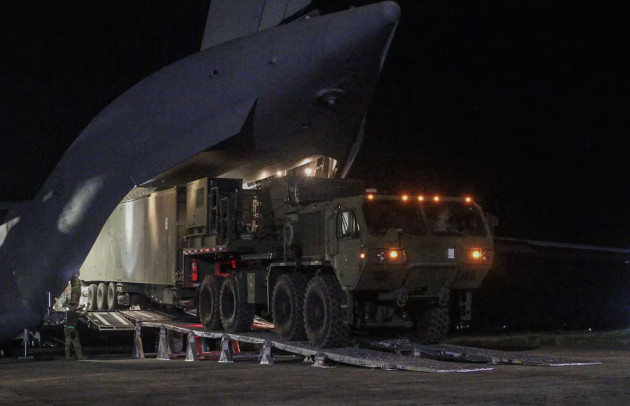
This buildout is not starting from scratch. The U.S. Army’s Typhon mid-range missile system was first brought into the Philippines for exercises and has remained in country since then, despite repeated objections from Beijing. Typhon can fire Tomahawk cruise missiles and SM-6 missiles, giving U.S. forces the ability to hold ships and land targets at significant range. Its presence alone complicates Chinese naval movement in the region.
The Marine Corps has also deployed the NMESIS (Navy-Marine Expeditionary Ship Interdiction System) during major exercises in the Philippines, demonstrating an expeditionary anti-ship capability designed to operate from dispersed island positions. That system is part of a broader U.S. shift toward mobile, hard-to-target firepower across the first island chain.
China has warned that expanded missile deployments destabilize the region and are aimed at containing its rise. Philippine leaders under President Ferdinand Marcos Jr. have rejected calls to remove the systems, arguing that they support national defense and treaty obligations with Washington.
The geography explains the urgency. The Bashi Channel and surrounding waters have become central to U.S. planning for any future crisis involving Taiwan or contested sea lanes in the South China Sea. Reuters reporting has described the area as a choke point where forward-positioned missiles and sensors could complicate Chinese naval access to the wider Pacific.
For now, Washington and Manila are framing the deployments as deterrence, not escalation. But the signal is unmistakable. The United States is placing more capability closer to the region’s friction points, and doing so with a treaty ally that appears increasingly willing to host it.










COMMENTS