

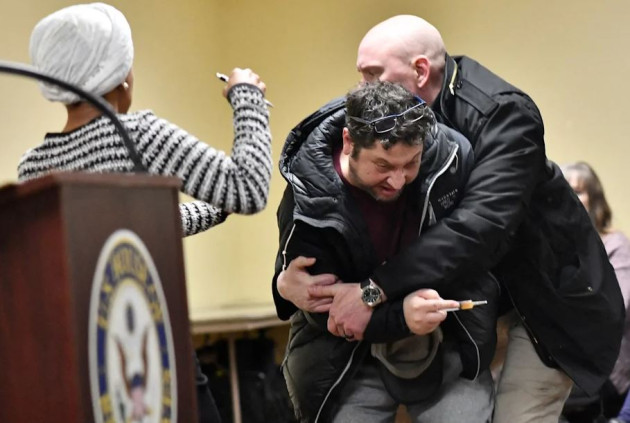
Ilhan Omar Assaulted During Minneapolis Town Hall, Suspect in Custody
A Minneapolis community town hall Tuesday night took a sharp turn when a man rushed the stage and sprayed an unknown liquid toward Omar during her remarks. The incident unfolded at the Park Avenue United Methodist Church, where the congresswoman was addressing constituents on immigration and public safety. Video from the scene shows the attacker emerging from the audience, raising a syringe-like device, and discharging the substance in Omar’s direction before security closed the distance.
The liquid did not appear to cause serious injury, and Omar was not physically harmed. Within seconds, plainclothes officers and event security tackled the suspect and restrained him on the floor as shocked attendees looked on. The man was arrested at the scene and later identified by Minneapolis police as a 55-year-old local resident. Authorities confirmed he was booked on suspicion of third-degree assault. As of this writing, investigators have not publicly identified the substance involved and say testing is ongoing.
What stood out was not just the speed of the response, but Omar’s decision to remain at the podium. After a brief pause, she resumed speaking, telling the audience that intimidation would not dictate how or where she engages with the public. The event continued under heightened security, a detail that underscores how normalized threat mitigation has become for elected officials.
Ilhan Omar was just attacked during a town hall tonight. There is an epidemic of violence in this state, and it’s aimed in exactly one direction. pic.twitter.com/Ipr9UnkihZ
— your old pal donavon (@hellodonavon) January 28, 2026
This was not Omar’s first brush with hostility. Since entering Congress in 2019 as one of the first Muslim women elected to the House, she has faced repeated threats tied to her politics, her background, and her visibility. Law enforcement agencies have acknowledged that members of Congress now operate under a very different risk environment than even a decade ago, especially during in-person events.
Reaction from Washington came quickly. Lawmakers across party lines condemned the attack and emphasized that political disagreement does not justify physical assault. Capitol Police confirmed they were coordinating with local authorities as part of a routine security review following the incident.
Rubio Warns Senators Venezuela’s Transition Will Be Long and Unstable
The Senate Foreign Relations Committee convened today with Secretary of State Marco Rubio at the center, and the message was unmistakable: stabilizing Venezuela is going to be hard, messy, and slow. There are no shortcuts, no clean transitions, and no instant democracy waiting behind the velvet curtain. Rubio made it clear to senators that the United States is now operating in a country with actors that do not meet our ideal standards, but for the moment, the U.S. has to work with the people in place to maintain stability and prevent further collapse.
Rubio framed the U.S. approach as targeted and limited: there is no war, no intention to occupy, and no plan to govern Venezuela. But “limited” does not mean simple. Senators pressed him on timelines for elections, measures of success, and the U.S.’s willingness to continue pressure if cooperation falters. Rubio was blunt: this is not something you can fast-track. These are deep, systemic problems, decades in the making, and they will take sustained effort to address.
“This is the first time in over a decade that we see even the glimmer of an opportunity to change conditions. A lot of that will depend on us but a lot of that will depend on them, and it also will depend on the rest of Venezuelan society … We have to be much further along in… pic.twitter.com/DLttJG9I8D
— Department of State (@StateDept) January 28, 2026
A key tension emerged around U.S. naval operations and economic stabilization efforts. Lawmakers questioned no-bid contracts in the oil sector and the cost of ongoing operations, while Rubio defended these moves as temporary measures designed to prevent collapse and ensure that essential services continue. He described the naval posture as a quarantine to enforce sanctions, not an escalation, and emphasized that the U.S. is prepared to apply pressure as necessary without overextending militarily.
The hearing underscored a broader reality: there is no neat path from Maduro to democracy. Even after Maduro’s removal, the country is still fragile, its institutions weakened, and its population facing severe economic and humanitarian challenges. Rubio’s testimony reflected an understanding that Washington is managing a transitional period with imperfect tools and imperfect partners, where patience and strategy are the only constants.
When the gavel fell, the takeaway was clear: Venezuela’s road to stability will be long, full of setbacks, and defined more by persistence than by flash. Rubio left senators with a sober warning: anyone expecting a quick victory is in for a disappointment.
Starmer Lands in Beijing: High-Stakes UK-China Diplomacy Begins
Britain’s Prime Minister Keir Starmer just landed in Beijing with a convoy of sixty delegates: business leaders, scientists, and cultural figures. This marks the first time a UK leader has made the trip in eight years, and this isn’t some ceremonial grip-and-grin tour.
This is London placing a hard bet on Chinese markets while the rest of the West is still trying to figure out if engagement means compromise or just good business. Starmer’s walking a tightrope between filling British bank accounts and keeping MI6 from having a full-blown panic attack, and he’s doing it at a moment when the global order is one bad headline away from coming completely unglued.
The UK and China have a long, complicated history. China is the UK’s third-largest trading partner, and strengthening economic links has been a top priority for ministers. Starmer is pushing for renewed cooperation in sectors ranging from finance to life sciences and the creative industries, while making clear that economic opportunity will not come at the expense of national security. British intelligence officials have repeatedly warned about espionage and influence risks, and Downing Street says engagement will be pragmatic but “clear-eyed.”
🇬🇧🇨🇳 British PM Keir Starmer arrived in Beijing seemingly nervous. He’s in China to defy Trump’s warning to Europe. pic.twitter.com/DiWglVc8bA
— Spetsnaℤ 007 🇷🇺 (@Alex_Oloyede2) January 28, 2026
The timing of the trip is strategic. Relations with China have been strained across Europe and the West, and Starmer’s visit is designed to ensure Britain is not left on the sidelines while other major powers continue high-level engagement in Beijing. While human rights issues remain in the background, Starmer is focused on practical, measurable cooperation, from trade deals to joint scientific research. The visit is also a signal to global investors: the UK is open for business, even in complex geopolitical conditions.
What makes this visit significant is not just the optics. It is a strategic effort to secure Britain’s interests while managing risk, ensuring that diplomacy and trade can continue without ignoring security concerns. Starmer’s approach is pragmatic: balance engagement with vigilance, and avoid letting decades of mistrust harden into isolation. In short, this is Britain staking its claim as a serious player in Asia’s shifting balance of power, without illusions of control or speed.
In Beijing, the cameras may catch smiles and handshakes, but the real story is in the subtle signals: Starmer is working to carve space for Britain in a world where economic opportunity, security, and strategic influence all collide.








COMMENTS