
In other quarters of the military, Delta Force—internally referred to simply as “the Unit”—was viewed with equal portions of awe and suspicion. Its operators had undeniable skills—practical marksmanship and rigorous training not found elsewhere—and organizationally it was scientifically adept and forward thinking.
However, it was also considered insular, secretive, and arrogant.
But if Delta’s soldiers were considered iconoclastic cowboys, Marcinko’s new unit was nothing short of a gang of pirates.
Marcinko eschewed conventional notions when determining the sorts of men and missions that should define SEAL Team Six. His idea of outside-the-box flirted with the lines of legality. He required SEALs that were loyal to him, dedicated to achieving the desired end result, and willing to break rules to make both happen.
“Demo Dick’s” pragmatic approach to this gray world—which demanded operators who could operate independently, decisively, and unnoticed in the darkest pits of the world at a moment’s notice—was not easily rationalized by those who did not see its mandate in the same fashion.
While Marcinko could present an argument in defense of almost every questionable procurement, activity, and team building exercise (code for nightly drinking sessions), to others the unit was simply out of control.
Marcinko deftly wielded his considerably charisma and developed intense loyalty from his enlisted SEALs. Meanwhile, he undercut and ran off any straight-laced officers who didn’t get with the program (eventual JSOC commander William McRaven was one such example). He wanted outlaws to combat outlaws and not everyone was comfortable with that idea. But “Six” also possessed capabilities no other unit maintained.
SEAL Team Six had grown out of an existing SEAL intercept/CT initiative dubbed Mobility 6 (or MOB-6). However, it too followed the UK model and was assembled in a largely similar fashion to Delta Force. Rather than platoons, the unit was organized into squadrons and further subdivided into troops, with teams beneath that.
Included in this arrangement was a robust, dedicated sniper capability, necessary for the types of surgical direct action (DA), hostage rescue (HR), and special reconnaissance (SR) missions for which the two units were designed to excel.
Previously, snipers and special operations forces had largely been separate, parallel force multipliers in the American military rather than a single compounded asset.
“You know why the Unit is so good?” one of its recently retired snipers asked in a clearly rhetorical fashion. “It’s all about unbroken continuity from one guy to the next for the past thirty years. Guys have access to every single hit that’s ever been done and they learn from that and build on that.”
That continuity traces its lineage back to Larry Freedman, one of the earliest and most influential figures of all Delta’s snipers.
A character among characters, Freedman was both animated and idiosyncratic. Just five eight but with an impressive physique (its maintenance said to be driven as much by narcissism as the physical demands of the job), he proudly went by the code name “Super Jew.”
While his custom-made cape brandishing the Hebrew letter “S” may have just been for show, Freedman’s concentration and marksmanship were regarded as effectively superhuman by his peers.
A decorated Special Forces veteran, Freedman proved fiercely protective of the snipers under his watch and worked hard to impart his knowledge to them—as they would for the next generation and so on down the line.
Super Jew intentionally tested the boundaries of personalities and situations just to find their limits. As a result, he was reportedly “fired” by Beckwith six times but returned after each dismissal to continue molding the fledgling CT force.
Freedman technically left Delta Force in 1982, but he continued to school its prospective snipers while serving as the Non-Commissioned Officer in Charge (NCOIC) of the Special Operations Target Interdiction Course (SOTIC)—the primary basic sniper course to which the Unit sent its men. He later returned to serve Delta more directly, acting as an instructor for the Unit into the early ’90s.
Then in his fifties and with a long white ponytail, Super Jew looked more like a Harley-Davidson-riding grandfather—which he in fact was—than a restless, motivated commando. However, that he was as well. Despite a deep-seated mistrust of the CIA that reflected his various dealings with the Agency while a Delta operator, Freedman signed on as a Paramilitary Officer of the CIA’s Special Activities Division.
In that capacity, he continued to shape future generations of spec ops snipers, although his reach widened significantly.
In the summer of 1990, just prior to the first Iraq War, a group of six CIA, DIA, and NSA intelligence operatives were keeping tabs on troop movements. However, they found themselves stranded and surrounded near the Iraq/Kuwait border when Iraq’s invasion came quicker than expected.
With nowhere else to flee, they secreted to Baghdad, hoping to find a means of escape in the heart of the enemy.
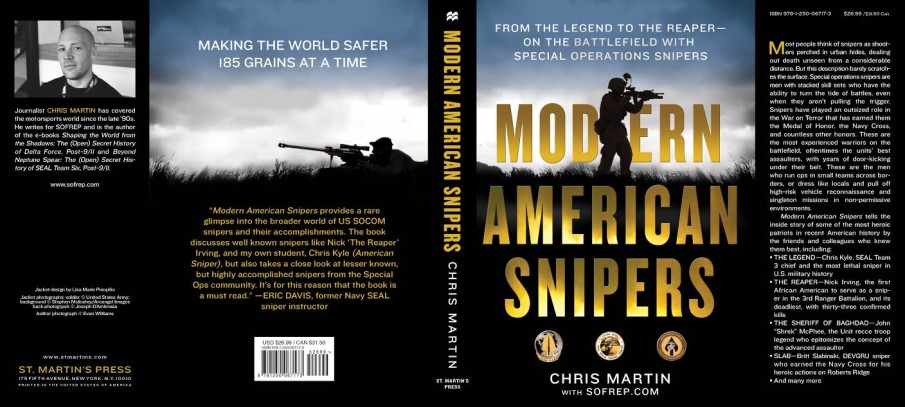
To pre-order the book please go to Barnes & Noble (this helps us the most) or Amazon. Pre-ordering helps us continue to put out solid titles for you (it really makes a difference), and it also makes you eligible for special giveaways on SOFREP so please screen shot and save your proof of purchase.
To pre-order Modern American Snipers click here.







COMMENTS