

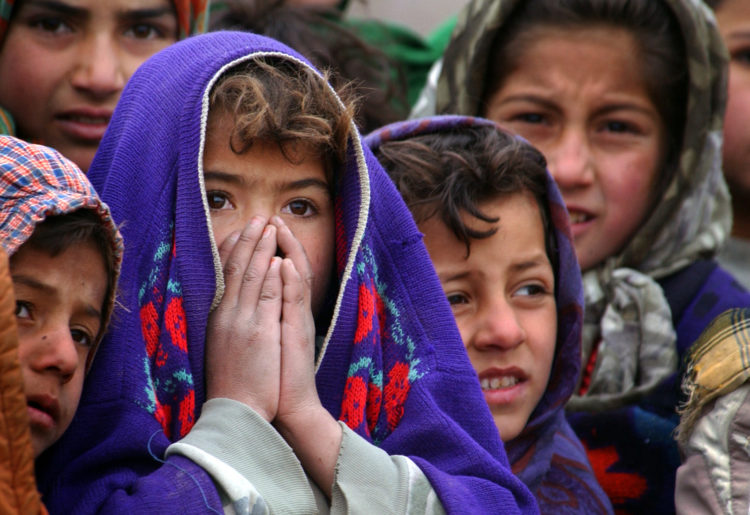
At the beginning of the first regime, the Taliban said it would keep women at home until “conditions are right” for them to come out to work. But such conditions never came. During the five years the Taliban spent in power in Kabul, women were locked at home. If they left the house, they had to do so in the company of a male guardian – a brother, son or husband.
The same reasoning – unsuitable conditions – is currently being used to prevent girls from accessing education. But the premise is plain wrong. The Taliban considers segregated classes to be the main condition for letting girls back into schools. Based on my experience studying in Kabul, girls and boys study together until class six (around age 12). After that, however, they take separate classes. In short, the condition posed by the Taliban is satisfied by the rules that are already in place. Their decision to prevent girls from going to school simply stems from the group’s retrograde ideology. According to this ideology, women should be confined to domestic affairs.
Today’s group cannot let go too much of its archaic ideology. If it did so, it would risk eroding credibility in the eyes of their more extreme elements and losing them to the local branch of the Islamic state in Afghanistan – the Islamic State – Khorasan Province. The Taliban would be seen to have abandoned its core Islamist values.
SL: I think that’s a great reading of the situation from so many different dimensions. We do know that there are women, including teachers, who are in hiding. They are concerned that if they come out, they will be identified as being part of the previous secular approach to education, and be punished for it. We are in limbo regarding what actually happens inside the country regarding women’s participation in all spheres of life.
How women’s progressive withdrawal from public life manifests is, in a sense, through self-regulation or self-censorship – in the workplace, in public spaces, and even at home. Many women do this to ensure they don’t fall foul of the Taliban. There was some protesting going on, made possible in Kabul by the presence of the international media. But it is, again, very difficult to scrutinise the situation beyond Kabul.
A number of non-governmental organisations (NGOs) were involved in promoting education including for girls inside the country. The Taliban initially said that NGOs could continue to operate. But a lot of them had to pull back because of the uncertainty.
I predict that the international community will put some conditions on aid tied to advancing, or at least maintaining, the status-quo in areas like education, health and community activity. But they are months away from that because the Taliban aren’t organised yet. Plus, the international community is in disarray, given the speed at which everything fell apart.
Would it be wise for the international community to grant legitimacy to the Taliban?
SL: As the Taliban have yet to establish a functioning government, even their biggest backers – such as Pakistan – are being cautious about recognising the Taliban’s rule as legitimate. As for the US, they aren’t going to recognise the Taliban in the near future, but nor are they going to try to remove the Taliban from power as they did in 2001. And when they did so then, it wasn’t because of the internal Afghan situation, but because of their war on terror.
When the Americans went to meet the Taliban in Qatar in October this year, they likely sought an agreement on collaborating against the common threat of Islamic State – Khorasan Province, an affiliate of Islamic State. While the Taliban refused to commit to this publicly, behind the scenes there would probably have been nods and winks. Not for nothing, the Taliban made a public statement (and they did so very quickly) in which they welcomed a US commitment to limited humanitarian aid.
In short, if the Taliban deal with the terrorist threat, aren’t too aggressive in terms of their foreign policy, and don’t get too close to Russia and China, the Americans will deal with them as the group in power.
But the Afghan people seem to be expendable in this, as do women’s rights, the rights of LGBTQ communities, and inherent rights to education, healthcare and political participation. The Biden administration is, in part, to blame for this. It gives lip service to human rights, but has in fact relegated them. When Joe Biden decided that US forces had to withdraw from Afghanistan back in April 2021, the US commitment to the Afghan people ended.
KR: Your point begs the question: is there a way for the west to offer Afghans humanitarian support without officially recognising the Taliban? I believe there is – after all, between 2002 and 2021 much of the aid to Afghanistan did not go through Afghan state machinery.
Before the recent Taliban takeover, health and education, like many other state services, were highly subsidised by international assistance. This could be revived on a smaller scale. But I highly doubt that the same amount of funding will flow into Afghanistan.
There are certainly potential risks to recognising the Taliban. Doing so at this point, while the ideologically fanatical element is still very dominant in the group, could contribute to strengthening the Taliban’s conception of themselves as leaders of some messianic mission in the region.
To refer to their leader, Hibatullah Akhunzadah, they still use the title Amir-ul Momenin, which means “leader of the faithful” – a title that was also claimed by Islamic State leader Abu Bakr Al-Baghdadi. The implied meaning is that the “Islamic Emirate of Afghanistan” is only one part of the totality of the Muslim population and the Taliban leader is, in effect, the leader of all Muslims.
Even though the Taliban do not overtly advocate global jihad – a term which can indicate an internal or an armed struggle, or the effort involved in building a good Muslim society – they nonetheless conduct their communications in a way that placates global jihadis. They also hold close ties with al-Qaeda and other global jihadi movements that do not recognise modern day boundaries and strive to establish a dominion for Muslim populations on earth called the caliphate.
The Taliban has so far not been entirely honest in their dealings with both the US and the former Afghan government – if you grant recognition to a group like this, what might it lead to? Given Pakistan – a nuclear power – is right next door, the security risks of an unbridled jihadi ambition could quickly spiral out of control.
SL: As for the question of whether granting financial aid is a good idea, I cannot but consider the matter at a personal level.
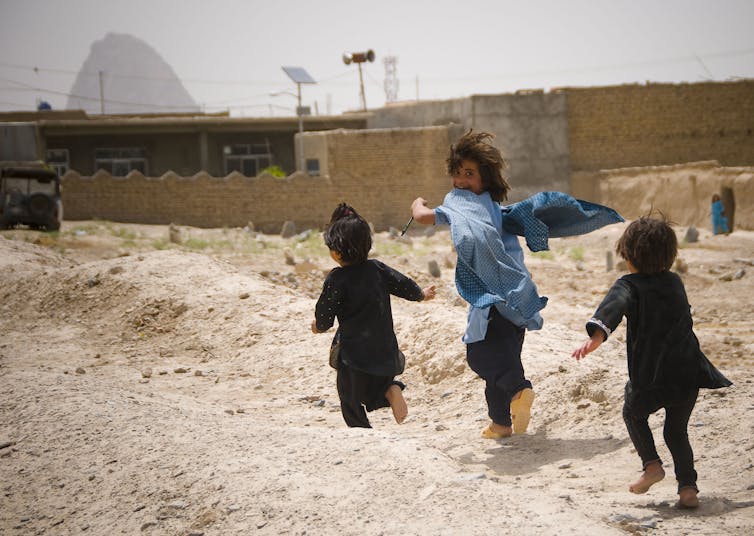
There are 14 million Afghans who are in food poverty, and too many of them are children. They have to deal with inadequate services, such as electricity and water, and with a country which has been damaged by years of conflict. If you cut off all essential support, how many of those people will be left with no level of subsistence? How many of them will die? I think that the best outcome would be to provide waivers on sanctions, especially those imposed by the US on the Taliban over “terrorism”. For example, there may be discussions around Afghanistan’s participation in the international coronavirus initiative, Covax.
Sarah Brown/Wikimedia
But the immediate question, of course, is whether it is wise to allow the Taliban access to tens of billions of dollars?
It is hard to even conceive of the Taliban and the IMF getting into the types of negotiations that many countries have. Such negotiations require transparency, competence and authority. If the Taliban manage to engage in negotiation, then I can tell you that we’re in a different situation than what we faced before 2001.
Is Afghanistan likely to become a breeding ground for terrorist groups once again?
SL: I don’t think seeing events through the prism of the war on terror, in place since 2001, has done anybody any good. And I think that’s as true of Afghanistan as anywhere else. The issues for Afghanistan after the US withdrawal are security, economics, politics, agriculture and manufacturing. When countering terrorism is your overall priority, you shove those to the side.
The label of terrorism is a dangerous thing. The US tried to obscure its disastrous withdrawal by committing to a continuation of the fight against terrorism. And the Taliban will go along with that. The Taliban will want to reassure the Chinese, who perceive a terrorist threat in China’s north-west and want to make sure that the Taliban don’t get involved in it.
The Kremlin, which suppressed terrorism in Chechnya and fears Islamic movements within Russia as destabilising to its authority, will also want the Taliban to say that they don’t support terrorism. So will the former Soviet republics, Pakistan, and so on. It’s in everybody’s interest for the Taliban to promise that they will deal with terrorism, but by no means does that fight against terrorism solve the fundamental issues for millions of Afghans in the near and foreseeable future.
Yuriy Seleznev/www.shutterstock.com
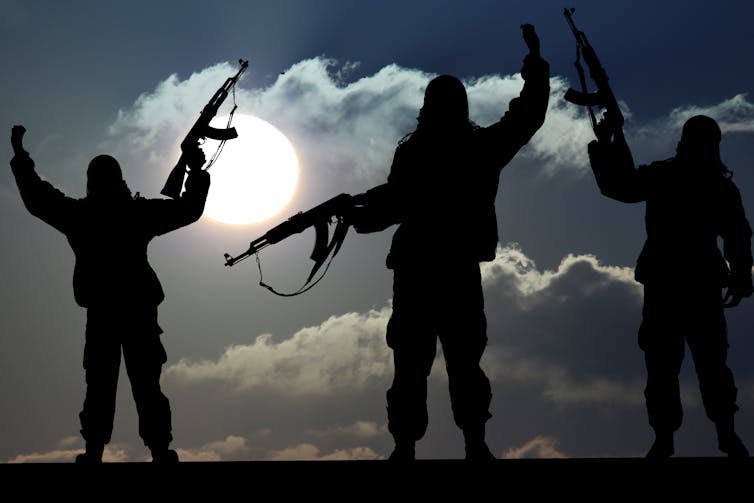
KR: In Taliban-controlled Afghanistan, Islamist groups like al-Qaeda are already seeing a revival. The competition among various Islamist groups will be judged domestically based on who is the more extreme, the more vicious and die-hard. I predict that this will push the Taliban towards more extreme positions.
As long as the more potent Salafist competitors – fundamentalist Muslims who seek to revive an original version of Islam purified from all western influences – are present on the scene, the Taliban’s current amorphous and tribal form of Islamist ideology will have to give formidable concessions, and undergo several setbacks. To retain their legitimacy both internally and externally, the group itself is likely to morph into a global menace and to maintain its commitment to host its jihadi brethren. Such a scenario will make it more and more difficult to disentangle the Taliban from al-Qaeda and from other Islamist groups, such as the Turkistan Islamist movement, or the Uzbekistan Islamic movement.
There are also social aspects to consider when trying to prevent people from slipping into extremism. International assistance with education and health services will be key. This will reduce the number of people who are pushed by poverty towards extremism and drawn to terrorist groups seeking purpose in life and monetary assistance.
What’s next for Afghanistan?
SL: If you’re an analyst of Afghanistan and the international context, caution is the watchword right now. There are countries that benefit from the Taliban being in authority.
I think Pakistan is a beneficiary, given the links it has had with the Taliban. And so is China in the long term – if Afghanistan were stable, it could become part of the Belt and Road Initiative, a major economic and political project for Beijing. Russia benefits at the very least because they think the US has been given a black eye. The same goes for Iran.
But everybody is playing a little bit of wait and see, especially while the economic crisis prevails.
Watchfulness should extend to the Afghan people. I think there will be other countries who will pay attention to Afghanistan. But at this point, nobody has the leverage to make life better for the Afghan people.
KR: There are essentially two scenarios for the Taliban from here.
One is what I call – for lack of a better term – the “Qatar-based inclusivity” approach, led by Afghanistan’s current deputy prime minister, Mullah Abdul Ghani Baradar. This is a product of the diplomatically savvy Taliban wing that led negotiations with the US resulting in the February 2020 Doha Agreement. This wing appears to be less extremist and more amenable to political concessions. It has promised to form an inclusive government in return for international recognition and humanitarian assistance.
The other, more downbeat, scenario is a more extremist one, rooted in the group’s original spiritual capital, Kandahar. Having defeated the US, the biggest crusading force to the Taliban’s mind, the group’s more hardline participants might think they can secure total victory against the remaining domestic opponents to their rule.
But the latter approach confuses insurgency with governance. Now the Taliban are the police officers. They’re the ones responsible for the much more difficult task of establishing law enforcement. They are the target of groups who might wish to disrupt their rule.
I think that, mostly, the Taliban don’t fully understand the significant difference between being an insurgent group and being a government in Afghanistan – a country which is highly layered in terms of ethnicity, tribal allegiance and political geography. A country literally cut in two by a huge mountain range.
If the Taliban does pursue a more extremist line, it might not be able to cope with, for example, the gradual depletion of current resources, such as weapons degrading and vehicles deteriorating. Within a year or two, we might see other militant groups, including the National Resistance Front, a military alliance of former Northern Alliance members and other anti-Taliban fighters, and Islamic State Khorasan Province, taking advantage of the Taliban’s weaker position.
Meanwhile, it wouldn’t be too far-fetched to think that neighbouring countries and regional powers might at some point begin supporting anti-Taliban groups with money and weapons, if they deem it strategically important. For instance, Russia might consider helping the National Resistance Front, if worried about a spill-over of extremism from Afghanistan to Tajikistan, Uzbekistan, and other countries on the other side of Amu River.
Regarding humanitarian support for ordinary Afghans, Scott is right to point out that public attention tends to shift. Nowadays, for instance, the millions of people threatened by starvation in Yemen are virtually ignored by the mainstream media. The sad reality is that Yemenis are viewed by many in power as not that significant in the big game of international relations. Similarly, the fate of ordinary Afghans may also slip out of the public eye – especially as media attention on the misery of Afghans would be a constant reminder to the US of its failure.
***
This piece is written by Kambaiz Rafi, Researcher in Political Economy, UCL and Scott Lucas, Professor of International Politics from the University of Birmingham. Want to feature your story? Send your draft here today.
This article is republished from The Conversation under a Creative Commons license. Read the original article.









.jpg)
COMMENTS