

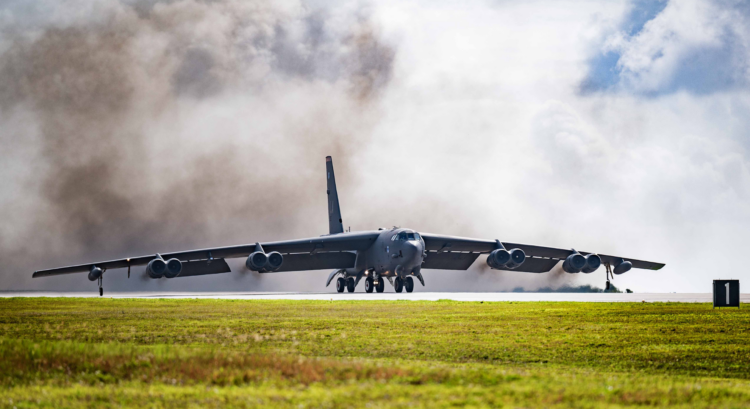
In a separate statement, Lt. Gen. Park Ha-sik, commander of the ROK Air Force Operation Command, said that the combined capabilities of the allies have proven to be perfectly ready and capable of responding “swiftly and overwhelmingly” in case of conflict.
The succession of exercises between Seoul and Washington in recent months, as well as with Tokyo, have solidified the nations’ “ironclad” relationship and fortified alliances against future provocations not just with Pyongyang but also with Beijing in the region.
Knowing how sensitive the North is regarding US-ROK military drills, it’s no surprise that Pyongyang responded again through its typical provocative actions, flaunting its nuclear-capable weapons like a child waving its lollipop.
North Korea has long decried these exercises as “a rehearsal of an invasion,” thus using it as a pretext to bolster its weapon tests. In March, supreme leader Kim Jong-Un also ordered its armed forces to intensify its own drills in preparation for a “real war” and called for an “exponential” increase in weapon production, including its prized tactical nukes.
North Korea warns US, South Korea military drills escalate tension to "brink of a nuclear war" https://t.co/K3FtalMjoz pic.twitter.com/sacX9t6KVJ
— The Hill (@thehill) April 6, 2023
In its latest commentary, state-owned news outlet Korean Central News Agency (KCNA) denounced the allies’ “frantic” military activities that transpired this week, adding to the accusation of war rehearsal that Pyongyang would take “offensive” actions against it.
It also accused the US of causing the region’s instability, dubbing the state a “cancer to the world peace,” shortly after Monday’s trilateral maritime drills with South Korea and Japan involving American nuclear-powered aircraft carrier USS Nimitz.
During the exercise, it was reported that the allies rehearsed anti-submarine tactics and other maneuvers that could potentially deter the underwater attack drone North Korea flaunted in late March.
The Venerable B-52 Bomber
Over seven decades later, American B-52 remains the ‘IT’ bomber plane of the Air Force, which will soon receive yet another upgrade from Boeing.
Informally known as the Big Ugly Fat F****r, or BUFF, the bomber is slated to be retrofitted with updated armaments, sensors and radars, and communication systems, along with new powerful engines.
Reportedly, the upcoming B-52J variant will feature cutting-edge Rolls-Royce F130 engines that will improve the bomber’s fuel efficiency, expand its range limit, and ramp up its overall performance in the field. It will also fit Raytheon’s AN/APG-79, a sophisticated active, electronically scanned array (AESA) radar currently employed on Navy’s F/A-18 Super Hornet fighter jets. This radar will boost the vision and navigation capabilities of weapons in flight.
With this, it would continue reigning the skies as a deadly warplane for at least a couple more decades and sends a clear message to adversaries’ on US forces’ air superiority and might.
Last November, Japan Times reported that the Korean People’s Army (KPA) Air and Anti-Air Force has “more than 900 fighter jets, 300 transport plans, and 300 helicopters,” most of which are obsolete or near-obsolete.
Not to mention how most of its aircraft were produced in the late 1980s by the Soviet Union and China, with speculations that the actual number of warplanes on active duty is deteriorating by the minute.
Unlike the evolving B-52 bomber, KPA’s fleet has barely improved, with funding struggles to cover fuel and maintenance costs. Pilot training is also an issue—significantly lacking and inadequate, pushing North Korea farther behind in dominating the sky.








COMMENTS