

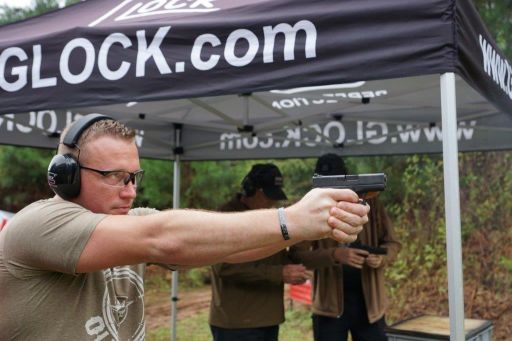
I went to the Glock Store and gave both guns a good look, then shot them on the store range. I will talk primarily about the 9mm G-43 and summarize my experiences. Spoiler alert: I couldn’t see any significant differences between the two, except the rounds in the magazine.
I am an early adopter of the Glock and a graduate of Glock Instructor and armorers courses. When I saw the Glock go down to the frame using only a punch, I was hooked. All the non-1911 guns were filled with tiny springs and screws. The Glock was simple and modular. Magazines of the same caliber would go into any Glock of smaller capacity and stick out the bottom.
The double stack mag is a little thin for some hands and thinner is easier to hide. The G-43 single stack lacks full compatibility with with its 9mm cousins, but under the hood it is pure Glock.

Some of the parts are a little different, but if you know how to disassemble any Glock, you can sort out the G-42 and G-43 very easily.
It disassembles just like all the others, but the parts are slimmer and the magazine is a 6 round single stack. It has all the virtues of a Glock in a neat little package.

I have always said that you should pick a handgun like you pick a pair of shoes. You have to find something that fits before you worry about fashion. The G-43 grip has a built-in beaver tail design which places the hand high on the back strap.
I didn’t expect to like it. My hands are pretty big and most small guns feel strange. The G-43 has a 1911-like feel and supports a thumbs-high grip, even with man hands. The grip is textured and provides nice tactile feedback.

On double stack guns, I always needed an extended mag release. The G-43 has a big catch like the gen 4 guns. It is easy to find and use.

The six round polymer magazines are well designed, and they fit in a pocket with more comfort and conceal-ability. The laws of physics being what they are, the six-round mags are small and light, but they only hold six rounds.
Firing the Glock 42 and 43 is like shooting the G-26 and other subcompacts. The gun’s weight and grip design change the way energy is transmitted to the hand. It makes recoil easy to manage. Using self-defense JHP ammo, the difference between the recoil of the .380 and 9mm was barely noticeable.
The sights are regular polymer Glock sights. I like the way they work for fast shooting up close, but there are much better sights available.
The trigger feels like a standard Glock 5.5lb trigger. Light enough to shoot, heavy enough to be safe. With other Glocks, you can change the connector to lighten the trigger. The 42 and 43 have a different connector so you get what you get. Polishing parts would help clean things up.

Glocks have three safeties. The Glock “Safe Action” is comprised of an external integrated trigger safety and two automatic internal safeties: a firing pin safety and a drop safety. The shooter does nothing to manipulate the safety except pull the trigger.
The traditional way to make a barrel is to cut lands and groves into a tube with a broaching machine. With all the machine guns headed for the front in WW2, the Nazis didn’t have time for that, so in 1939, they invented the hammer-forged barrel. A hole is drilled in a steel tube and it is placed on a tungsten carbide mandrel with the rifling pattern ground into its surface. The barrel/mandrel combo is then placed between two opposing power hammers. The barrel is rotated and beaten until the inside takes the shape of the mandrel.

Hammer forging produces the Glock female polygonal rifling with a right-hand twist. This bore provides a better gas seal around the projectile, which provides consistency in muzzle velocities and increased accuracy.
The caliber choice between .380 and 9mm is yours to make. Modern .380 ammo is greatly improved, but I don’t see a good reason not to go with the bigger caliber. The recoil is virtually the same and magazine capacity is equal.
The Glock 42 and 43 do not disappoint. They are thin and have an elegant feel, optimized for conceal-ability yet still shoot well. If you are looking at a 24/7 carry gun, stop by your Glock dealer locator and try one on for size.
The Glock 43 compares well to the popular Glock 26. To see the stats side by side, check the Glock provided table below:

To give you a better idea of the size of these guns. I have provided the pictures of the G-42 and G-26 for comparison.

The following data is drawn from the us.Glock.com.
| Comparison Table | Glock 43 | Glock 42 | Glock 26 |
| CALIBER/SYSTEM | 9×19 / Safe Action | .380 AUTO / Safe Action | 9×19 / Safe Action |
| LENGTH | 159 mm / 6.26 in. | 151 mm / 5.94 in. | 165 mm / 6.49 in. |
| HEIGHT | 108 mm / 4.25 in. | 105 mm / 4.13 in. | 106 mm / 4.17 in. |
| WIDTH | 26 mm / 1.02 in. | 24 mm / 0.94 in. | 30.00 mm / 1.18 in. |
| BARREL HEIGHT | n/a | n/a | 32 mm / 1.26 in. |
| BETWEEN SIGHTS | 132 mm / 5.20 in | 125 mm / 4.92 in. | 137 mm / 5.39 in. |
| BARREL LENGTH | 86 mm / 3.39 in. | 82.5 mm / 3.25 in. | 87 mm / 3.42 in. |
| WEIGHT (Unloaded) | 509 g / 17.95 oz. | 390 g / 13.76 oz. | 615 g / 21.71 oz. |
| WEIGHT (Loaded) | 634 g / 22.36 oz. | ~490 g / ~17.29 oz. | 740 g / 26.12 oz. |
| TRIGGER PULL | ~2.5 kg / ~5.5 lbs. | ~25 N / ~5.5 lbs. | ~2.5 kg / ~5.5 lbs. |
| TRIGGER TRAVEL | ~12.5 mm / ~0.49 in. | ~12.5 mm / ~0.49 in. | ~12.5 mm / ~0.49 in. |
| BARREL RIFLING | right hand, hexagonal | right hand, hexagonal | right hand, hexagonal |
| LENGTH OF TWIST | 250 mm / 9.84 in. | 250 mm / 9.84 in. | 250 mm / 9.84 in. |
| MAGAZINE CAPACITY (STANDARD) |
6 | 6 | 10 |
*Featured image courtesy of Glock
This article was originally published on the Loadout Room and written by








COMMENTS