

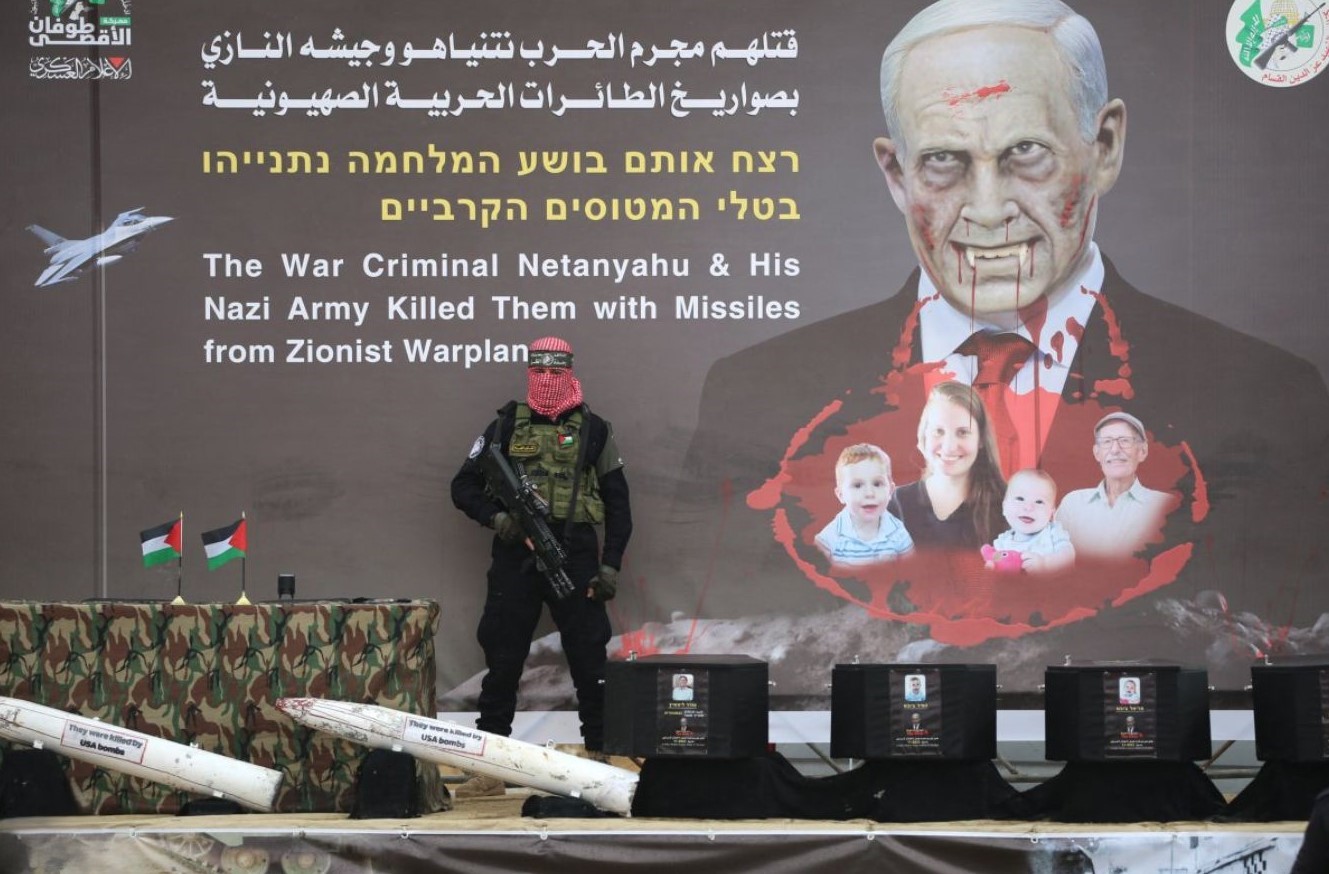
This disgraceful act was widely condemned. UN Secretary-General António Guterres criticized Hamas’ handling of the hostages’ remains, stating that international law requires the deceased and their families to be treated with dignity. The World Jewish Congress also denounced Hamas, stating that their treatment of the victims in death was just as abhorrent as their treatment in life.
This event serves as yet another example of Hamas’ disregard for basic human dignity. Even in death, hostages and their families continue to be exploited as tools in its ongoing propaganda war against Israel.
International Repercussions
The way Hamas handled the return of the hostages’ bodies has triggered widespread international condemnation. Instead of treating the situation with the dignity and respect it deserved, Hamas turned the handover into a public spectacle, violating international humanitarian standards.
Many world leaders and organizations criticized the event, including United Nations Secretary-General António Guterres, who condemned the parading of the bodies and the public display of the coffins. He emphasized that such actions go against international law regarding the proper treatment of deceased individuals. The International Committee of the Red Cross (ICRC) also expressed dissatisfaction, stating that the transfer should have been conducted privately and with dignity rather than being used as a propaganda tool.
The incident has further strained diplomatic relations, with Israeli Prime Minister Benjamin Netanyahu vowing that Hamas will pay the “full price” for this breach of the ceasefire agreement. He described the act as a deliberate provocation and a cruel insult to the families of the hostages. The World Jewish Congress also weighed in, condemning the display as a “shocking display of cruelty and propaganda” that violated human dignity.
Beyond diplomatic tensions, the misidentification of Shiri Bibas’s body has put additional pressure on ceasefire negotiations, raising doubts about Hamas’ credibility in future hostage exchanges. This controversy has also renewed international calls for the immediate release of all remaining hostages, with governments and humanitarian organizations urging urgent action.
The entire event has intensified global scrutiny of Hamas and its treatment of both living and deceased hostages. Many see this as further proof of the group’s inhumane tactics, reinforcing its international designation as a terrorist organization by multiple governments. This incident has not only worsened diplomatic tensions but also highlighted the complex humanitarian challenges at the heart of the ongoing conflict in Gaza.
Conflicting Narratives
Hamas has asserted that Shiri Bibas and her children were killed in an Israeli airstrike while in captivity. However, Israeli authorities dispute this claim, stating that forensic evidence indicates the children were “brutally murdered” by their captors. The absence of Shiri’s body has intensified the anguish of her family and fueled further accusations against Hamas for their handling of the hostages.
A Fragile Ceasefire Under Strain
The misidentification of Shiri Bibas’s body has placed even more strain on the already fragile ceasefire between Israel and Hamas. Israeli Prime Minister Benjamin Netanyahu has accused Hamas of a “cruel and malicious violation” of the agreement, vowing that the group will pay the “full price” for this breach. His strong rhetoric, including a promise of retaliation, has heightened fears of potential Israeli military action in response.
This incident has also raised serious concerns about the reliability of future hostage releases and prisoner exchanges. While six more hostages are scheduled to be released on Saturday, the controversy has introduced uncertainty into the process, making it unclear whether those releases will proceed as planned. U.S. envoy Adam Boehler called the release of the wrong body “horrific” and a “clear violation” of the ceasefire, suggesting that there could be diplomatic consequences for Hamas.

Hamas, for its part, has stated that it will conduct a review to determine what went wrong, suggesting that a mix-up may have occurred due to Israeli airstrikes. However, this explanation has been met with widespread skepticism, further complicating an already tense situation. The timing of this controversy is particularly troubling as negotiations for the second phase of the ceasefire were set to begin in early March. Progress on those talks was already uncertain, and this latest development could make discussions even more difficult.
Meanwhile, Netanyahu is facing pressure from far-right members of his cabinet to abandon the ceasefire and resume full-scale military operations in Gaza. This incident may further embolden those calling for an end to negotiations. Hamas, on the other hand, has stated that it will not release the remaining hostages unless a lasting ceasefire is reached and Israel fully withdraws. However, Netanyahu, with backing from the Trump administration, remains committed to dismantling Hamas’s military and governing capabilities. These opposing objectives make a long-term ceasefire seem increasingly unlikely.
And while we are talking about the Trump administration, what happened to “All hell breaking loose” if all of the hostages were not released alive by the President’s noon on February 15th deadline? Should we really be talking tough if we are not going to back it up?
Ultimately, this controversy has highlighted just how delicate the ceasefire agreement is and how difficult it will be to maintain. With tensions at a breaking point, the risk of further escalation is high, putting future hostage releases and broader peace efforts in serious jeopardy.
Wrapping Up
The return of the bodies of Kfir and Ariel Bibas, alongside the misidentified remains purported to be their mother, has deepened the sorrow and outrage surrounding the Israeli-Hamas war. The manner in which Hamas conducted the handover has drawn widespread condemnation and highlighted the profound human cost of the ongoing hostilities. As the ceasefire teeters on the brink, the path to peace remains fraught with challenges, and the need for a compassionate and lawful approach to such sensitive matters is more critical than ever.








COMMENTS