

“Your Russian is impressive,” he said. “With your background, you’d be better in staff or intelligence, not frontline. This war isn’t Iraq or Afghanistan. It’s armor, thermobarics, incendiaries, endless artillery. We’re fighting for survival. You might be dumped in a trench. I can’t recommend it.”
His warning gave me pause, but not enough to stop me. In April, I traveled to Lviv to deliver medical supplies and gauge the situation. Western Ukraine felt stable, almost peaceful. To get a real picture, I needed to reach Kyiv.
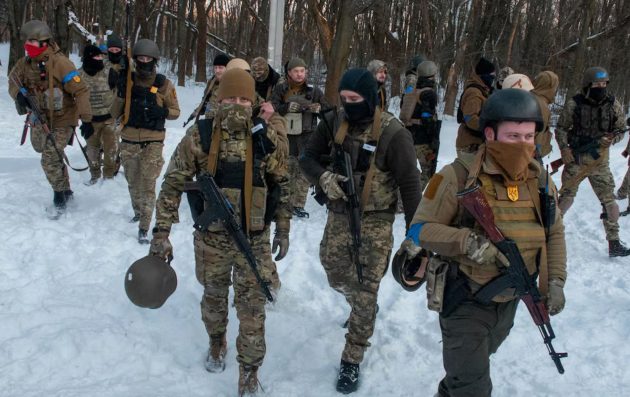
Once there, I volunteered with a group training Ukrainian soldiers. Watching men of all ages step forward to fight made the choice clear. I wasn’t there to teach; I was there to serve.
My first interaction with the military as a prospective recruit came in early May. A new unit was forming: the Ivan Bohdan Special Purpose Brigade. The name sounded punishing, and the commander promised four weeks of training before deployment. In the recruiting seminar I saw men with no prior service volunteering for combat. The idea of going into a kinetic war with recruits who had three weeks of training was sobering. I passed. The unit soon deployed to Lysychansk, suffered heavy losses, and later became the infamous Second Battalion of the International Legion, known for poor discipline and substance abuse.
Outside that seminar I met a former Marine who spoke Russian. He told me about another outfit: the Norman Brigade. All-volunteer, unpaid, but disciplined. He passed me the Signal contact of its commander, Hrulf (RIP). I sent my DD-214, and he cleared me to join him in Dnipro. Days later I was picked up and shuttled to the front. Three weeks of unpaid combat followed, eight men and a jeep. That story deserves its own telling.
After roughly three weeks, several of us left the Norman Brigade. We had been promised direct-action missions against tanks; instead, we dug trenches in Velyka Novosilka, under constant artillery, seemingly waiting to die. The others needed pay, so we applied to First Battalion, International Legion.
Before joining, I was tasked with picking up a drone in Poland for our squad. I spent a week near Kraków, procuring supplies and taking drone instruction at a small training site run by volunteers. When it was time to return, I took a bus back to Lviv, then endured a sixteen-hour train ride through the night to Kyiv, and onward to Kharkiv, where I would in-process with the Legion.
At Legion headquarters in Kharkiv, code-named Alamo, the in-processing took two hours: contract, NDA, rifle. A Polish volunteer named Mihail, who would later be killed near Bakhmut, drove me to our safehouse. It was a modest dacha in the countryside near the Siverskyi Donets River. Quiet, almost pastoral. There, I spent thirty-three days conducting ISR drone operations, occasionally taking artillery fire, and manning a defensive outpost in the forest by the river.
I left after those thirty-three days. My drone was damaged beyond field repair, and replacements required leaving the country. Officially, the only way to do that was to break contract. That was allowed at the time. I also had to retrieve my dog from a sitter in Serbia. In those early months, the Legion’s system was fluid; you could walk away and return without consequence.
I tried to go back to normal life. It didn’t hold. After a year drifting through Southeast Asia, I returned to Ukraine. This time, I joined Chosen Company, the reconnaissance and assault element of the 59th Motorized Infantry Brigade. By 2023, the system had hardened. Foreign volunteers were routed through Fourth Battalion, which handled training, while the main administrative intake operated out of Ternopil: a quick physical, sparse paperwork, and assignment orders. Because I came in through Chosen Company directly, I bypassed training and went straight to the front. It didn’t go well.
Since then, Ukraine has refined its recruiting process. Contracts now carry six-month minimums. Leaving early is considered AWOL, not a free exit. Most applications are processed online.
My own service ended in October 2023, but the story didn’t. What followed was betrayal, loss, and war crimes—all of it detailed in my forthcoming memoir, War Tourist, represented by Writers House Literary Agency in New York.
If you’d like to hear more about those chapters, let me know in the comments, and watch the embedded video above where I discuss my time in Ukraine.
Despite everything, I can end this with only two words:
Slava Ukraini.








COMMENTS