


This in-depth campaign targeted the U.S. government, its military, and the defense-industrial base. Moshe (2022, p. 3) elaborates:
Most of the activities were directed toward governmental institutions, including the White House, governmental bodies (the State Department, Department of Commerce, Department of Defense, Homeland Security, Department of Energy, and Department of Labor), military branches, intelligence agencies (CIA, FBI, DIA), and the National Aeronautics and Space Administration (NASA), as well as leading defense industries (Lockheed Martin, Boeing, and Raytheon)
This activity leaves little doubt about why the Chinese were able to design and produce a fifth-generation fighter (the J-20) suspiciously fast, or why the newest CCP aircraft carrier the Fujian, has the Electro Magnetic Aircraft Launch System (EMALS). The designs for these technologies were no-doubt stolen from the U.S. military or defense contractors via cyber theft.
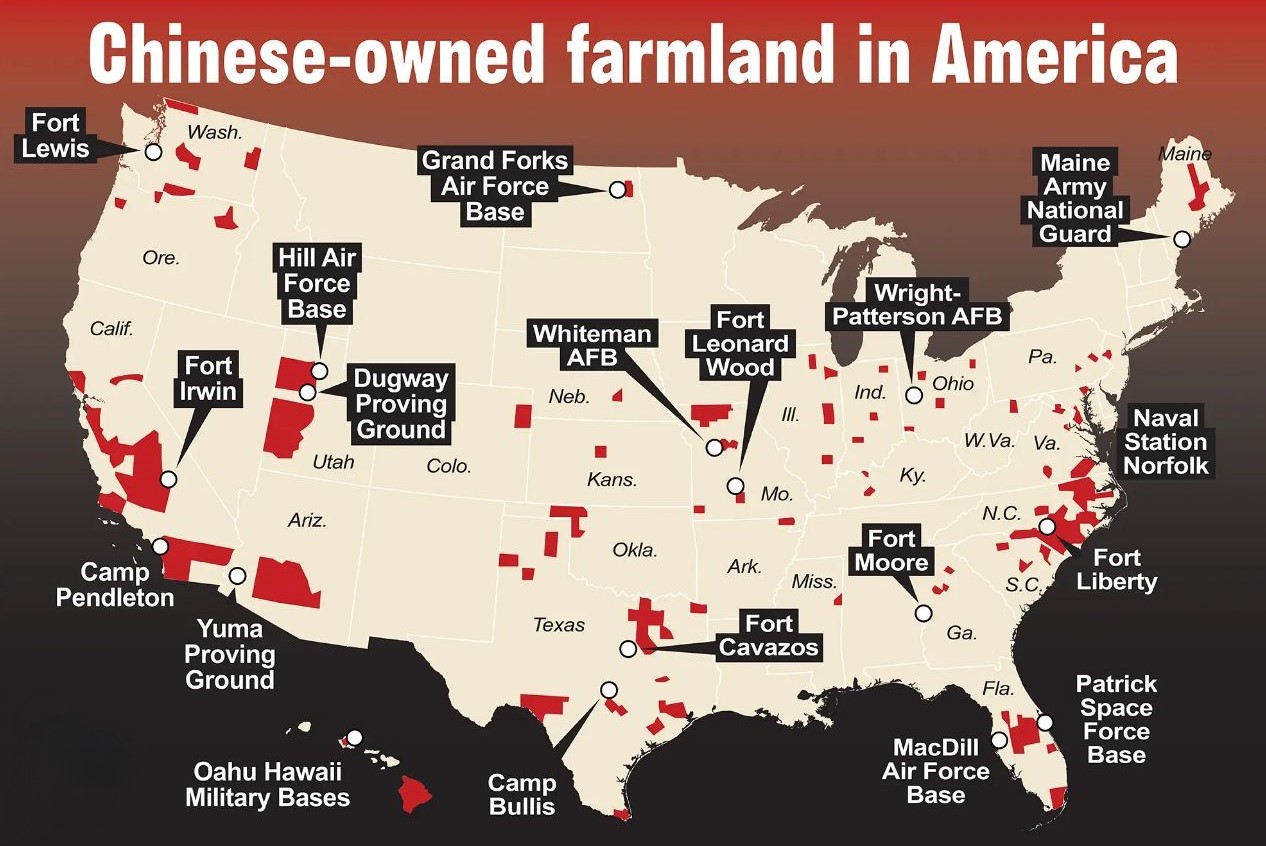
Another route for the CCP and its intelligence services to obtain sensitive information is through physical observation, perhaps the oldest method of spycraft. An aspect of the CCP overseas espionage strategy is to, among other things, engage in direct investment, pursue overseas acquisitions and joint ventures (Office of The Secretary of Defense, 2023). With this knowledge, it should be no surprise that Chinese entities have purchased “farmland” near or directly neighboring 19 key U.S. military installations (Di Santolo, 2024).
These Chinese-purchased “farms” pose a grave threat to both the personnel on these bases and the security and protection of sensitive information and operations of these bases. Potential Chinese espionage activities could include “setting up reconnaissance posts, installing tracking devices, using radar and infrared technology to monitor military activities, or even deploying drones to gather intelligence (“Chinese Farmland Purchases,” 2024).
The Relationship Between Chinese Illegal Immigration and Espionage
Dovetailing with direct observation, is the massive influx of illegal immigrants from China. In 2021, the Border Patrol apprehended 342 Chinese nationals. Fast forward to 2024, and the number has grown to 24,296. If this pace continues, through the year, this will represent a 14,000 percent increase (Hunt, 2024).
Further, Hunt (2024), indicates that many of these illegal immigrants (primarily military-age men) use WeChat and Douyin, (the Chinese version of TikTok). Both platforms are heavily monitored by the CCP intelligence organizations. Thus, these intelligence organizations are aware of this immigrant flow and are either making no effort to stop it or they are unconcerned.
What is more, coinciding with this recent drastic increase in Chinese illegal immigration, there have also been over 100 attempted breaches at U.S. military bases, perpetrated by Chinese nationals within the last few years (Di Santolo, 2024).
Conclusion
Presently, the CCP is engaged in a multifaceted espionage campaign against the U.S. This campaign is designed to acquire as much valuable information as possible for the benefit of both the CCP military and Chinese companies. Sensitive information stolen from U.S. military and defense industrial databases is used to further the advancement of Chinese military technology. This brings the Chinese military to closer parity with the U.S. and aids its ability to threaten its neighbors and U.S. bases in the Asia region.
Additionally, China’s purchase of farmland near U.S. military bases will (or does) provide valuable information to the CCP’s intelligence services. This information pertains to the daily operations of the U.S. military bases, their capabilities, their potential weaknesses, as well as data about the testing and performance of new military equipment or ordnance. Worryingly, information can be gathered about the security of these military installations and potential targets within the bases.
It would be very wise to both deny any further sales of U.S. land to Chinese entities (or U.S. entities with ties to China), and also seize this land, as quickly as possible. One would have to have his or her head buried deeply in the sand to entertain the ludicrous notion that Chinese-owned farmland, located conveniently near key U.S. military facilities, is simply designated to grow vegetables. Bottom line, the CCP is no friend to the U.S. and Americans must wake up to the reality that it bears no goodwill towards us, but rather seeks to weaken and eventually overthrow us.
—
Listed below are the US military installations and their operations near “farmland” purchased by Chinese entities. Given the nature of the installations, it takes little imagination to discern the type of information that Chinese intelligence services are (or could) collect from their potential observation. This should alarm all who read this.
Disclaimer: This list was compiled from sites such as Military.com, Installations.militaryonesource.mil, Wikipedia and other US military websites. The author does not claim the information below as his intellectual property. Hyperlinks are provided to the sources of the information below.
Fort Lewis: One of the largest and most modern installations in the U.S. military. It’s home to the I Corps, 62nd and 446th Airlift Wings, 7 Infantry Division, 1st Special Forces Group, 75 Ranger Regiment, 66th Theater Aviation Command.
Fort Irwin: The location – an isolated area – was ideal because of its over 1,000 square miles (2,600 km2) capacity for maneuver and ranges, its uncluttered electromagnetic spectrum, and its restricted airspace.
Camp Pendleton: The base hosts year-round training for U.S. Marines in addition to all other branches of the U.S. military. Amphibious and sea-to-shore training takes place at several key points along the base’s 17 miles (27 km) of coastline.
Yuma Proving Grounds: A test center for military equipment and munitions.
Oahu: This island is home to approximately 300,000 personnel from all of the U.S. military branches, stationed at 11 bases.
Dugway Proving Ground: The primary mission is to test United States and Allied biological and chemical weapon defense systems in a secure and isolated environment.
Camp Bullis: It’s primarily used as a maneuver training ground for the U.S. Army, Air Force and Marine combat units.
Fort Leonard Wood: Fort Leonard Wood Garrison Command is proud to have 1st Engineer Brigade, 3rd Chemical Brigade, 14th Military Police Brigade.
Fort Cavazos: Home of the III Armored Corps.
Fort Moore: Fort Moore supports more than 120,000 active-duty military. Fort Moore is the home of the U.S. Army Maneuver Center of Excellence, Army Armor School, Army Infantry School, and elements of the 75th Ranger Regiment and more. As a power projection platform, the post can deploy combat-ready forces by air, rail, and highway for their designated mission(s).
Patrick Space Force Base: Space Launch Delta 45, collocated at Patrick SFB and Cape Canaveral SFS, provides activities and resources for the safety of flight, range instrumentation, infrastructure, and scheduling required to support and assure space and ballistic launches, and other operations. The Delta manages space-launch operations from the Eastern Range for the United States Space Force. Space Launch Delta 45 is also home to the Air Force Technical Application Center (AFTAC), Defense Equal Opportunity Management Institute (DEOMI), and the 920th Rescue Wing (AFRES).
Norfolk Naval Station: Located in Virginia, this is the headquarters and home port of the U.S. Navy’s Fleet Forces Command. The installation occupies about 4 miles (6.4 km) of waterfront space and 11 miles (18 km) of pier and wharf space. It is the world’s largest naval station, with the largest concentration of U.S. Navy forces comprised of 75 ships alongside 14 piers and with 134 aircraft and 11 aircraft hangars at the adjacently operated Chambers Field. Port Services controls more than 3,100 ships’ movements annually as they arrive and depart their berths.
Air Operations conducts over 100,000 flight operations each year, an average of 275 flights per day or one every six minutes. Over 150,000 passengers and 264,000 tons of mail and cargo depart annually on Air Mobility Command (AMC) aircraft and other AMC-chartered flights from the airfield’s AMC Terminal.
Fort Liberty: (Formerly Fort Bragg): Home of the Army’s XVIII Airborne Corps and it is the headquarters of the U.S. Army Special Operations Command, which oversees the 1st Special Forces Command (Airborne) and 75th Ranger Regiment. It is also home to the U.S. Army Forces Command, U.S. Army Reserve Command, and Womack Army Medical Center.
Fort Liberty maintains two airfields: Pope Field, where the United States Air Force stations global airlift and special operations assets as well as the Air Force Combat Control School, and Simmons Army Airfield, where Army aviation units support the needs of airborne and special operations forces on post.
Air Force Bases (AFB)
Grand Forks AFB: Home of the 319th Reconnaissance Wing, operating Global Hawk drones in the role of intelligence, surveillance and reconnaissance for both U.S. operations and partner forces.
Hill AFB: The base is also home to the 75th Air Base Wing and the flying activities of the 388th and 419th Fighter Wings. Additionally, Hill is a hub of activity for the depot maintenance of numerous aircraft and weapons systems, as well as other military logistics and parts programs.
Whiteman AFB: This base is the current home of the B-2 Sprit stealth bomber.
Wright-Patterson AFB: The base is headquarters for a vast, worldwide logistics system, a world-class laboratory research function, and is the foremost acquisition and development center in the U.S. Air Force.
MacDill AFB: The 6th Air Refueling Wing is comprised of the 6th Operations Group, the 6th Maintenance Group, the 6th Mission Support Group and the 6th Medical Group. In addition to the 6th Air Refueling Wing, MacDill Air Force Base, Florida, is also home to 28 mission partners, including U.S. Central Command and U.S. Special Operations Command.
References
Chinese farmland purchases. (2024, June 20). Chinese farmland purchases near U.S. military bases raise national security concerns. In The Washington Times. https://www.washingtontimes.com/news/2024/jun/20/chinese-farmland-purchases-near-us-military-bases-/
Di Santolo, A.S. (2024, June 21). China buys land next to 19 US military bases sparking major spying fears: The ownership of farmland near US military bases by Chinese entities is causing increasing worries about national security. Daily Express US. https://www.msn.com/en-us/news/world/map-shows-chinese-owned-farmland-next-to-19-us-military-bases-in-alarming-threat-to-national-security-experts/ar-BB1oAONQ
Hunt, J. (2024, May 1). Chinese illegal border crossings spike by 7,000 percent. Only China knows why. Hudson Institute Inc. https://www.hudson.org/immigration/chinese-illegal-border-crossings-spike-7000-percent-only-china-knows-why-jeremy-hunt
Moshe, B.N. (2022). Chinese espionage operations in the United States: And in Israel? Institute for National Security Studies. http://www.jstor.org/stable/resrep39805
Office of the Secretary of Defense. (2023). Military and security developments involving the People’s Republic of China: 2023: Annual Report to Congress. U.S. Department of Defense. https://media.defense.gov/2023/Oct/19/2003323409/-1/-1/1/2023-MILITARY-AND-SECURITY-DEVELOPMENTS-INVOLVING-THE-PEOPLES-REPUBLIC-OF-CHINA.PDF
About the Author

Christian P. Martin is a Michigan-based military researcher and writer. He lived and worked in Vietnam for seven years, giving him a deep understanding of regional dynamics and Vietnamese culture. Additionally, he earned a Master’s degree in Defense & Strategic Studies from the University of Texas at El Paso. His professional interests are history, land and naval warfare and a keen interest in an emergent China.
—
Disclaimer: SOFREP utilizes AI for image generation and article research. Occasionally, it’s like handing a chimpanzee the keys to your liquor cabinet. It’s not always perfect and if a mistake is made, we own up to it full stop. In a world where information comes at us in tidal waves, it is an important tool that helps us sift through the brass for live rounds.








COMMENTS