

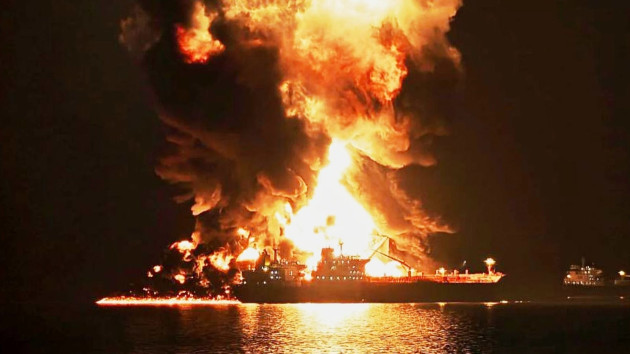
Iran warned that any attacks on its oil infrastructure would trigger strikes against US-linked oil, economic, and energy facilities.
Iran warned it will target American-linked oil and energy facilities in the Middle East if its own infrastructure is attacked, reiterating its threat after the US bombed military targets on the critical outpost of Kharg Island https://t.co/H9kV0MsVu4
— Bloomberg (@business) March 14, 2026
The Islamic Republic has also called for evacuations of three major UAE ports, highlighting the war’s potential to spill further into civilian and economic areas.
The Strait of Hormuz, through which roughly 20 percent of the world’s traded oil flows, has effectively been closed to hostile forces. US President Donald Trump has urged allies, including China, France, Japan, South Korea, and the United Kingdom, to deploy warships to keep the waterway open.
Britain has confirmed ongoing discussions with allies to secure shipping, though details remain sparse.
The US Treasury Department also granted a 30-day waiver on certain Russian sanctions to free stranded oil cargoes, an effort intended to ease supply disruptions but criticized by Ukrainian President Volodymyr Zelenskyy for strengthening Russia.
Military Deployments and Accidents
The conflict has prompted heavy US military deployments. Air and naval assets remain on high alert, though logistical and operational challenges persist. Six US service members died in a military refueling aircraft crash in western Iraq while supporting operations. Names and ranks of the victims have been publicly released.
BREAKING NEWS | The Pentagon has identified six airmen who died in the March 12 crash of a KC-135 in Iraq:
Maj. John A. Klinner, 33, of Auburn, Ala.;
Capt. Ariana G. Savino, 31, of Covington, Wash.;
Tech. Sgt. Ashley B. Pruitt, 34, of Bardstown, Ky.;
Capt. Seth R. Koval, 38, of…— Stars and Stripes (@starsandstripes) March 15, 2026
Despite Trump’s assurances that US naval ships would escort tankers through the Strait of Hormuz, this has yet to materialize.
Analysts warn that continued disruption in oil exports could keep global energy prices volatile, affecting airlines, consumers, and the broader economy.
Political Fallout at Home
The war is taking a heavy toll on President Trump’s political standing. Poll numbers are declining, and even some supporters question his handling of the conflict and lack of an exit strategy.
Democrats are seizing the moment, framing rising gas prices and economic turmoil as evidence that Republican promises to lower everyday costs remain unfulfilled. Party strategists predict potential midterm gains reminiscent of the 2018 “blue wave” election.
Trump has expressed frustration with media coverage, tweeting that “media actually want us to lose the war.”
— Rapid Response 47 (@RapidResponse47) March 14, 2026
Broadcast regulators responded by threatening to pull licenses unless outlets correct course. Right-wing commentators, including Tucker Carlson and Megyn Kelly, have openly criticized Trump, highlighting divisions within his base. Meanwhile, Trump maintains public appearances, golf outings in South Florida, and closed-door fundraisers for his MAGA super PAC, projecting confidence despite mounting domestic and international pressure.
At rallies, Trump has insisted the US “won” the initial phase of the war, even as Iranian attacks and energy disruptions continue. He has promised voters that gas prices will fall “as soon as this is ended,” though the timeline remains uncertain.
A War with No Clear End
Two weeks into the war, the situation remains fluid and deadly. US and Israeli forces conduct precision strikes while Iran responds with missiles, drones, and threats to critical infrastructure. The conflict has already claimed thousands of lives, displaced hundreds of thousands, and disrupted energy markets worldwide.
From Kharg Island to Baghdad, from Gulf skies to the Strait of Hormuz, the Middle East is on fire, and the global consequences are immediate. The war’s human toll, political reverberations, and economic shockwaves make clear that this is no isolated conflict. Every ripple is felt far beyond the region, in the fuel at gas stations, the prices of groceries, and the stability of international politics.
As missiles streak across the Gulf and leaders struggle to contain the chaos, the question remains: who can break the cycle of strikes, counterstrikes, and economic fallout before the costs become unmanageable?
Editor’s Note: Details in this story reflect the latest information at publication and may change as events evolve.








COMMENTS