

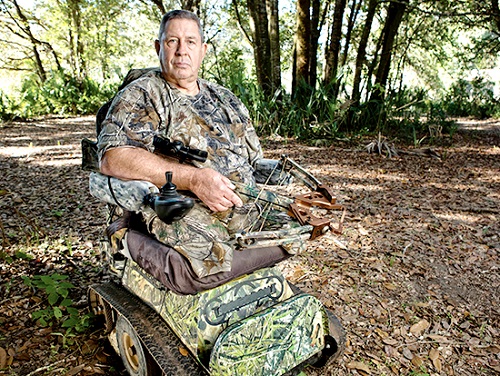
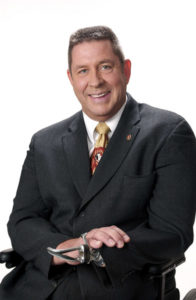
Most of their operations were “search and clear” or “search and destroy” movements designed to seek out enemy units and draw them out in battle. The Cav moved from village to village and whenever an infantry unit was pinned down by heavy fire, the Cav could move in and lay down enough suppressive fire to allow them to pull back. “We got a lot of Army infantry guys out of trouble,” he said. “I like to tease Marines about it because we saved a lot of them too.”
As his in-country experience grew, he moved from being the machinegunner to the track commander which was a Sergeant (E-5) slot. He did that for six months, helped break in a new CO, and was the track commander for the Command Track, an E-6, Staff-Sergeant position. He then went to combat leadership school at Chu Lai and was promoted to SSG with 22 months of service.
On an operation with the First Platoon, the unit set up in a night laager position. Sursely’s job was to check the perimeter’s security, ensure that the Claymore mines were in place, and then get the troops to set up for the evening. It was at that moment that his life would change forever.
“While walking the perimeter, I stepped on a landmine that was later thought to be about 20-25 pounds of TNT,” he recalls. The tremendous force of the explosion blast off both of his legs above the knees and his left arm above the elbow. He was just a few weeks away from returning home to the United States.
“I remember going up in the air, coming back down and landing flat on my back. And I remember reaching down with my good right hand, and I touched what would be like midthigh on my right leg, which kind of gave me a feeling that I was probably OK and still intact. I had absolutely no idea that I’d lost three limbs at that point.”
“The interesting thing about the blast,” he added, “was that there was no shrapnel in the mine, just an enormous bag of powder. The fireball from which partially cauterized my wounds and no doubt saved my life.” That allowed the medics to work out Sursely before the helicopters brought him to an evac hospital. The explosive may have been in the ground for an extended period of time since Sursely had unexploded powder from the TNT inside his body from the blast, indicating it may have gotten wet after prolonged exposure to the elements.
He spent a few days at the 95th Evac Hospital in Da Nang where the doctors stabilized him and conducted debridement of his injuries. From there he was evacuated to Yokohama, Japan at the 106th Hospital where they conducted 12 major surgeries on him. He returned to the states of February 22, 1969, and was transported to Fitzsimmons Hospital in Aurora, Colorado.
He spent another nine months in the hospital in Colorado and was discharged in November 1969. He was excited to get home to Minnesota, but he quickly learned that living in a wheelchair, while difficult under normal circumstances, was even harder when dealing with winter conditions such as snow and ice.
He was fit with a prosthetic arm which he used to facilitate driving a car, but the extent of his injuries prohibited the use of prosthetic legs. The blast tore his left leg off at the hip, where there was no femur to drive a prosthetic leg, and his right leg had such a short stump, it wasn’t possible for him to get anywhere efficiently enough, so he has been confined to a chair for the past 50 years.
He met a woman while in Colorado. She quit her job and moved to be with him in Minnesota. The two were married in February of 1970. They had two sons and moved to Florida but divorced ten years later. “It was one of those things where we were much better friends when we weren’t married than when we were.”
Life is difficult and transitioning from an athlete and combat soldier to a wounded vet in a wheelchair was a hard time, as it would be for anyone. He met his second wife Jeannie and the two started a real estate business in Apopka, FL — they have been married for 35 years. At her urging, he transferred to the DAV in Chapter 30 in Sanford. He currently belongs to the DAV Chapter in Orlando that has 2,800 members.
“We know how important our wives are in our recovery,” he said referencing Bobby Barrera, who we spoke to a few days ago. “And as much as I kid my wife (Jeannie) about me being her caregiver, we both know who is the indispensable one here.”
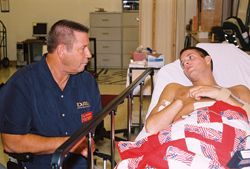
His wife accompanies him on trips to Walter Reed and other hospitals, speaking with the wives, mothers and girlfriends of the injured veterans, giving the message that while life will change, it is going to be ok.
Sursely was very active in the DAV. His fellow veterans recognized his leadership and he is the current Chapter Commander, a position he also held in Sanford. He was then given positions of more and more responsibility at the state and national level even becoming the National Commander of the DAV.
“Our mission is tied to service to veterans,” he said. “Whether it be at the local VA hospital or the Assisted Community Center and just all kinds of activities in the state. We try to do anything we can to enhance the lives of veterans in the area of Central Florida.”
He says that the 260 National Service Officers and Transition Assistance Officers who are there for veterans are a big part of what the DAV does. He added that “Jim Sursely is happy to be just a small part of it.”
The DAV is celebrating its 100th Anniversary this year. Each year, DAV (Disabled American Veterans) helps more than one million veterans and their families get the benefits they’ve earned. To learn more, visit www.DAV.org.








COMMENTS