Ukraine and the United States advance structured talks ahead of a potential March trilateral with Russia, while the Pentagon escalates pressure on an AI firm over military-use restrictions and a former F-35 pilot faces arrest in a China training case.
Read the full article for more on:
Important insights and detailed analysis
Expert commentary on current events
Breaking developments and updates
Updating summary...
Morning Brief: Ukraine U.S. Russia Talks Advance as Pentagon Presses AI Firm
Benjamin Reed
Speed
1x
Listen
COMMENTS
Ukraine and the United States advance structured talks ahead of a potential March trilateral with Russia, while the Pentagon escalates pressure on an AI firm over military-use restrictions and a former F-35 pilot faces arrest in a China training case.
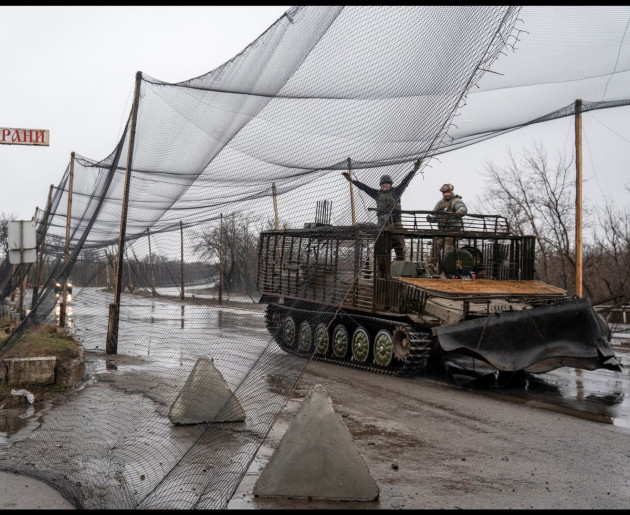
Ukrainian servicemen ride atop a tracked armored vehicle along a roadway covered with anti-drone netting near the eastern frontline city of Druzhkivka, Donetsk region. Photograph: Tommaso Fumagalli/EPA
Ukraine and U.S. Advance Structured Talks as Trilateral Format Looms
Ukraine and the United States advanced preparations Thursday for a potential three-way diplomatic session with Russia in early March, following a direct call between President Volodymyr Zelenskyy and President Donald Trump and bilateral discussions held in Geneva.
Advertisement
Ukrainian officials described the Geneva meeting as a sequencing step rather than a breakthrough. Kyiv’s delegation met with U.S. counterparts to define parameters before any trilateral engagement that would include Moscow. The objective, according to Ukrainian readouts, is to establish technical understandings on ceasefire conditions, prisoner exchanges, humanitarian corridors, and reconstruction planning before elevating talks to the leader level.
Zelenskyy said after his call with Trump that Washington supports this staged format: U.S.–Ukraine coordination first, then a trilateral framework, with the possibility of direct presidential engagement if progress holds. U.S. officials have framed the initiative as an effort to accelerate an end to hostilities while preserving Ukraine’s negotiating leverage.
The diplomatic movement comes as the war enters its fifth year without a decisive operational breakthrough on either side. Military conditions at the front continue to shape the political space for negotiation.
Advertisement
🚨 Another russian mass attack on Ukraine, it’s not for nothing this happens again just hours after Trump spoke to Zelenskyy, in what clearly has been another attempt to pressure Ukraine to surrender to the absurd demands of the terrorists!
Russian forces maintain sustained pressure across eastern and southern Ukraine, relying on artillery mass, glide bombs, missile strikes, and incremental infantry assaults. Recent campaign assessments indicate Moscow retains the manpower reserves and industrial output necessary to continue large-scale combat operations into 2026, though at significant material and personnel cost.
Advertisement
Ukrainian forces have consolidated localized gains in selected southern sectors while holding defensive lines in contested eastern areas. Advances on both sides remain measured in kilometers rather than sweeping maneuver. The front remains attritional.
Western defense assessments note that Russia has adapted its force-generation model to offset heavy losses, increasing domestic munitions production and integrating irregular formations into formal command structures. Ukraine, by contrast, continues to depend heavily on Western matériel, intelligence, and financial support while confronting persistent manpower constraints.
Neither side has achieved strategic decision. That reality underpins the renewed diplomatic effort.
Core Negotiation Obstacles Remain Intact
Territorial control, enforceable security guarantees, and sanctions sequencing remain the principal barriers to settlement.
Kyiv maintains that any agreement must preserve sovereignty and include binding security commitments. Ukrainian officials have rejected proposals that would formalize Russian control over occupied territory without reciprocal concessions. Public opinion inside Ukraine remains sensitive to perceived compromise.
Moscow continues to demand recognition of territorial claims and constraints on Ukraine’s future security alignment. Russian officials have linked broader normalization to sanctions relief and Western recognition of battlefield realities. No public indications suggest meaningful convergence on these positions.
European governments have reiterated that any negotiated framework must align with Ukraine’s stated objectives and preserve the credibility of collective security guarantees. Alliance cohesion remains a central variable in Washington’s diplomatic calculus.
Strategic Stakes for Washington and Kyiv
For Kyiv, the structured format offers both opportunity and exposure. A defined process could reduce battlefield tempo and create space for reconstruction planning and economic stabilization. It also carries political risk if negotiations appear to concede core principles without tangible gains.
For Washington, the talks test its ability to shape an endgame after years of military and economic assistance. The administration must balance domestic priorities with alliance cohesion and deterrence toward Moscow. A stalled process risks eroding credibility; a premature agreement risks fracturing European unity.
The March trilateral session, if convened, will not resolve the war on its own. It may, however, establish whether the current phase of attritional combat can transition into structured negotiation. The durability of that transition will depend on battlefield developments and on the willingness of all three capitals to adjust maximalist positions in pursuit of a negotiated outcome.
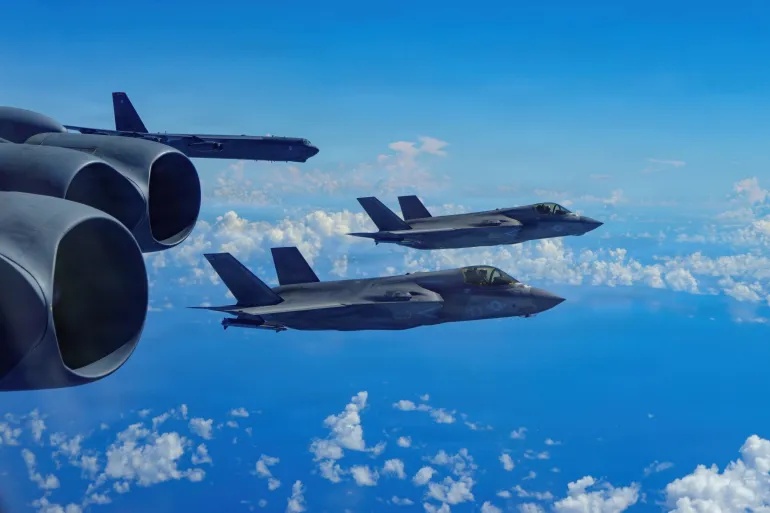
A U.S. Air Force B-52H Stratofortress bomber flies alongside U.S. Marine Corps F-35B Lightning II aircraft in the U.S. Southern Command area of responsibility in 2025. Handout: U.S. Air Force via AP Photo.
Former U.S. F-35 Pilot Arrested in Case Involving Chinese Military Training
U.S. authorities have arrested a former Marine Corps F-35 fighter pilot on charges related to providing unauthorized military training to individuals linked to the Chinese armed forces, according to federal court filings unsealed Wednesday.
The former aviator, who previously flew the F-35B short takeoff and vertical landing variant, allegedly traveled overseas after leaving active duty and participated in training programs that prosecutors say benefited China’s military aviation capabilities. The Justice Department alleges he failed to obtain required authorization before providing defense-related instruction to foreign nationals, in violation of U.S. export control laws.
Federal officials did not indicate that classified materials were physically transferred. The charges instead center on the provision of technical instruction and tactical knowledge that may fall under controlled defense services regulations.
Daniel Duggan, a Former U.S. Maine Corps Pilot who renounced his American Citizenship after moving to China in 2013, will finally be Extradited soon back to the United States; after he was Arrested in 2022, at his Family Home in Australia, on Charges of violating a U.S. Arms… pic.twitter.com/YisUAcqgSC
Legal Framework: Export Controls and Defense Services
The case hinges on the International Traffic in Arms Regulations (ITAR), which govern the export of defense articles and services. Under ITAR, U.S. persons must receive State Department approval before providing certain types of military training or expertise to foreign entities.
Prosecutors argue that advanced fighter pilot instruction — particularly involving fifth-generation aircraft such as the F-35 — constitutes a controlled defense service. Even absent transfer of hardware or documents, the dissemination of tactical doctrine, operational techniques, or aircraft systems knowledge can fall within statutory restrictions.
Defense officials have increasingly warned that former Western military pilots have been targeted by Chinese-linked aviation training programs seeking to accelerate the People’s Liberation Army Air Force’s modernization. Similar cases in the United Kingdom and Australia have prompted tightened restrictions on post-service employment involving foreign militaries.
Strategic Context: Beijing’s Military Modernization Effort
China has invested heavily in upgrading its air combat capabilities, including expansion of fifth-generation aircraft programs and joint operations training. Western defense agencies have assessed that Beijing seeks not only hardware parity but also doctrinal refinement derived from NATO operational experience.
Recruitment of former Western pilots offers a shortcut to institutional knowledge that would otherwise take years to replicate. Training programs allegedly linked to Chinese entities have focused on air combat tactics, carrier aviation procedures, and advanced flight operations.
U.S. officials have framed the latest arrest as part of a broader counterintelligence effort aimed at protecting sensitive operational expertise. The Pentagon has emphasized that even unclassified tactical experience, when aggregated, can offer strategic advantage to rival militaries.
Broader Implications for Military Personnel
The arrest underscores growing scrutiny of former service members’ overseas employment. Defense and intelligence agencies have increased outreach to veterans, warning that foreign training contracts may expose them to criminal liability if proper authorization is not secured.
The case also highlights tensions between post-service career opportunities and national security safeguards. As advanced weapons systems grow more complex and networked, operational knowledge itself becomes a strategic asset.
The defendant is expected to appear in federal court in the coming days. Authorities have not indicated whether additional individuals are under investigation.
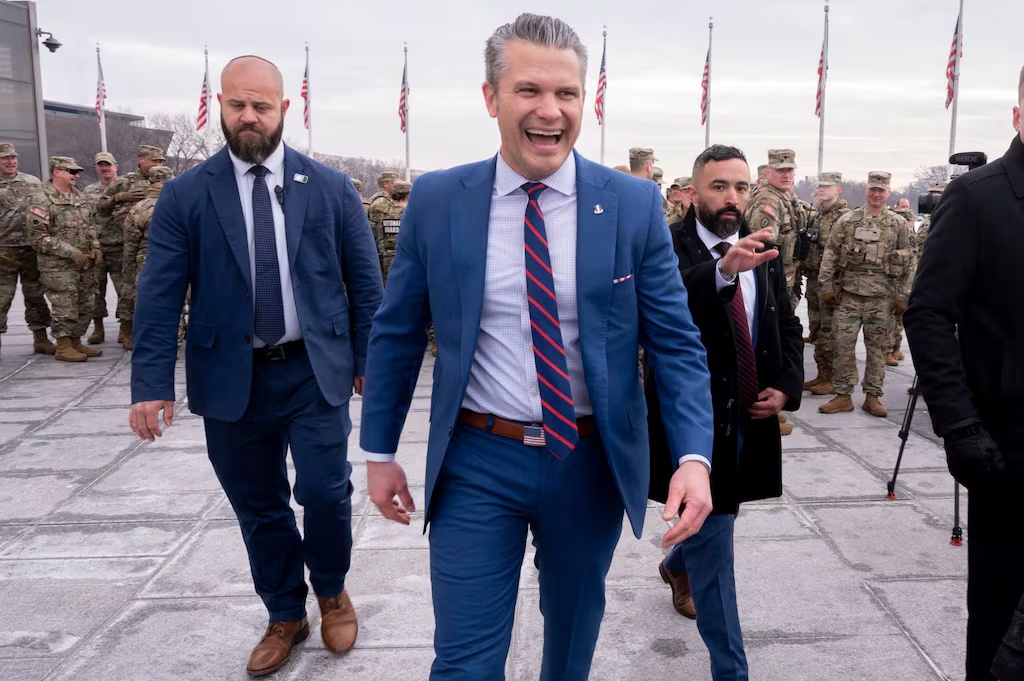
Defense Secretary Pete Hegseth departs an oath of enlistment ceremony on Friday, Feb. 6, 2026. Kevin Wolf/AP Photo.
Hegseth Issues Deadline to Anthropic as Pentagon Presses for Fewer AI Restrictions
Defense Secretary Pete Hegseth met Anthropic Chief Executive Dario Amodei at the Pentagon on Tuesday and delivered a clear message: revise the company’s restrictions on military use of its artificial intelligence systems by Friday evening or face potential consequences, including contract termination and designation as a supply-chain risk.
The meeting, described by officials as tense but professional, marks a sharp escalation in a dispute over how far commercial AI firms should go in limiting defense applications of their models. Hegseth pressed Anthropic to loosen prohibitions that restrict certain uses of its Claude system, particularly in areas involving autonomous targeting functions and domestic surveillance.
Anthropic has so far maintained its existing red lines. The company said discussions with the Defense Department continue in good faith.
Contract Leverage and Legal Pressure
Anthropic holds a Pentagon contract reportedly valued at up to $200 million as part of broader 2025 awards to frontier AI firms cleared to operate in classified environments. The department has signaled that failure to adjust usage policies could result in cancellation of that agreement.
Officials have also raised the possibility of labeling Anthropic a “supply-chain risk,” a designation typically applied to foreign entities considered security concerns. Such a move could limit the company’s eligibility for future federal contracts.
In addition, sources familiar with the discussions indicated that the Defense Production Act remains an available tool should the department determine that cooperation is necessary for national security purposes. Invocation of the statute would represent a significant escalation.
The Pentagon has not publicly confirmed which enforcement mechanisms it would pursue if Anthropic declines to revise its policies.
Safety Framework Update Adds Scrutiny
The meeting occurred the same day Anthropic released Version 3.0 of its Responsible Scaling Policy, replacing earlier firm deployment thresholds with a more flexible framework centered on a “Frontier Safety Roadmap.” The update shifts from hard pause commitments tied to capability milestones toward adaptive safeguards that evolve with model development.
The timing has drawn attention in Washington. Some policymakers and analysts argue that the revisions reflect competitive pressure as AI firms race to deploy increasingly capable systems. Anthropic maintains that the changes preserve layered protections while allowing for more realistic scaling in a rapidly advancing field.
The company continues to prohibit autonomous lethal targeting without meaningful human oversight and rejects mass domestic surveillance applications. Those restrictions sit at the center of the current dispute.
Military AI Integration Accelerates
The Defense Department has expanded generative AI pilots across intelligence analysis, logistics forecasting, administrative automation, and simulation environments. Officials view AI systems as tools to compress decision cycles, improve sensor fusion, and manage complex operational data streams.
Pentagon leaders argue that restrictions imposed by commercial vendors may limit operational flexibility at a time of intensifying strategic competition, particularly with China. They maintain that existing law-of-war principles and human-in-the-loop policies provide sufficient guardrails against misuse.
At issue is whether private-sector safety frameworks should constrain lawful military applications once a system has been approved for classified use.
Strategic Stakes Beyond the Contract
The confrontation underscores a broader tension between Silicon Valley governance models and national security imperatives. Frontier AI labs have built public credibility around risk mitigation and deployment thresholds. The Pentagon, meanwhile, views technological speed and operational adaptability as central to deterrence.
Whether Anthropic revises its policies before Friday’s deadline will test how far the Defense Department is willing to use procurement leverage and statutory authority to reshape commercial AI guardrails.
No immediate policy changes have been announced. But the outcome of this dispute may set a precedent for how future AI firms navigate the boundary between private governance commitments and state demands in an era of rapid military technological competition.
Advertisement
What readers are saying
Generating a quick summary of the conversation...
This summary is AI-generated. AI can make mistakes and this summary is not a replacement for reading the comments.










COMMENTS