

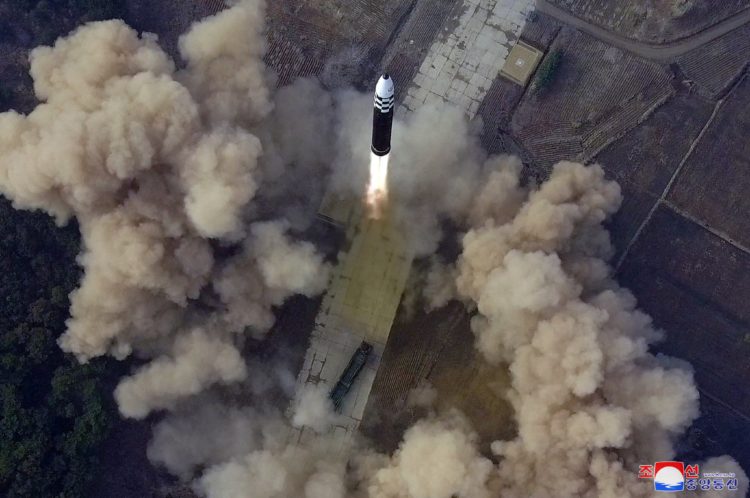
North Korea showed off its biggest intercontinental ballistic missile, the Hwasong-17, as Kim Jong Un pledges to strengthen his country's atomic arsenal https://t.co/jPdBAqz8Mw pic.twitter.com/qEnUmpODtM
— Bloomberg Originals (@bbgoriginals) April 27, 2022
Cha Du-Hyeogn, a security adviser for former South Korean President Lee Myung-bak, believed that the latest launch was indeed a short-range ballistic missile or medium-range at most.
“Kim Jong Un’s nuclear strategy was becoming more offensive and hostile,” Cha said. “There’s less incentive for him to conduct such a costly test with reduced range.”
The teams of both incoming and outgoing South Korean administrations condemned the launch. Yeol denounced Kim’s test as an “outright violation” of United Nations agreements to ban ballistic missile tests and vowed to respond with “more fundamental deterrent measures.”
“North Korea’s recent action, including frequent missile launches, cannot be tolerated, as it poses a threat to the security and safety of the region and international community,” Japanese Prime Minister Fumio Kishida said.
Wednesday’s launch came as Japanese and South Korean officials got together in Seoul to urge the North to stop conducting tests that would lead to further escalation in the region. The United States military also gave a statement urging Pyongyang to cease destabilizing actions and reiterated its commitment to aid the South and Japan.
“The United States condemns these actions and calls on the DPRK (North Korea) to refrain from further destabilizing acts,” the U.S. Indo-Pacific Commands wrote in a statement.
“While we have assessed that this event does not pose an immediate threat to U.S. personnel, territory, or that of our allies, we will continue to monitor the situation. The U.S. commitment to the defense of the ROK and Japan remains ironclad.”
This year saw North Korea break its self-imposed 2017 missile testing moratorium, which was celebrated as a diplomatic win for the then Trump administration. However, recent developments show that while the country was outwardly calling for peace, the reality was it continued to develop weapons in secret.
It’s likely that the North will also resume its nuclear testing. Preparations for smaller, tactical nuclear weapons have been observed by South Korean and American authorities.
Ballistic Missiles Fired Ahead of Biden’s Visit
North Korea’s launch comes ahead of President Biden’s visit to the South to meet with the newly-elected Yoon Suk-Yeol. Biden is scheduled to be in Seoul from May 20 to May 22 and meet with the South’s new leader on the 21st.
The visit will come just a few weeks after Yoon is sworn in as president. South Korean President’s spokesperson Bae Hyun-jin said that Yoon welcomes the visit of the US president, adding that the two leaders are set to discuss the countries’ alliance, North Korea, and other international concerns.
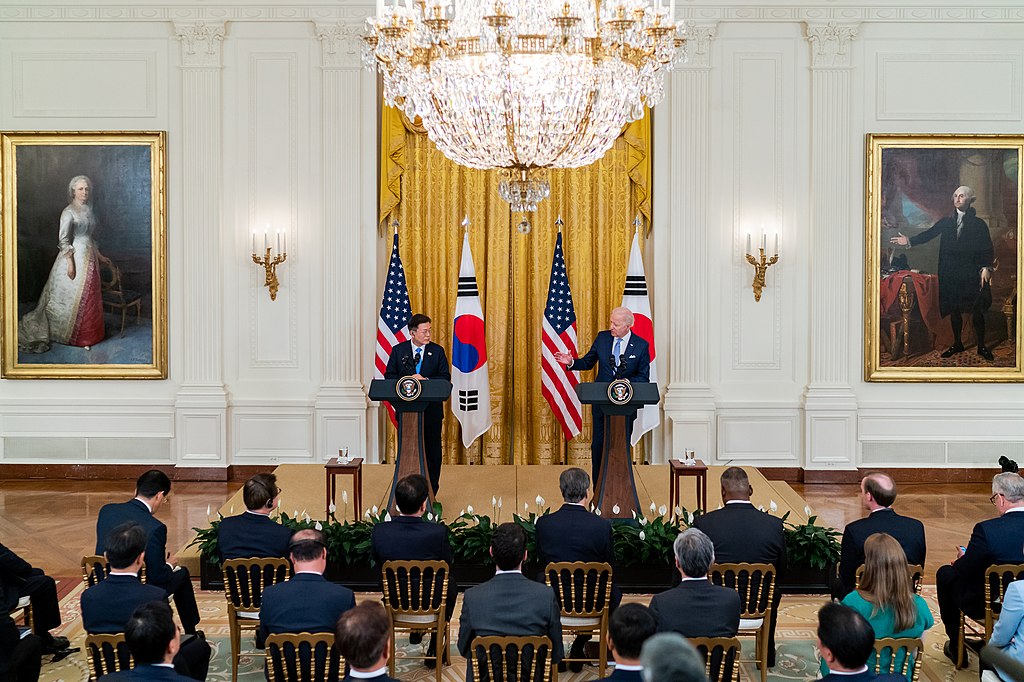
White House Press Secretary Jen Psaki said that the visit aims to “further deepen ties between our governments, economies, and people.”
She added that the trip will “advance the Biden-Harris Administration’s rock-solid commitment to a free and open Indo-Pacific and to US treaty alliances.”
“The leaders will discuss opportunities to deepen our vital security relationships, enhance economic ties, and expand our close cooperation to deliver practical results,” Psaki’s statement further wrote.
Biden is also set to visit Tokyo to meet with Japanese Prime Minister Kishida Fumio and with leaders of the Quad groupings of India, Japan, the U.S., and Australia.








.jpg)
COMMENTS